
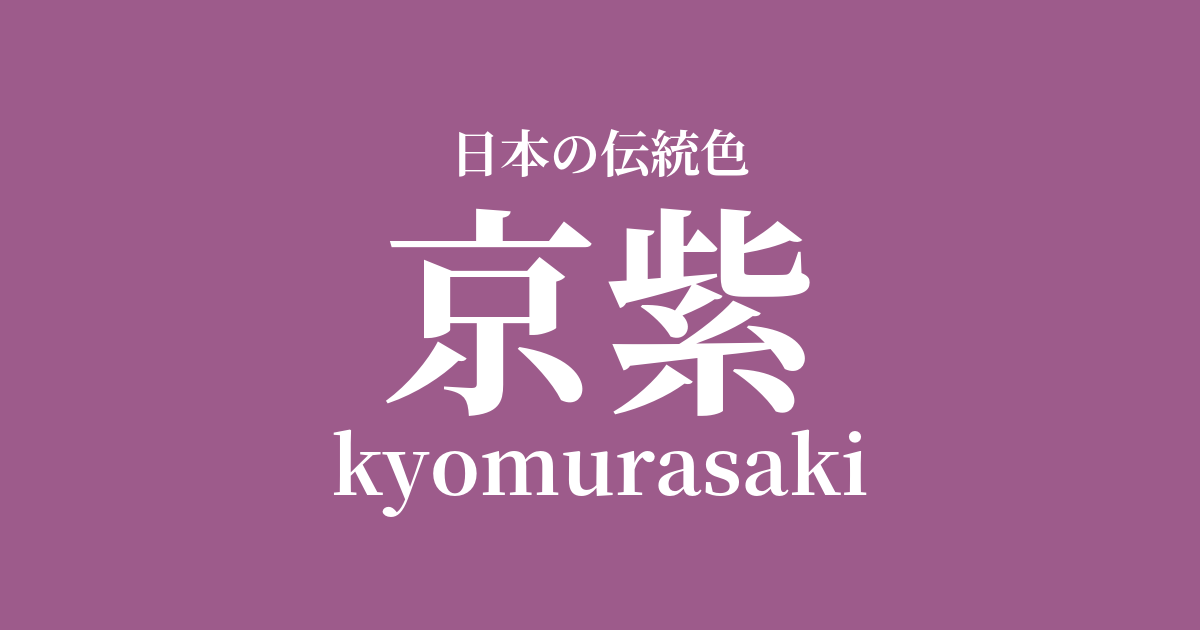
| Japanese color name | Kyoto purple |
|---|---|
| reading | kyomurasaki |
| HEX | #9D5B8B |
| RGB | 157, 91, 139 |
What is Kyo-murasaki? Origin and etymology
Kyo-murasaki, as its name suggests, is a noble shade of purple that originated in Kyoto. Historically, purple was dyed using the root of the gromwell plant, and was considered a forbidden color, reserved only for those of high rank. Kyo-murasaki inherits this traditional dyeing technique and can be said to be a color nurtured within the refined aesthetic sensibilities of the capital. It is particularly characterized by its elegant, reddish hue, and its refined texture has made it beloved by many.
The reddish hue of Kyoto purple is said to lie in the dyeing process. In traditional purple dyeing, lye made from camellia ash is used as a mordant. It is believed that this alkaline lye reacts with shikonin, the pigment in purple gromwell, to produce a beautiful, deep reddish-purple color. The depth and luster produced by this technique form the distinctive elegance of Kyoto purple.
Historical background of Kyoto purple
Purple has long been a symbol of authority and nobility, as evidenced by its designation as the highest-ranking color in the Twelve Levels of Court Rank established by Prince Shōtoku. During the Heian period, it was particularly cherished within aristocratic culture and was depicted as a color symbolizing noble women, as seen in "Lady Murasaki" in "The Tale of Genji." It is believed that the refined aesthetic sensibilities cultivated during this era formed the basis for later Kyoto purple.
In the Edo period, "Edo purple" became popular as the color of the headband worn by the Kabuki actor Sukeroku, and it became a color that symbolized the refined aesthetic sense of the Edo people. In contrast, the traditional reddish-purple dyed in the ancient capital of Kyoto was called "Kyoto purple," and its elegance and refinement were highly valued. As symbolized by the phrase "Kyoto's extravagant dressing," Kyoto purple continued to be treated as a special color within Kyoto's sophisticated culture.
Related literature, waka poetry, and seasonal words
Purple has long been a subject of literary works. The Manyoshu anthology contains a famous poem by Nukata no Okimi: "Going to the crimson-dyed purple fields, going to the marked fields, does the field guardian not see you waving your sleeves?" The "purple fields" mentioned in this poem are fields where purple gromwell grows, and it is clear that purple is used as a color to symbolize love and nobility.
In "The Tale of Genji," the pinnacle of Heian literature, purple also plays an important role. The young girl whom the protagonist, Hikaru Genji, finds to be his ideal woman is named "Wakamurasaki" and later becomes "Murasaki no Ue," his beloved wife. This symbolizes his connection to Fujitsubo no Miya (wisteria = purple), whom Hikaru Genji longed for, and is an example of purple being effectively used as a color symbolizing nobility and deep connection.
On the way to Murasakino, the way to Shimeno, the field guardian does not see you waving your sleeve.
Color scheme preview
This is to check the readability of the text when this color is used as the background.
Kyoto purple color scheme proposal
Golden (#E6B422)
The combination of noble Kyoto purple with gold, another color symbolizing nobility, creates a luxurious, resplendent, and elegant impression. This traditional and dignified color scheme evokes the attire and furnishings of Heian period aristocrats.
Light green (#A9D159)
The reddish Kyoto purple and the vibrant, fresh green of young leaves are almost complementary colors, enhancing each other's beauty. This color scheme embodies both vitality and elegance, creating a classic yet fresh and youthful impression.
Color produced (#FBFBF4)
By combining it with off-white, which symbolizes unblemished purity, the elegance and nobility of Kyoto purple are further enhanced. This color scheme gives a simple yet sophisticated impression, achieving both cleanliness and dignity.
Practical Scenes
Kyoto purple is a color particularly valued in the world of traditional Japanese clothing. It is widely used in formal kimonos such as visiting kimonos, formal kimonos, and solid-colored kimonos, as well as in accessories such as obi sashes, obiage sashes, and obijime sashes. Its elegant reddish hue gives the wearer a sense of grace and composure, and it pairs exceptionally well with classical patterns. It embodies the traditional beauty of Japan in a variety of settings, from celebratory occasions to tea ceremonies.
In interior design, incorporating Kyoto purple as an accent can add depth and a sense of luxury to a space. For example, using it on one wall, cushions, or curtains can give the entire room a refined and calming atmosphere. It is effective not only in Japanese-style rooms but also when adding Japanese elements to modern Western-style rooms, contributing to the creation of a sophisticated and mature space.