
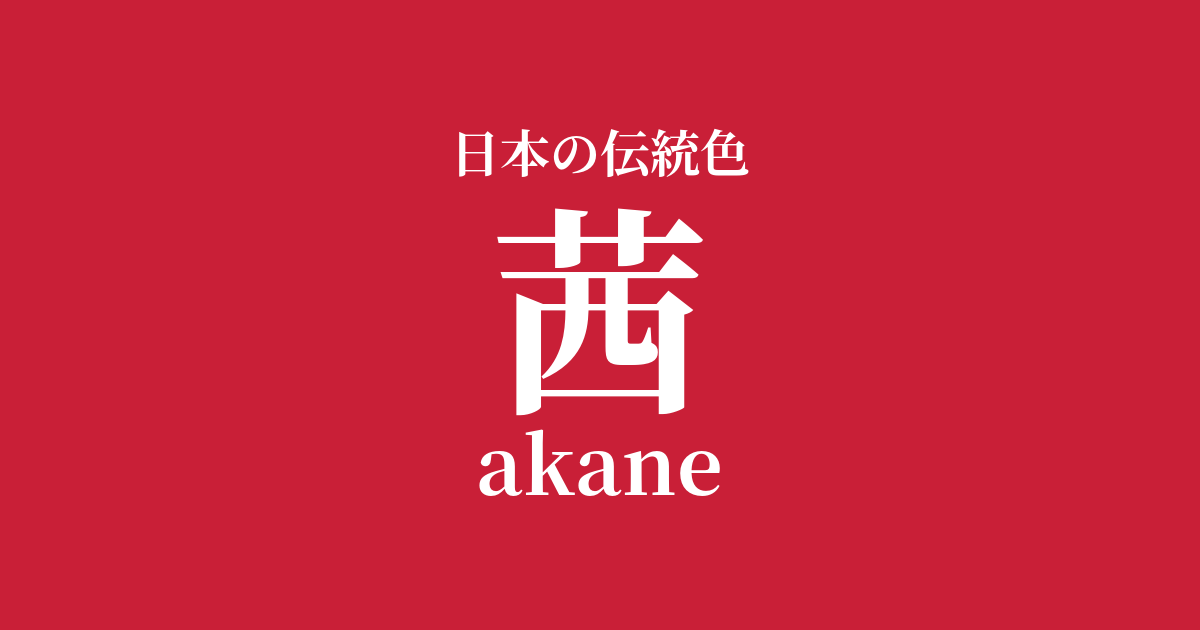
| Japanese color name | 茜 |
|---|---|
| reading | akane |
| HEX | #C91F37 |
| RGB | 201, 31, 55 |
What is Akane? Origin and etymology
Akane-iro refers to a deep red color with a slightly dark tint. The name of this color originates from the madder plant "akane," a perennial vine belonging to the Rubiaceae family, which is used as a dye. It is said that the roots of this plant are red, hence the name "akane" (red root), which then became the name of the color. Madder roots contain red pigments such as alizarin and purpurin, and have been used as a red dye in various parts of the world since ancient times.
Known as one of the oldest plant dyes in Japan, its deep, warm hues have captivated many people.
Akane's historical background
Dyeing with madder has an extremely long history in Japanese dyeing culture. Fragments of cloth believed to have been dyed with madder have been discovered in Jomon and Yayoi period ruins, suggesting that it was an important dye from ancient times. There is also a theory that in the Twelve Levels of Court Rank established by Prince Shōtoku during the Asuka period, madder was treated as the second most noble color after purple. In the Heian period, safflower, which could produce a more vivid red color, was introduced, and madder gradually became established as a color for common people.
During the Edo period, it was widely used for dyeing cotton, and it is said that due to its durability, it was also used for firefighting attire.
Related literature, waka poetry, and seasonal words
The color madder red appears as a symbolic color in classical Japanese literature, particularly in the Manyoshu anthology. Among these, "akane sasu" is especially famous as a makurakotoba (a conventional epithet) that leads to words such as "sun," "light," "purple," and "you." This indicates that madder red was a beautiful color that evoked the shining sun, light, or something noble. The poem by Nukata no Okimi, "Going to the purple fields, going to the marked fields, does the field guard not see you waving your sleeves?" is widely known as a representative example.
Furthermore, even in modern times, the expression "crimson sky" has become established as a word to describe the beautiful scenery of a sunset, and is frequently used in literature and song lyrics.
On the way to Murasakino, the way to Shimeno, the field guardian does not see you waving your sleeve.
Color scheme preview
This is to check the readability of the text when this color is used as the background.
Akane's color scheme proposal
Indigo (#243A6C)
Madder and indigo are two colors that represent traditional Japanese plant dyes. They are close to complementary colors, and each color powerfully enhances the other. This color combination evokes a sense of gravitas, calmness, and old-fashioned charm, making it suitable for designs themed around history and tradition.
Blue gold (#FABE22)
The deep red of madder and the vibrant yellow of turmeric create a warm color scheme reminiscent of autumn foliage and harvest. Both are traditional dye colors, and this combination maintains a Japanese aesthetic while creating a lively and vibrant atmosphere.
Black (#1C1C1C)
The deep crimson of madder red is accentuated by a sharp, ink-black color, creating a modern and sophisticated impression. Its high visibility and ability to combine strength and elegance make it effective for logo design, packaging, and other applications where a strong impression is desired.
Practical Scenes
In the world of traditional Japanese clothing, madder red is widely used in kimonos, obi sashes, and accessories such as obi ties. It is particularly well-suited to expressing the feeling of autumn and creates a calm, mature look for adult women. It is also a familiar color in everyday Japanese clothing such as cotton kimonos and samue (work clothes).
In interior design, incorporating it as an accent on a wall of wallpaper, cushions, or noren (traditional Japanese curtains) brings warmth and a Japanese aesthetic to the space. It pairs particularly well with light-colored wood and dark brown wood, and harmonizes well with traditional Japanese-style interiors and modern Japanese spaces.
In web and graphic design, it is effective as a key color for websites themed around Japanese tradition and history. Because it possesses both warmth and calmness, it can also be used as an image color for brands that want to convey trustworthiness and a sense of luxury.