
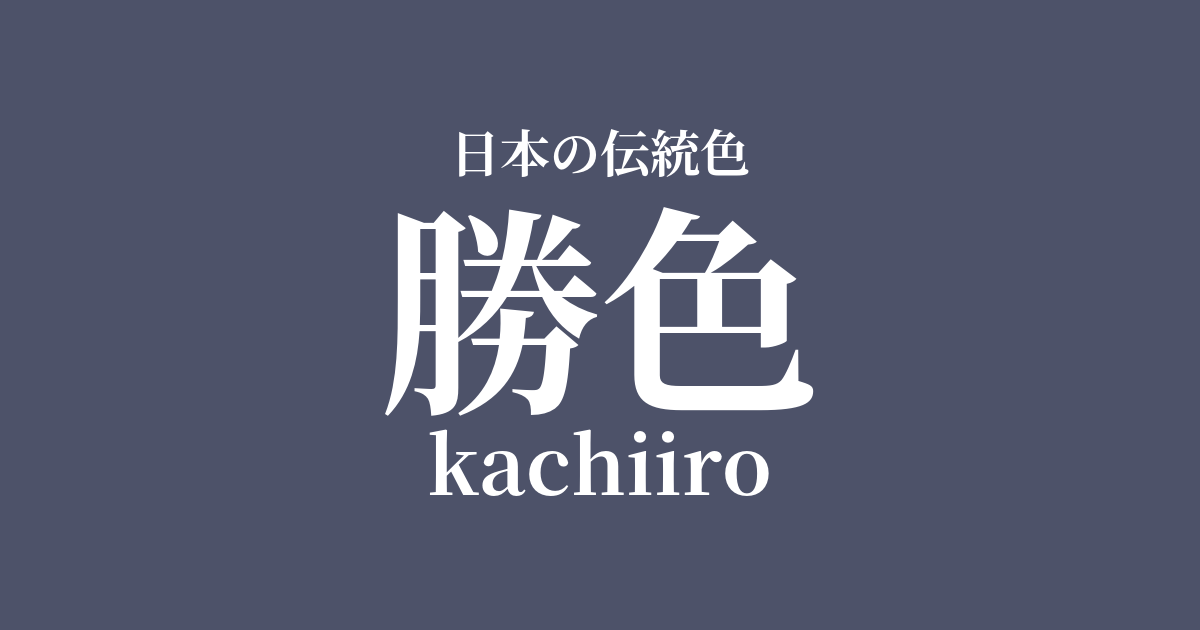
| Japanese color name | Kachiiro |
|---|---|
| reading | kachiiro |
| HEX | #4D5269 |
| RGB | 77, 82, 105 |
What is "Kachiiro"? Origin and etymology
Kachi-iro is a type of indigo dye so dark it almost appears black. Its name is said to originate from the verb "katsu," which refers to the vigorous beating of the cloth during the indigo dyeing process. To allow the dye to penetrate deep into the fibers, fix the color, and give it luster, the dyed cloth was repeatedly beaten with a fulling block (kinuta). Because the sound of "kachi" sounds similar to "kachi" (victory), it became a highly valued auspicious color among samurai, and the name "Kachi-iro" (victory color) became established.
Originally, it was written as "kachin-iro" or "tsuki-iro." Records show that during the Heian period, it was called "kachin-iro" and was used as the color of the robes of lower-ranking officials. Indigo dyeing involves repeatedly dipping the fabric in the dye solution and exposing it to air for oxidation, which deepens the color. Kachi-iro is characterized by its deep, powerful hue, achieved by repeating this process to the extreme.
Historical background of the color "Kachi-iro"
While this color existed as "brown" during the Heian period, it gained particular attention during the Kamakura period. With the arrival of the samurai class, warriors who valued simplicity and strength favored its powerful hue and its auspicious association with "victory," actively adopting it as the color for their armor and hitatare (a type of formal attire). As a result, the color of victory established itself as a symbol of the samurai spirit.
During the Edo period, indigo dye became popular not only among samurai but also among commoners as a color of "sophistication." In particular, as dyeing techniques improved and various shades of indigo dye became popular, the deepest shade, kachi-iro (victory color), was treated as a special color. Its popularity continued into the modern era, and in the Meiji period, it was adopted as the color of school uniforms and military uniforms. Today, it is known as the color of the Japanese national soccer team's uniform and is considered the origin of "Samurai Blue."
Related literature, waka poetry, and seasonal words
Due to its historical background, the color of victory (kachi-iro) frequently appears as a symbol of samurai, especially in war chronicles. In classical literature such as "The Tale of the Heike" and "The Taiheiki," expressions like "kachin armor" and "brown armor" are found to describe the color of the armor worn by warriors. These descriptions are believed to have had the effect of visually representing the bravery of the characters and their firm resolve to face battle.
While the color "kachi-iro" (victory color) itself is rarely the subject of specific waka or haiku poems, the indigo plant used for dyeing, Polygonum cuspidatum, is a seasonal word for summer, and scenes of indigo dyeing are sometimes depicted as a symbol of summer. Therefore, although not directly, kachi-iro is a color deeply connected to cultural contexts such as the scenery of Japanese summer and the handiwork of artisans.
Color scheme preview
This is to check the readability of the text when this color is used as the background.
A proposed color scheme in the color of "Kachi-iro" (victory color).
Golden (#E6B422)
This traditional color combination is often seen in weapons, armor, and battle surcoats. The richness of the victory color and the splendor of the gold complement each other, creating an air of dignity and formality. It is a highly refined color scheme that balances strength and luxury.
White training (#F3F3F3)
The combination of deep navy blue (kachi-iro) and pure white (shironeri) creates a very high contrast, conveying a sense of cleanliness and purity. This color scheme possesses a dignified and serene atmosphere, reminiscent of the samurai spirit and the world of Zen. It is also easily applicable to modern designs.
Crimson (#B7282E)
This combination evokes the pre-dawn sky or the flames of a battlefield. The quiet strength of the victory color is combined with the passionate crimson, creating a dramatic and striking contrast. This color scheme, often used in the banners of warlords, conveys a strong sense of determination.
Practical Scenes
In the world of traditional Japanese clothing, the color "Kachi-iro" (victory color) is used for men's kimonos, hakama (trousers), and obi (sashes), creating a stylish look that conveys strength while maintaining a sense of composure. In particular, it has long been favored as the color of uniforms and hakama in martial arts such as kendo and kyudo, and has become established as a color that symbolizes mental strength and concentration.
In interior design, incorporating accent walls, sofas, rugs, and other large areas brings depth and tranquility to a space. It's suitable for spaces where you want to concentrate quietly or relax, such as studies and bedrooms. Combining it with white or wood-grain materials creates a modern and sophisticated impression.
In web and graphic design, this color is used to convey trustworthiness, professionalism, and a sense of luxury. It is particularly effective as a corporate color for companies, traditional brands, and financial institution websites. When used as a background color, it enhances text and other elements, creating a highly visible design.