
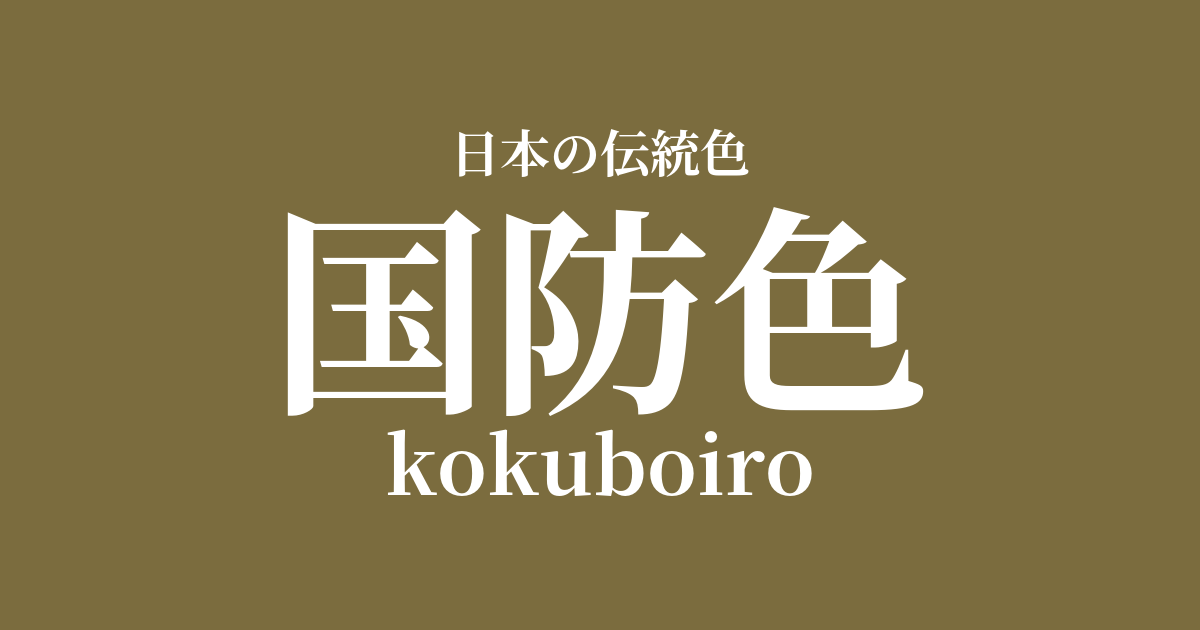
| Japanese color name | national defense colors |
|---|---|
| reading | kokuboiro |
| HEX | #7B6C3E |
| RGB | 123, 108, 62 |
What is "military color"? Origin and etymology
The name "national defense color" literally means "national defense," and it is known as the color adopted for Japanese Army uniforms from the 1930s to the 1940s. Unlike traditional colors derived from specific plants or dyes, it was born out of modern military necessity. Its hue is intended to have a camouflage effect to hide from the enemy on the battlefield, and it is a dark olive-brown color similar to the color of soil or withered grass.
It is believed that this color name became established as a result of prioritizing practicality above all else.
Historical background of national defense
The color 'national defense' became widely adopted in the early Showa period, following the Manchurian Incident, as militarism intensified. Its origin is said to be khaki (bluish-brownish), which was officially adopted as the color of the army's uniforms in 1934. Later, in 1940, the "National Uniform Order" was promulgated, and national defense was designated as the color of the "national uniform" worn by male civilians. As a result, it became widespread not only among soldiers but also among the general public, and became a color that symbolized wartime Japan.
Related literature, waka poetry, and seasonal words
Because the color "national defense color" is a relatively modern color, it is not directly mentioned in classical literature or Japanese poetry. However, it frequently appears in wartime literature, diaries, and films as a color that reflects the social conditions of the time. For example, in literature depicting the chaotic period during and after the war, such as Fumiko Hayashi's "Floating Clouds" and the works of Ango Sakaguchi, it is sometimes depicted as the color of the national uniforms worn by the characters.
Through these works, the color of national defense has become an important visual element that conveys the lives and feelings of the people at that time.
Color scheme preview
This is to check the readability of the text when this color is used as the background.
Proposed color scheme in national defense colors
Iron color (#282A2D)
The rugged and imposing impression of the military color is toned down by the dark, bluish iron color. The combination of metallic hardness and earthy tones makes it suitable for industrial design and military-inspired color schemes. It's a combination that balances strength and composure.
Hay grass color (#E1D1A6)
This natural color scheme evokes the camouflage effect that was the original purpose of military colors. The withered grass color is brighter than military colors and represents the color of dry plants. The combination of earth tones harmonizes with outdoor fashion and natural-style interiors, creating a calm atmosphere.
Hinoki bark color (#965E47)
By combining it with hinoki bark color, a reddish-brown derived from hinoki bark, the yellow tones of the national defense color gain warmth. It evokes natural elements such as wood and earth, giving a simple and stable impression. This color scheme is suitable for Japanese-style interiors and retro-style designs.
Practical Scenes
Defense colors, due to their historical background, are a staple color in military fashion and workwear. They pair well with durable and practical clothing such as cargo pants and jackets. Furthermore, their subdued hue makes them suitable for vintage or industrial-style interiors, adding a sense of weight and tranquility to the space.
In web and graphic design, earth tones can be used as part of a color scheme. Their low saturation and subdued tones create a sense of reliability and stability when used as background or accent colors. They are particularly effective when expressing specific concepts, such as for outdoor brands or content themed around history.