
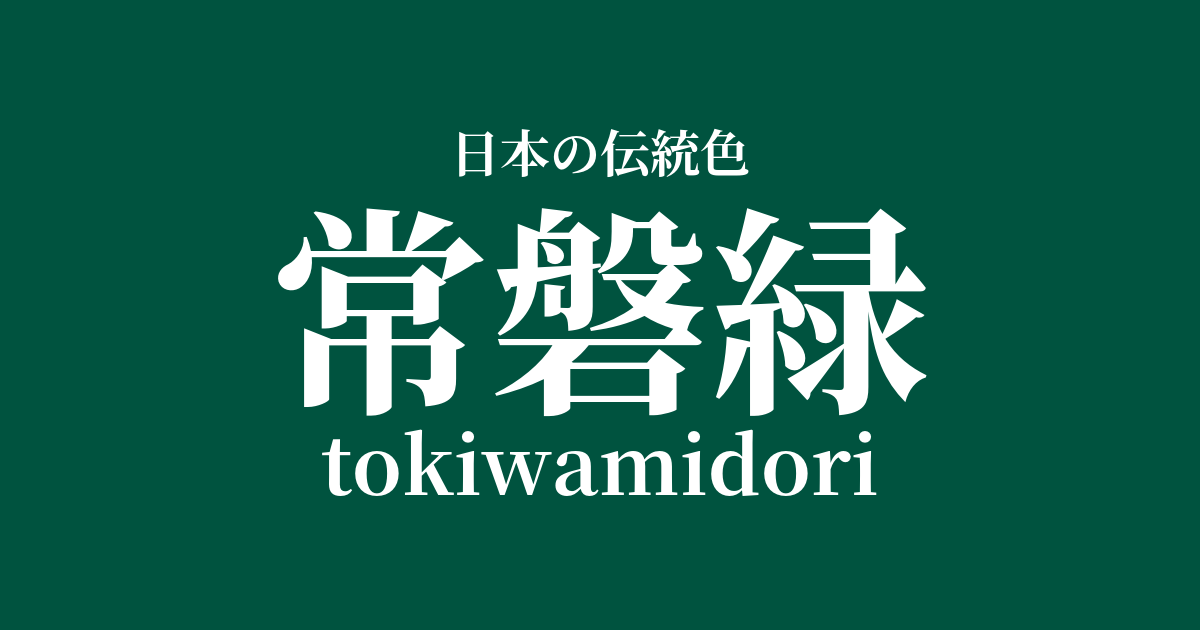
| Japanese color name | Evergreen |
|---|---|
| reading | tokiwamidori |
| HEX | #00533F |
| RGB | 0, 83, 63 |
What is Tokiwa Midori? Origin and Etymology
The "Tokiwa" in Tokiwa-midori (常岩緑) means "something that remains unchanged." It has been used since ancient times to refer to things that are unchanging, like rocks and stones. In particular, evergreen trees such as pine and cedar, which keep their leaves green all year round, are called "Tokiwagi" (常岩木), and the vibrant color of their leaves is the origin of the name Tokiwa-midori. This color is a deep and calming green, named after the unchanging nature of the world.
Evergreen, a color deeply rooted in Japanese culture, is considered an auspicious color with meanings such as unchanging, eternal, longevity, and prosperity stemming from its etymology. Since ancient times, people have found mystery and sacredness in the evergreen trees that maintain their unchanging green color, and have revered them as auspicious. For this reason, it is often used in special occasions such as celebrations and sacred ceremonies, and is considered one of the colors that plays an important role in Japanese color culture.
Historical background of evergreen
The word "Tokiwa" itself is ancient, appearing even in the Manyoshu anthology, but it is believed that "Tokiwa-midori" (Tokiwa Green) as a color name only became established during the Edo period. In the mid-Edo period, it became popular among common people as an auspicious color, and there are records of it being used in particular for the formal attire and haori jackets of samurai. Furthermore, this deep green was effectively used in ukiyo-e woodblock prints when depicting pine trees and other similar subjects.
Even after the Meiji era, evergreen green continued to be cherished in various fields due to its traditional image and calming hue. It was favored not only for traditional Japanese clothing such as kimonos and obi sashes, but also for crafts such as ceramics and lacquerware. Even today, its timeless beauty remains undiminished, and it is used in a wide range of situations, such as a key color in Japanese-style designs and as a corporate color for companies that want to express reliability and stability.
Related literature, waka poetry, and seasonal words
In the world of literature, "Tokiwa" has been frequently used, especially in waka poetry, as a symbol of permanence. It is used as a makurakotoba (a conventional epithet) for pine trees and rocks, and is often used to express unchanging feelings or eternal love. The Manyoshu and Kokin Wakashu contain many poems that begin with the word "Tokiwa naru," suggesting that it is a concept deeply ingrained in the Japanese aesthetic sense.
Although few works directly use the color name "Tokiwa-midori" (evergreen), many scenes that evoke this color are depicted using expressions such as "pine green" or "the color of a thousand years." For example, in the Noh play "Takasago," the spirits of the twin pine trees sing, "On the final day, they soothe the people, and on the final day, they extend life," depicting the green of the pine as a symbol of longevity and peace. In this way, Tokiwa-midori has been expressed in literary works with a profound spirituality that transcends a concrete color.
Maple leaves fall upon the evergreen rocks, as if rain of tears falling.
Color scheme preview
This is to check the readability of the text when this color is used as the background.
Tokiwa Green Color Scheme Proposal
Golden (#E6B422)
The combination of evergreen pine and golden color has long been considered a symbol of good fortune, much like the pine trees depicted in gold-leaf screen paintings. It creates an atmosphere of formality and luxury, and effectively highlights auspiciousness and splendor in celebrations and traditional designs.
Kutsuha color (#917347)
The green of evergreen trees and the brown of fallen leaves create a natural color scheme reminiscent of a Japanese forest landscape from autumn to winter. It creates a calm and profound harmony, evoking feelings of peace and warmth. This combination is easy to incorporate into interior design and fashion.
White training (#FFFFFF)
The contrast between deep evergreen and pure white creates a very clean and sophisticated impression. The clear contrast makes it highly visible and can be effectively used in modern Japanese-style designs or websites where credibility is important.
Practical Scenes
In the world of traditional Japanese clothing, evergreen is considered a color of high status. When used in patterns or as a base color for formal kimonos such as tomesode, houmongi, and iromuji, it adds a sense of calm and elegance. In particular, when incorporated as the color of an obi or obi-jime, it tightens the overall coordination and gives a dignified impression.
In interior design, evergreen is used as a color that brings a deep sense of calm and tranquility to a space. By using this color as an accent wall, or incorporating it into fabrics such as curtains, sofas, and cushions, it is possible to create a space that combines a sense of luxury with a relaxing effect.
In the fields of web and graphic design, evergreen is an effective color for symbolizing reliability, stability, and tradition. It is often used as the main color on websites of long-established companies and financial institutions, as well as in environmental projects. When combined with white or beige tones, it is possible to achieve an elegant design while maintaining readability.