
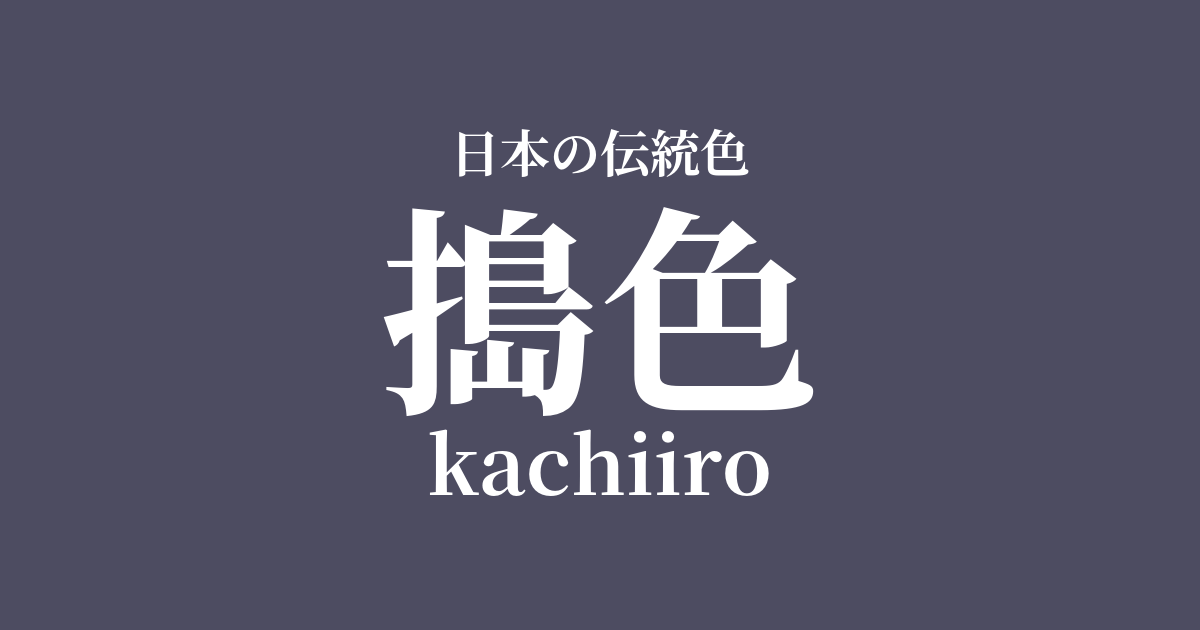
| Japanese color name | maroon |
|---|---|
| reading | kachiiro |
| HEX | #4D4C61 |
| RGB | 77, 76, 97 |
What is "Tsukiiro"? Origin and etymology
Kachi-iro refers to a dark navy blue color, almost black, achieved by dyeing indigo dye to a deep shade. Its name is said to originate from the dyeing process. A leading theory suggests that the color came about because the cloth dyed with indigo was pounded (katsu) with a kinuta (fuller) to give it a sheen. Another theory suggests that it was named "kachi-iro" because the cloth was repeatedly dipped in the dye and pounded to achieve a deep indigo color.
These vibrant colors have been used for weapons and samurai attire since ancient times.
Historical background of color pounding
The color "tsukiiro" (a type of woven fabric) was particularly deeply ingrained in the samurai class from the Kamakura period onward. Because its name sounds similar to "kachi" (victory), samurai considered it auspicious and greatly favored this color. It was frequently used in armor, helmet lacing, and other military equipment and attire such as hitatare (a type of formal robe), and became established as a symbolic color of the samurai class. Its popularity did not wane even into the Edo period, and it was used not only by samurai but also by commoners in items such as firefighters' jackets, and was cherished as a color that conveyed strength and style.
Related literature, waka poetry, and seasonal words
Due to its samurai-related background, the color "tsukiiro" (拫色) frequently appears in war chronicles and literary works depicting samurai society. In classical literature such as "The Tale of the Heike," it is sometimes described as the color of samurai attire. Even without the direct use of the word "tsukiiro," it is often depicted as a deep indigo or navy blue, symbolizing the strength and resolve of samurai. While it is not directly related as a seasonal word, it is often discussed in historical contexts as a color representing the spirit of the samurai.
Color scheme preview
This is to check the readability of the text when this color is used as the background.
Color scheme proposal for pounded metal
Kutsuha color (#917345)
The withered leaf color is a calm brown reminiscent of fallen autumn leaves. When combined with a strong, pounded color, it adds a natural charm and depth to the ruggedness, creating a dignified and refined impression. This is a traditional combination also seen in the color schemes of samurai armor.
White training (#F3F3F3)
Combining a pure white (almost white) with a dark, rubbing color creates a very strong contrast. This color scheme emphasizes purity and integrity, giving a modern and sophisticated impression. It can also be interpreted as a color scheme that expresses the upright spirit of the samurai.
Golden (#E6B422)
The luxurious and dazzling gold, when combined with a dark, subdued reddish-brown, enhances the beauty of both colors. This color scheme, often seen in armor and furnishings, simultaneously expresses authority, dignity, and splendor. It is suitable for formal occasions.
Practical Scenes
Due to its dignified and refined appearance, the tsuki-iro color is still used in a variety of settings today. In traditional Japanese clothing such as kimonos, obi sashes, and hakama, it is used in men's formal wear and martial arts uniforms, conveying strength and dignity. In interior design, incorporating it into accent walls or cushions can give a space a sense of calm and luxury. In web design and graphics, using it as a background color or main color is effective in conveying reliability and stability.