
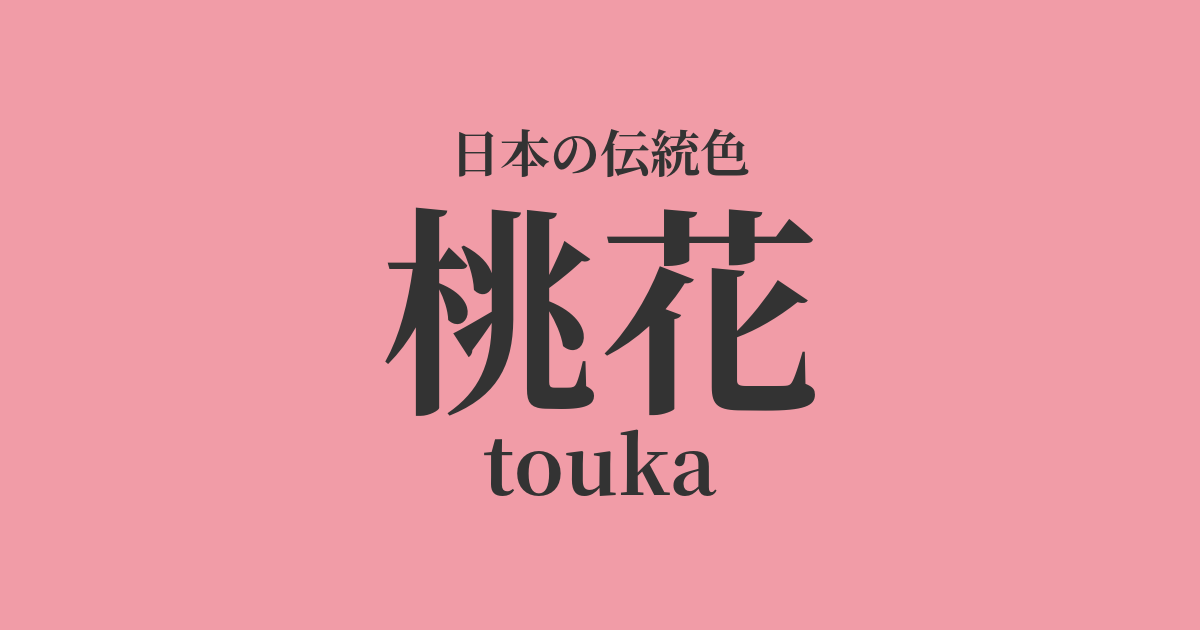
| Japanese color name | peach blossom |
|---|---|
| reading | touka |
| HEX | #F19CA7 |
| RGB | 241, 156, 167 |
What is a peach blossom? Origin and etymology
As the name suggests, "peach blossom" refers to a bright, gentle reddish-pink color derived from the peach blossom, a plant belonging to the rose family. In ancient China, the peach was considered a sacred tree that warded off evil spirits, and the color of its flowers was also believed to have special significance. Influenced by this belief, it is said that in Japan, it became established as a representative color of spring. It is one of the oldest color names, existing even before the word "peach" became common in modern times.
The character for "peach" (桃) is written with the radical for "tree" (木) and the character for "omen" (兆), meaning "sign" or "omen," and has therefore been revered as a flower that heralds the arrival of spring. Furthermore, the third day of the third month of the lunar calendar is the time when peach blossoms bloom, and is therefore called "Peach Blossom Festival" (桃の節句), a festival established to pray for the healthy growth of girls. Peach blossom color is also a symbolic color of this festival and is often used in the costumes and decorations of Hina dolls.
Historical background of peach blossoms
Peach blossom is a color with a long history, appearing in literary works from the Heian period. The name "peach" can be found in "kasane no irome," a set of color schemes for the clothing of the nobility, and it was used for spring attire. It is said that various combinations were devised to suit the changing seasons, such as using a light crimson for the outer fabric and plum blossom or light green for the lining.
During the Edo period, peach blossoms became popular not only among the aristocracy but also among commoners. They were particularly favored for young women's kimonos and accessories, and their popularity is depicted in many ukiyo-e prints. Dyes made from safflower and other sources were used to express these delicate colors in woodblock prints, showcasing the high level of skill of the artisans.
Related literature, waka poetry, and seasonal words
Peach blossoms have been celebrated in numerous waka and haiku poems, and have been treated as an important element that adorns the spring scenery. The Manyoshu anthology contains several poems about peach blossoms, showing how much people at the time cherished the color of this flower. Its vibrant color was also used as a metaphor for love and the brilliance of life.
Furthermore, peach blossoms are an established seasonal word for spring and appear in the poems of haiku poets such as Matsuo Basho and Yosa Buson. They were effectively used to depict peaceful spring scenery and the vibrant atmosphere of the Hina Matsuri (Girls' Festival). The Kojiki (Records of Ancient Matters) contains a myth in which Izanagi-no-Mikoto drives away a female demon by throwing peaches, suggesting that the belief in the protective power of peaches led to an affinity for the color of the blossoms.
In the spring garden, the peach blossoms glow crimson, and a maiden stands on the path bathed in their light.
Color scheme preview
This is to check the readability of the text when this color is used as the background.
Peach blossom color scheme proposal
Light green (#A9D159)
By combining the fresh green of spring leaves with the vibrant colors of peach blossoms, it is possible to express a scene overflowing with the life force of a spring in full bloom. This is a traditional combination also seen in the layered color scheme of "peach," and it is a classic and gorgeous color scheme.
White training (#F3F3F3)
When combined with a pure, lustrous white reminiscent of silk fabric, the loveliness and purity of peach blossoms are further enhanced. It gives an elegant and refined impression and is suitable for creating a graceful atmosphere in Japanese clothing and Japanese-style designs.
Blue and white (#EBF4F8)
The slightly bluish indigo-white color evokes the clear skies of spring. When combined with peach blossoms, it creates a refreshing and sophisticated impression without being overly sweet. It is effective for modern Japanese designs or when you want to add a touch of elegance to a calm atmosphere.
Practical Scenes
In the world of traditional Japanese clothing, peach blossoms are particularly frequently used in spring kimonos and obi sashes. They are incorporated into young women's furisode, houmongi, and komon kimonos, adding a touch of elegance to their attire. Using them as accents on accessories such as obiage and obijime can add charm and a sense of the season to an outfit.
In interior design, using peach blossoms as an accent color brings warmth and a gentle atmosphere to a space. Incorporating them into fabrics such as cushion covers and curtains, or using them on parts of sliding doors or wallpaper in a Japanese-style room, will give the entire room a brighter feel.
In the fields of web design and graphic design, peach blossom is an effective color for expressing friendliness and femininity. Using it in spring campaign websites or in the packaging designs of cosmetics and confectionery can convey a sense of happiness and gentleness to the target audience.