
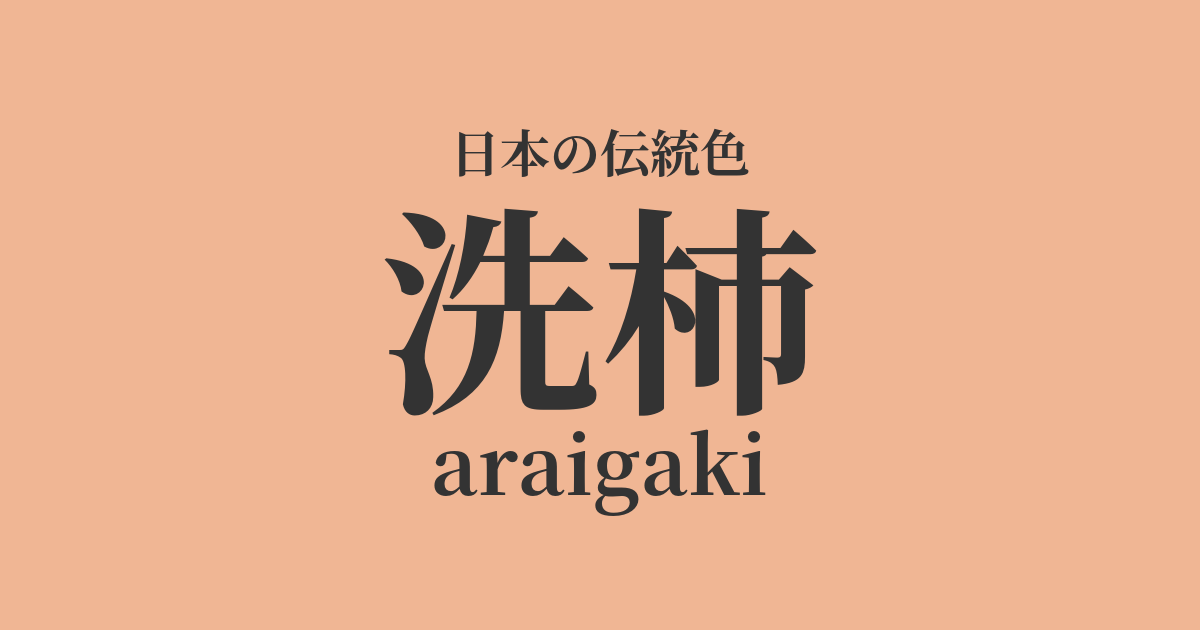
| Japanese color name | Washed persimmon |
|---|---|
| reading | araigaki |
| HEX | #F0B694 |
| RGB | 240, 182, 148 |
What is "washed persimmon"? Origin and etymology
Arai-gaki, as the name suggests, derives its color from the way a cloth dyed with persimmon tannin is repeatedly washed in water to lighten its hue. Persimmon tannin is a liquid made by squeezing the juice of unripe, astringent persimmons, fermenting and aging it, and has been used as a dye and paint since ancient times. While the dark brown color dyed with this persimmon tannin is called "kakishibu-iro," Arai-gaki refers to a reddish, light yellowish-brown. It can be said that this color name expresses the simple and warm texture unique to persimmon tannin dyeing in a lighter way.
Historical background of washing persimmons
The history of persimmon dyeing is long, and it is believed that the technique already existed during the Heian period. However, it is thought that the refined, pale color name "arai-gaki" (washed persimmon) became common only after the mid-Edo period. During this time, along with the development of townspeople's culture, the subdued and calm color palette known as "shijūhacchahyakunezumi" (forty-eight shades of brown and one hundred shades of gray) became popular.
Among these, persimmon tannin dyeing was widely used for the clothing and daily necessities of ordinary people, and it is said that as a variety of colors were pursued, derivative colors such as washed persimmon were born.
Related literature, waka poetry, and seasonal words
It is difficult to pinpoint any famous waka poems or literary works that directly feature the color name "arai-gaki" (washed persimmon). However, the "persimmon," which is the source of the image associated with this color, has long been depicted in many literary works as a symbol of autumn. Persimmons are a seasonal word for autumn, and the way they change color symbolizes the changing of the seasons.
The warmth and gentle hues of the washed persimmon, reminiscent of ripe fruit, are deeply connected to the wabi-sabi aesthetic cherished in classical Japanese literature, and to the sensibilities of people who live in harmony with nature.
Color scheme preview
This is to check the readability of the text when this color is used as the background.
Color scheme proposal for washed persimmons
Persimmon color (#9F563A)
The combination with the persimmon tannin color from which the washed persimmon comes is a unified and natural gradation. The deep persimmon tannin color complements the lighter washed persimmon, giving the overall impression of calmness, warmth, and elegance. It is suitable for designs that want to emphasize a Japanese aesthetic.
Uguischa (#715C1F)
The muted green, reminiscent of nightingale tea, evokes images of persimmon leaves and natural landscapes, and pairs exceptionally well with washed persimmons. The combination of earth tones creates a calm and natural atmosphere. The colors complement each other, resulting in a pleasant and harmonious color scheme.
Blue and white (#EBF4F8)
The bright indigo-white, with its very pale bluish tint, beautifully complements the warm tones of the washed persimmon. This creates a clean and elegant feel, resulting in a light and sophisticated color scheme. It's also suitable for modern Japanese designs and creating bright, open spaces.
Practical Scenes
Washed persimmon is a color favored for kimonos, obi sashes, and Japanese accessories due to its warmth and pleasant feel against the skin. It pairs particularly well with simple fabrics such as pongee silk and cotton, enhancing their natural beauty. Its exquisite shade, neither too flashy nor too plain, makes it a valuable accent color for obi ties and collars.
In the field of interior design, incorporating it into fabrics such as wallpaper, curtains, and cushions brings warmth and tranquility to a space. It harmonizes beautifully with wooden furniture and tatami mats, making it suitable for creating Japanese modern or natural-style spaces. Under warm lighting, it reveals an even softer appearance.
In web and graphic design, this color can be used to convey friendliness and a sense of security. When used as a background or accent color, it gives viewers a calm impression, making it suitable for themes related to natural foods, traditional crafts, and lifestyle. When combined with white or off-white, it creates an elegant and sophisticated design.