
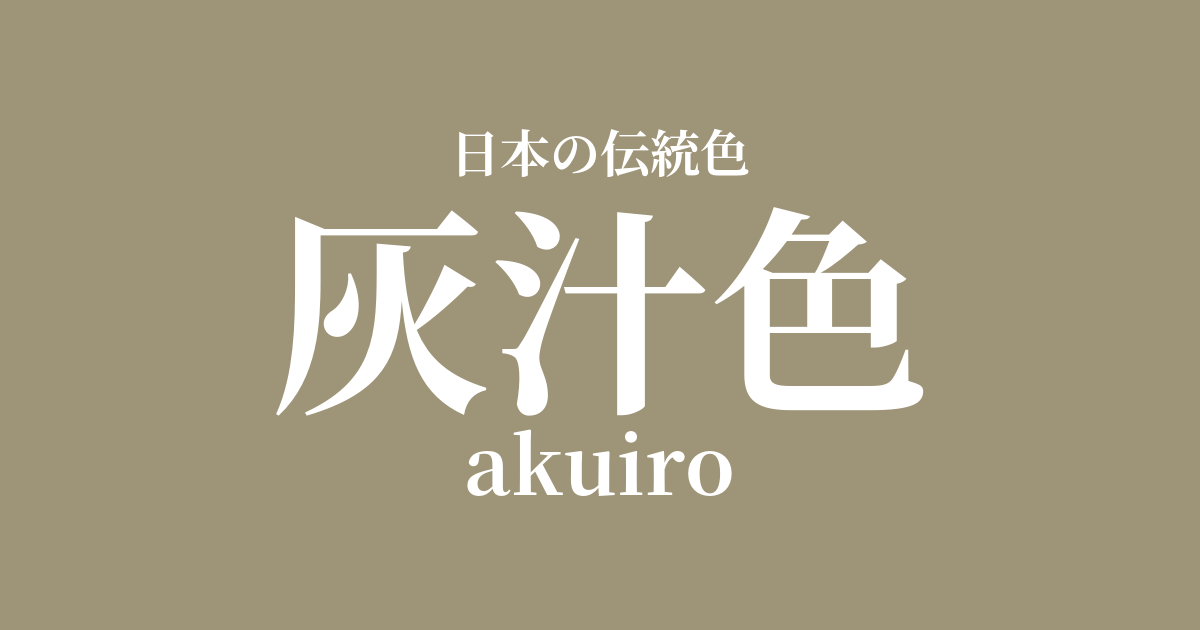
| Japanese color name | Ash color |
|---|---|
| reading | akuiro |
| HEX | #9E9478 |
| RGB | 158, 148, 120 |
What is "ash color"? Origin and etymology
Akuiro (灰汁色) is a color name derived from "aku" (灰汁), as its name suggests. Aku is an alkaline liquid obtained by soaking the ashes produced from burning plants in water and filtering the supernatant. Since ancient times in Japan, this lye has been used as a mordant in dyeing, a cleaning agent, and in food processing. The color of the lye itself, or a slightly yellowish, dull gray that looks like it was dyed with lye, came to be called "akuiro."
The distinctive feature of the color "aku-iro" (ash green) is that it is named not by a single specific plant dye, but by the manufacturing process and state of the dye. It refers to a yellowish-gray or dull yellowish-brown, and the interpretation of the shade varies depending on the era and literature. It can be described as a simple, everyday color born from nature and discovered in the work closely related to people's lives. Its subdued tone is also linked to an aesthetic sense that avoids ostentation.
A historical background of gray
The name "ash-colored" dates back to the Heian period, and its history is long. The Engishiki (a historical document) lists ash as a dyeing material, suggesting that ash was widely used in dyeing. Unlike the image of the dazzling attire of Heian aristocrats, ash-colored was mainly used for monks' robes and mourning clothes, and in situations where ostentation should be subdued in public. It was a color that was highly valued in occasions where composure and formality were required.
With the arrival of the Edo period, the shogunate's sumptuary laws led to a trend among commoners of subdued colors such as brown and gray. Within this trend, known as "Forty-Eight Browns and One Hundred Grays," ash gray also gained widespread acceptance. This simple color, obtainable without expensive dyes, was frequently used in the everyday clothing of commoners—cotton and hemp garments—and became one of the colors symbolizing Edo's refined aesthetic.
Related literature, waka poetry, and seasonal words
The color ash-gray also appears in "The Tale of Genji," considered the pinnacle of Japanese classical literature. In the "Suetsumuhana Chapter," where Hikaru Genji visits the unfortunate princess Suetsumuhana, her worn-out clothes are described as "ash-gray." This description symbolically portrays the princess's fallen circumstances and her old-fashioned, honest character, untainted by worldly affairs. This is an example of how the imagery of a color can eloquently tell the story of a character's background.
This color embodies a sense of calm, solitude, and simple beauty, the antithesis of splendor. Although it is not designated as a specific seasonal word, its hue evokes images of withered plants and quiet winter landscapes. Therefore, it can be said that this color is deeply connected to the uniquely Japanese aesthetic sensibilities of "wabi-sabi" and "mono no aware" found in waka and haiku poetry.
Color scheme preview
This is to check the readability of the text when this color is used as the background.
A color scheme proposal in shades of gray.
Aphrodisiac tea (#715C1F)
The deep, greenish-brown of the "kobuchi" color enhances the yellowish tint of the "akui-iro" color. Both are color names derived from nature, creating a harmonious earth tone reminiscent of soil and withered grass. This combination gives a gentle, rich, and tranquil Japanese impression.
White training (#FCFAF2)
The muted, ash-colored hue and the pure, warm white of the white base create a beautiful contrast. It achieves both cleanliness and simplicity, making it ideal for creating a sophisticated Japanese-style space. The colors complement each other, resulting in a bright yet calming atmosphere.
Blue Rat (#6C7C7D)
The yellowish-gray and bluish-gray colors complement each other. This combination of colors, favored during the Edo period, exudes an intellectual and calm atmosphere. It's effective when you want to create a modern and chic impression.
Practical Scenes
In the world of traditional Japanese clothing, ash-colored kimono is often used for everyday wear such as kimonos, obi sashes, and haori jackets made of silk or cotton. It creates an unpretentious yet stylish look and pairs exceptionally well with brown and gray tones. As a color that exudes a calm and mature atmosphere, it is favored by both men and women.
In interior design, incorporating ash-colored tones into wallpaper, curtains, and furniture upholstery can create a calm and relaxing space. It has a particularly high affinity with natural materials such as wood, bamboo, and Japanese paper, and harmonizes well with Japanese modern styles and natural-themed spaces.
In web and graphic design, using it as a background or accent color can give a site or artwork a sense of calm and trustworthiness. It is particularly suitable when you want to convey an authentic atmosphere, such as with traditional crafts, natural foods, or history-related content.