
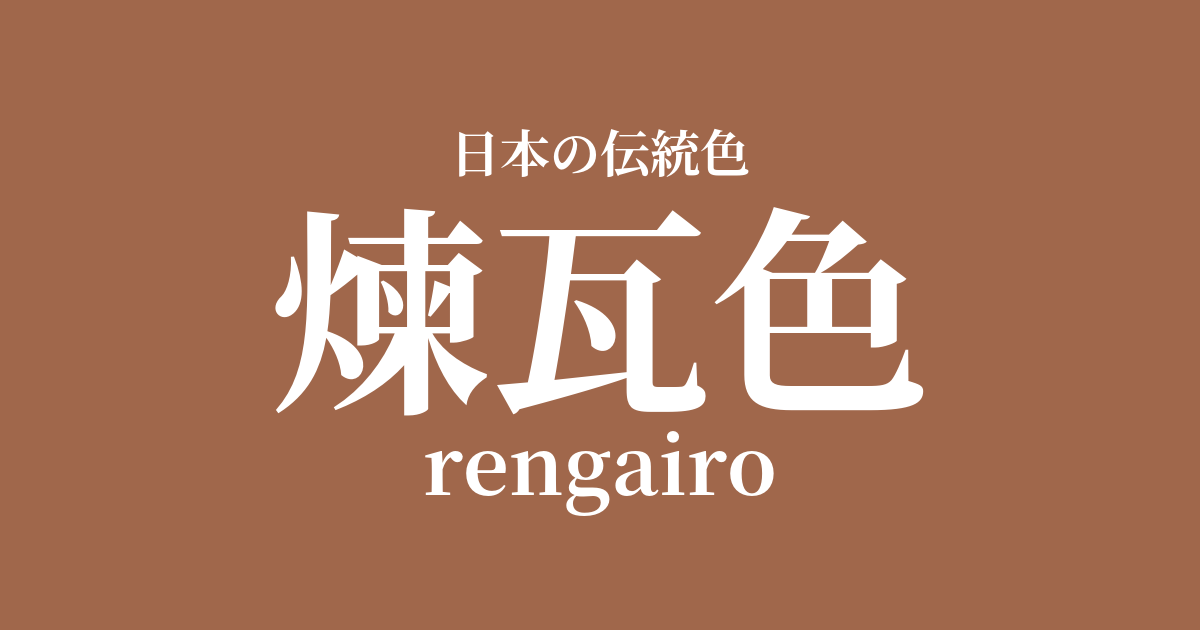
| Japanese color name | brick color |
|---|---|
| reading | rengairo |
| HEX | #A0674B |
| RGB | 160, 103, 75 |
What is brick red? Origin and etymology
Brick color is a dull reddish-brown color derived from "brick," a building material made by firing clay or shale. Although brick itself has existed since ancient times, it is believed that this color only became widely recognized and established as a color name in Japan relatively recently, after the Meiji era. With the introduction of Western architecture, brick buildings such as the Marunouchi Station building of Tokyo Station and the Yokohama Red Brick Warehouse became an important element of Japan's urban landscape.
Due to its modern and robust appearance, it became widely known among people as a color symbolizing the modernization of Japan.
Brick-colored historical background
The large-scale production and use of bricks in Japan began during the late Edo period and the Meiji era. The Meiji government actively introduced Western technology as part of its policy of enriching the country and strengthening its military, and made extensive use of bricks in government-run factories and public buildings. In particular, the "Ginza Brick Street," planned as part of the reconstruction efforts after the Great Ginza Fire of 1872 (Meiji 5), was a pivotal event that dramatically altered Japan's urban landscape. During this period, brick was not merely the color of a building material, but was seen as a symbol of modernization and Western culture.
Its popularity continued into the Taisho era, and it was adopted in many Western-style buildings, becoming deeply rooted in the Japanese landscape.
Related literature, waka poetry, and seasonal words
The color "brick red" is a relatively recent name, and therefore does not appear directly in Heian period waka poetry or classical literature. However, in modern literature from the Meiji era onward, it frequently appears as an important element in describing the landscape of the time. Works such as Natsume Soseki's "Sanshiro," Mori Ogai's "Seinen," and Nagai Kafu's "Bokuto Kidan" depict the brick buildings and streetscapes of Tokyo at that time.
Through these descriptions, the brick color conveys to the reader a modern atmosphere of the Meiji Restoration period, and at times, a melancholic urban scene.
Walking along the long red brick wall, you'll find yourself in the stillness of an afternoon shimmering with heat haze.
Color scheme preview
This is to check the readability of the text when this color is used as the background.
Brick-colored color scheme proposal
Indigo (#274054)
The warm brick red and cool indigo blue complement each other, creating a modern and sophisticated color scheme. It evokes the Western-style buildings of the Meiji era and the blend of Japanese and Western styles, creating an atmosphere of calm and refinement. The strong contrast provides a visually stable combination.
Gray white (#E9E4D4)
The light grayish-white color, reminiscent of brick mortar, softly enhances the reddish hue of brick. The overall impression is natural and calming, creating a warm and inviting space. This color scheme is often used in architecture and interior design to highlight the texture of materials.
Dark Green (#00552E)
This classic and dignified color scheme evokes images of ivy clinging to brick buildings. Both are earth tones found in nature, creating a harmonious balance. It exudes a sense of stability and luxury, making it suitable for designs that evoke tradition and history.
Practical Scenes
In fashion, incorporating it into coats, jackets, and leather goods creates a classic and warm impression. It is particularly useful in autumn and winter outfits, serving as an accent color that creates an intellectual atmosphere. It also pairs well with basic colors such as white, black, and navy.
In interior design, using it in wallpaper, fabrics, and tiles creates a calm and sophisticated space. When used as an accent wall, it adds depth and warmth to a room, creating a cozy atmosphere reminiscent of a cafe or study.
In web and graphic design, it is effective when you want to convey a sense of reliability and stability. It is used as a key color for websites themed around history and tradition, or for brands that want to project a sense of luxury. It is often combined with white or off-white to ensure readability.