
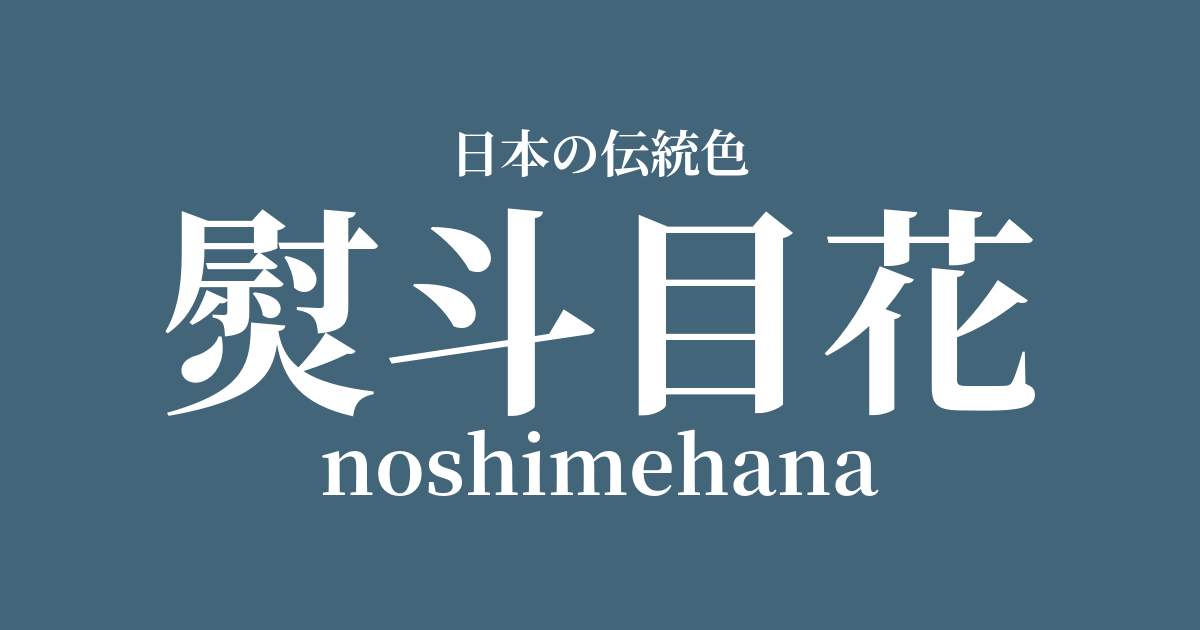
| Japanese color name | Noshime Hana |
|---|---|
| reading | noshimehana |
| HEX | #426579 |
| RGB | 66, 101, 121 |
What is Noshimebana? Origin and etymology
Noshimehana refers to a subdued, slightly grayish blue color. Its origin is said to be derived from the "noshime kosode," a formal garment worn by samurai during the Edo period. "Noshime" refers to a type of kimono with a change in dye or weave at the waist, and indigo-dyed versions were particularly common. "Hana" is thought to be an abbreviation of "hanada," which represents the color of indigo dye.
In other words, Noshimebana is a color name that symbolizes the aesthetic sense of the samurai class, and it has the meaning of "the light blue color used in Noshime kosode (a type of formal kimono)."
Historical background of Noshime flower
During the Edo period, the samurai class had dress codes (clothing regulations) that were set according to social status, and the Noshime Kosode was widely used as semi-formal attire and everyday wear for samurai. Among them, the Noshime Hana pattern dyed with indigo was particularly favored as a color that suited the spirit of the samurai, who valued simplicity and strength. This color spread not only among samurai but also among commoners when Kabuki actors wore it as stage costumes, and it became a popular color in Edo townspeople's culture as well.
Although its role as formal attire for samurai ended with the rise of Western clothing after the Meiji Restoration, its name has been passed down to the present day as a traditional Japanese color.
Related literature, waka poetry, and seasonal words
While it is difficult to pinpoint specific waka or haiku poems that directly mention the color name "noshimebana," the word "noshime" itself frequently appears in Edo period literature and ukiyo-e prints. For example, in Ihara Saikaku's ukiyo-zoshi "The Life of an Amorous Man," a character wearing a noshime kosode is depicted in the context of describing the customs of the time. Through these works, we can learn about the position of noshime in society at that time.
Although it is not an established seasonal word, the indigo dye color sometimes evokes the image of summer.
Color scheme preview
This is to check the readability of the text when this color is used as the background.
Color scheme proposal for Noshime flower
White Rat (#BDC0BA)
The light gray color, or "white mouse," enhances the overall impression of the design without detracting from the elegance of the Noshime flower pattern, creating a bright and light feel. Its modern and urban atmosphere, combined with its sophisticated and refined color scheme, makes it suitable for interior design and web design.
Kutsuha color (#917347)
The withered leaf color is a reddish-brown, and it is almost a complementary color to the blue-toned Noshime flower. This combination enhances each other's colors, creating a calm and warm impression reminiscent of an autumn landscape. It is a color scheme that deepens the sense of Japanese aesthetics.
Indigo (#165E83)
By combining it with indigo, a color in the same indigo family as the Noshime flower, it creates a unified and calm impression. It evokes an intelligent and sophisticated atmosphere, and the gradation-like transition of colors brings depth and dimension to the design.
Practical Scenes
In the world of traditional Japanese clothing, the Noshime flower pattern is often used on men's kimonos, hakama (trousers), and obi (sashes). Its subdued colors evoke the dignity of a samurai, giving an impression of refined elegance and sophistication. Even today, it is popular for formal wear and fashionable clothing, often combined with other traditional patterns.
In interior design, incorporating accent walls, sofas, and cushions brings tranquility and depth to a space. Combining it with white, beige, or wood-grain furniture creates a sophisticated, modern Japanese atmosphere.
In the fields of web design and graphic design, it is used as a color to express trustworthiness and integrity. Using it as a corporate color or as the base color for a website with a calm tone can give viewers a sense of security and an intelligent impression.