
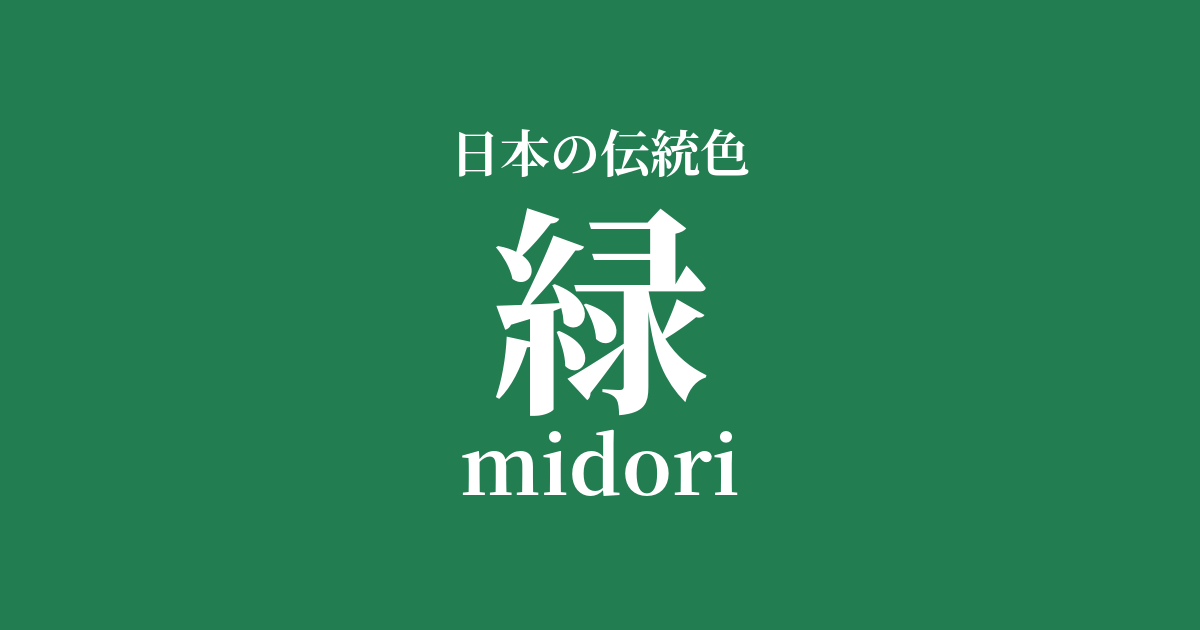
| Japanese color name | 緑 |
|---|---|
| reading | midori |
| HEX | #227D51 |
| RGB | 34, 125, 81 |
What does "green" mean? Origin and etymology
The most widely accepted theory is that the word "midori" (green) originates from "mizumizushi," which describes the appearance of new shoots sprouting and youthfulness. It is thought that this word, which referred to a fresh state full of vitality, became established as a color name. In ancient Japan, the concept of color differed from that of today, and the word "ao" referred to a wide range of colors, from green to blue and indigo. It is believed that "midori" gradually differentiated from "ao" to refer specifically to the vibrant color of newly sprouted leaves.
Furthermore, "green" can sometimes be interpreted as a word meaning "intermediate." This is said to originate from the Yin-Yang Five Elements philosophy, where "blue (green)" symbolizes spring and the east, while "green" is considered an intermediate state in the transitions of seasons and directions. It is a color with deep and rich meaning, symbolizing the very cycle of life in the natural world.
Green Historical Background
In ancient Japan, green was a color included in the category of "blue," but during the Heian period, it became established as an independent color name and frequently appeared in literary works such as "The Tale of Genji." During this period, green was sometimes treated as a color symbolizing youth and immaturity, and was considered a color worn by boys before their coming-of-age ceremony. On the other hand, the green of the evergreen pine tree was revered as "Tokiwa-iro" (evergreen color) as a symbol of longevity and permanence.
From the Kamakura period onward, green tones began to be used in samurai attire, such as the hitatare. In the Edo period, various dyes became available to commoners, and a wide range of greens were enjoyed through plant dyeing. As a color of nature and a color that brings peace, green has become deeply rooted in the lives of the Japanese people across generations.
Related literature, waka poetry, and seasonal words
In the era of the Manyoshu, "midori" was often used not as a color name, but rather as a word referring to youthful vitality itself, as in "midorigo" (a young child). This is thought to reflect the linguistic sensibilities of an era when colors were not yet clearly differentiated. There are many poems that depict scenes that evoke the breath of life, such as the young grass of spring and budding trees.
In Heian period literature, particularly in "The Tale of Genji," the color green plays an important role in symbolizing the social status and feelings of the characters. In the "Wakana" chapter, the scene where Hikaru Genji welcomes the youthful Onna San no Miya, contrasting her with Murasaki no Ue, is depicted, and green is effectively used as a symbol of youth and immaturity. Furthermore, in the world of haiku, words related to green, such as "wakaba" (young leaves), "aoba" (green leaves), and "matsu no ryoku" (green of pine), are frequently used as seasonal words for spring and summer, making them an indispensable element in expressing a sense of the season.
In spring, I saw it as a single green blade of grass; in autumn, I see it as a riot of flowers.
Color scheme preview
This is to check the readability of the text when this color is used as the background.
Green color scheme proposal
Kutsuha color (#915E33)
The withered leaf color is a reddish-brown reminiscent of fallen leaves, and when combined with vibrant green, it expresses the natural cycle from new growth to autumn leaves and then to leaf fall. The harmony of these calm and deep earth tones creates a color scheme that evokes a sense of peace and the changing seasons.
Golden (#E6B422)
Golden is a brilliant color that symbolizes a bountifully ripened rice field. When combined with vibrant green, it strongly evokes images of abundance and prosperity. The two colors vividly complement each other, creating a powerful and positive impression, making it an auspicious combination.
Mauve (#BBADDD)
Wisteria purple is a noble and elegant light purple color that was beloved by the Heian period aristocracy. Combining vibrant green with soft wisteria purple creates a refined and elegant atmosphere. This color scheme possesses a classic and sophisticated beauty that evokes the world of "The Tale of Genji."
Practical Scenes
Green is one of the most popular colors in kimono and obi sashes. It is widely used in patterns ranging from furisode (long-sleeved kimono) that express youthfulness to those of more subdued houmongi (formal visiting kimono) and tomesode (formal kimono). In particular, green used in auspicious motifs such as pine, bamboo, and chrysanthemum is considered a suitable color for celebratory occasions as it symbolizes longevity, prosperity, and permanence.
Incorporating greenery into interior design is said to have a psychological effect of relaxation and a sense of security. Using it not only in houseplants, but also in fabrics such as wallpaper, curtains, and cushions, can create a calm and comfortable space that allows you to feel connected to nature even while indoors.
In web and graphic design, green is a suitable color for conveying themes such as safety, trust, nature, and health. It is effectively used as a key color to express integrity and safety on websites of environmental organizations, organic food companies, and financial institutions.