
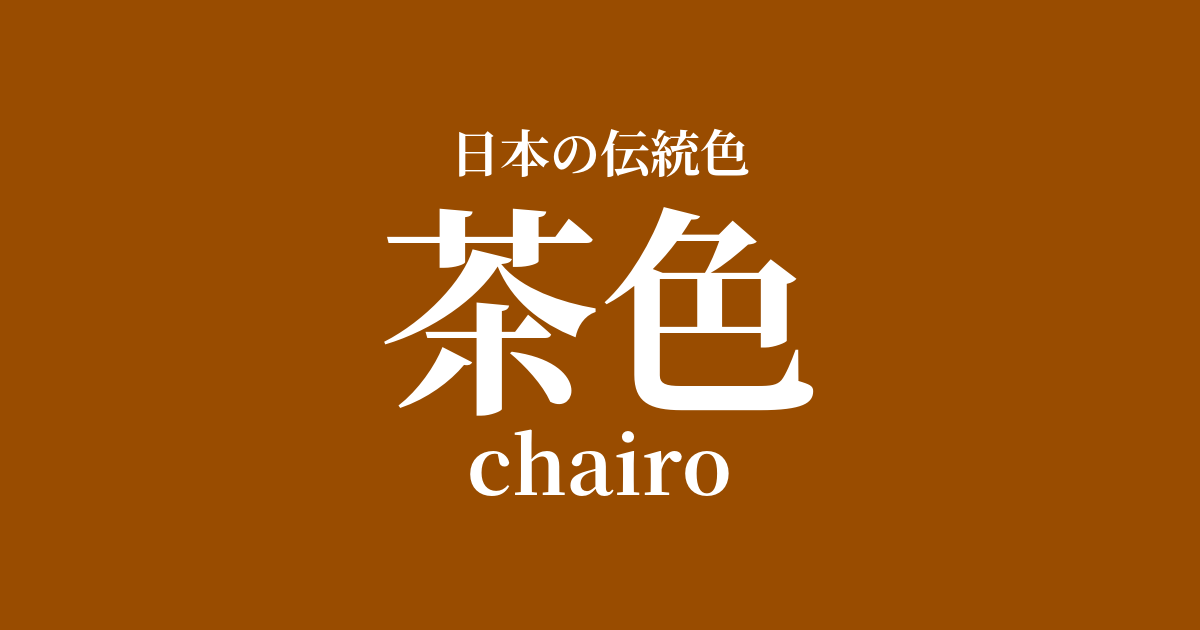
| Japanese color name | brown |
|---|---|
| reading | chairo |
| HEX | #994C00 |
| RGB | 153, 76, 0 |
What is brown? Origin and etymology
The word "brown" literally derives from the beverage "tea." It was named after the color obtained by dyeing with the liquid brewed from tea leaves, or from the color of the tea leaves themselves. This dyeing method was called "chazome" (tea dyeing), and it is believed to have existed as early as the Heian period, but it was not yet a common color name at that time. As tea became more widespread among the common people, this color name also became widely established.
The color "brown" is generally believed to have come into common use after the Muromachi period, and is deeply connected to the development of the tea ceremony culture. In the Edo period, brown became explosively popular along with the flourishing of popular culture. In particular, the restrictions on extravagant colors imposed by sumptuary laws fostered a culture of "iki" (sophistication and refinement) that found beauty in subdued colors such as brown and gray.
The historical background of brown
Although the term "tea dye" is found in Heian period documents, it was not widely recognized as a color name. From the Kamakura period to the Muromachi period, as the custom of drinking tea spread along with the spread of Zen Buddhism, the word "brown" gradually came into use.
In the mid-Edo period, when the shogunate issued sumptuary laws, commoners could no longer wear bright colors. As a reaction to this, people began to enjoy subtle differences in subdued colors such as brown and gray, resulting in such a diverse range of variations that it was called "forty-eight shades of brown and one hundred shades of gray." Brown became a representative color that symbolized sophistication and refinement during this era.
In particular, the connection with Kabuki actors was deep, and brown teas named after popular actors such as "Danjuro Tea," which was favored by the first Ichikawa Danjuro, and "Roko Tea," which was said to have been a favorite of the fifth Ichikawa Danjuro, became popular one after another. This shows that ordinary people at the time were strongly influenced by Kabuki culture, which was the source of trends.
Related literature, waka poetry, and seasonal words
In Edo period works such as Ihara Saikaku's ukiyo-zoshi and Shikitei Sanba's humorous books, the color brown frequently appears in depictions of the customs of the time. By being depicted as the color of the clothing worn by the characters, it served to convey to the reader the character's social status, refined character, and economic situation.
In modern literature, brown is a color that evokes images of earth, fallen leaves, and old wooden houses, and is effectively used to depict nostalgic scenes and simple life. Brown also appears as part of the background descriptions in the works of Natsume Soseki and Akutagawa Ryunosuke, deepening the atmosphere of the stories.
While brown itself is rarely treated as a seasonal word in haiku, the world of haiku has many winter seasonal words that strongly evoke the color brown, such as "withered field," "fallen leaves," and "winter trees." These words express a deep sense of the season, such as the desolation of winter when all things are still, and the cycle of life waiting for the next spring, and are closely linked to the image of brown.
Color scheme preview
This is to check the readability of the text when this color is used as the background.
Brown color scheme proposal
Indigo (#274054)
Brown and indigo, widely used by common people during the Edo period, represent a traditional Japanese color combination. The deep blue of indigo enhances the warmth of brown, creating an impression of calmness and dignity. This classic color scheme can be seen in kimonos, noren curtains, and other Japanese crafts.
Moss color (#69821B)
Brown and moss green are both earth tones that evoke soil and plants, making them very harmonious. This creates a calm and reassuring color scheme reminiscent of natural landscapes, and incorporating them into interior design or fashion can create a relaxed and natural atmosphere.
White training (#EFEFEF)
Combining warm brown with pure, bright white creates a sophisticated and modern impression. The contrast is beautiful, and each color enhances the other. This color scheme achieves both cleanliness and elegance in web design and contemporary Japanese-style interior design.
Practical Scenes
In the world of traditional Japanese clothing, brown remains a popular color, embodying the refined elegance of the Edo period. It is frequently incorporated into everyday wear, particularly tsumugi silk and komon patterned kimonos, and its versatility allows for a wide range of looks depending on the combination with obi sashes and accessories. Its subdued hue makes it easy to wear regardless of age.
In interior design, brown evokes images of wood and earthen walls, creating a warm and reassuring space. Using it in large areas such as wallpaper, curtains, and sofas can create a natural and comfortable atmosphere. It's a versatile color that harmonizes well with other earth tones.
In web and graphic design, brown is suitable for expressing themes such as trust, tradition, and nature. When used as a background color, it gives a calm impression, and when used as an accent color for headings and buttons, it results in a warm design.