
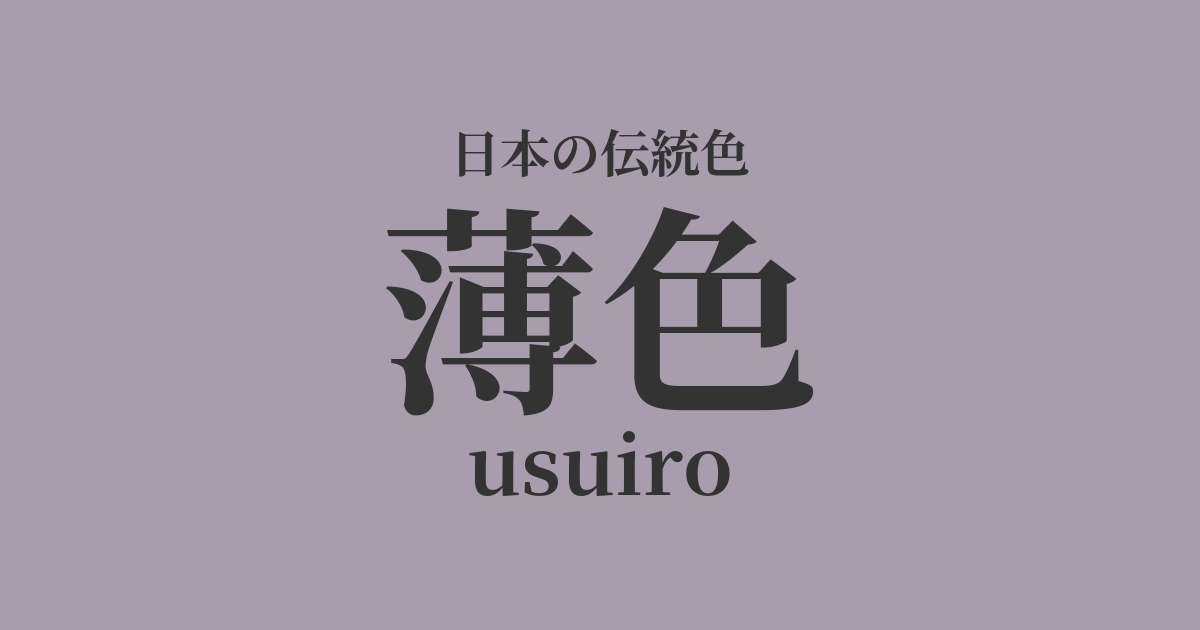
| Japanese color name | light color |
|---|---|
| reading | usuiro |
| HEX | #A89DAC |
| RGB | 168, 157, 172 |
What is "pale color"? Origin and etymology
"Usuiro" refers to a very light purple color achieved by dyeing with shikon, the root of the gromwell plant (Lithospermum erythrorhizon). Dyeing with shikon results in varying shades of purple depending on the amount of dye, mordant, and number of dyeing cycles, and these were called "kokimurasaki" (deep purple), "nakamurasaki" (medium purple), and "asakimurasaki" (light purple) in descending order of intensity. The term "usuiro" originated to refer to an even lighter shade than asamurasaki, and as the name suggests, its direct etymology is "a diluted purple."
This color name symbolizes Japan's rich color culture, which allows for the discernment of subtle color differences.
Lightly colored historical background
Purple has long been a color symbolizing noble status, as it was the highest-ranking color in the Twelve Levels of Court Rank established by Prince Shōtoku. During the Heian period, deep purple and medium purple were forbidden colors that could only be worn by the emperor and a select few of high rank, but lighter shades were exempt from this restriction and could be worn by people from a relatively wide range of social classes. Its delicate and elegant hue was particularly favored in the attire of court ladies and was cherished as a symbol of grace and intelligence.
On the other hand, light colors also have an aspect as colors of mourning. The Engishiki, a collection of laws compiled in the mid-Heian period, specifies in detail the colors of clothing to be worn according to the period of mourning. According to it, when a close relative dies, mourning clothes should initially be a dark, dull color, then lighter after 49 days, and even lighter after the first anniversary. Thus, light colors were colors with complex meanings, used in both celebratory and sorrowful occasions.
Related literature, waka poetry, and seasonal words
Pale colors are depicted as playing an important role in the world of Heian literature, particularly in "The Tale of Genji." For example, in the chapter "Wakamurasaki," the young girl (later Lady Murasaki) that Hikaru Genji glimpses is wearing a "yellow-colored undergarment and a light-colored robe," and these colors are effectively used to symbolize her loveliness and noble lineage. Pale colors also frequently appear in the clothing of other characters, conveying their social status, feelings, and the atmosphere of the scene to the reader.
Furthermore, in the section on "things to be admired" in Sei Shonagon's essay collection "The Pillow Book," there is a line that reads, "Pale colors are associated with the hollyhock." This shows the aesthetic sensibilities of the time, where the color of the hollyhock flower came to mind when thinking of pale colors. In this way, through literary works, we can see that pale colors were associated with the beautiful colors of the natural world and were deeply rooted in people's lives and sensibilities.
Tears fall onto my pale garment, and today my body is stained with smoky colors.
Color scheme preview
This is to check the readability of the text when this color is used as the background.
Light-color scheme proposal
White training (#FFFFFF)
By combining it with pure white, the elegance and transience of light colors are brought out to their fullest potential. This color scheme evokes a sense of cleanliness and tranquility, and can give a sophisticated impression in traditional Japanese clothing and formal designs.
Light green (#A9D159)
By combining it with a vibrant, fresh green reminiscent of young leaves, the color scheme becomes bright and refreshing, evoking the arrival of spring and the breath of life. It adds a fresh accent to the quiet impression of the lighter colors, bringing movement and vibrancy to the design.
Silver mouse (#AFAFAF)
Combining it with a light gray or silver-gray creates a sophisticated and modern urban impression. The combination of low-saturation colors enhances each other, creating a calm yet refined and chic atmosphere.
Practical Scenes
In the world of traditional Japanese clothing, light colors are used in a variety of kimonos, including formal visiting kimonos, solid-colored kimonos, and patterned kimonos. They are particularly favored for springtime attire and occasions where a modest yet dignified appearance is required, such as tea ceremonies. By incorporating light colors as accents in accessories such as obi sashes, obi ties, and collars, an elegant atmosphere can be added to the entire outfit.
In interior design, incorporating it into textiles such as wallpaper, curtains, and cushions gives a calm and tranquil impression to a space. It blends well not only with Japanese-style rooms but also with modern Western-style rooms, and when combined with white, beige, or wood-grain furniture, it creates an elegant and relaxing space.
In the fields of web and graphic design, light colors are suitable for expressing gentleness and femininity. Using them as the main color creates an elegant and calming website. Furthermore, using them as accent colors in minimalist designs based on white or gray can add a touch of Japanese aesthetics to a sophisticated atmosphere.