
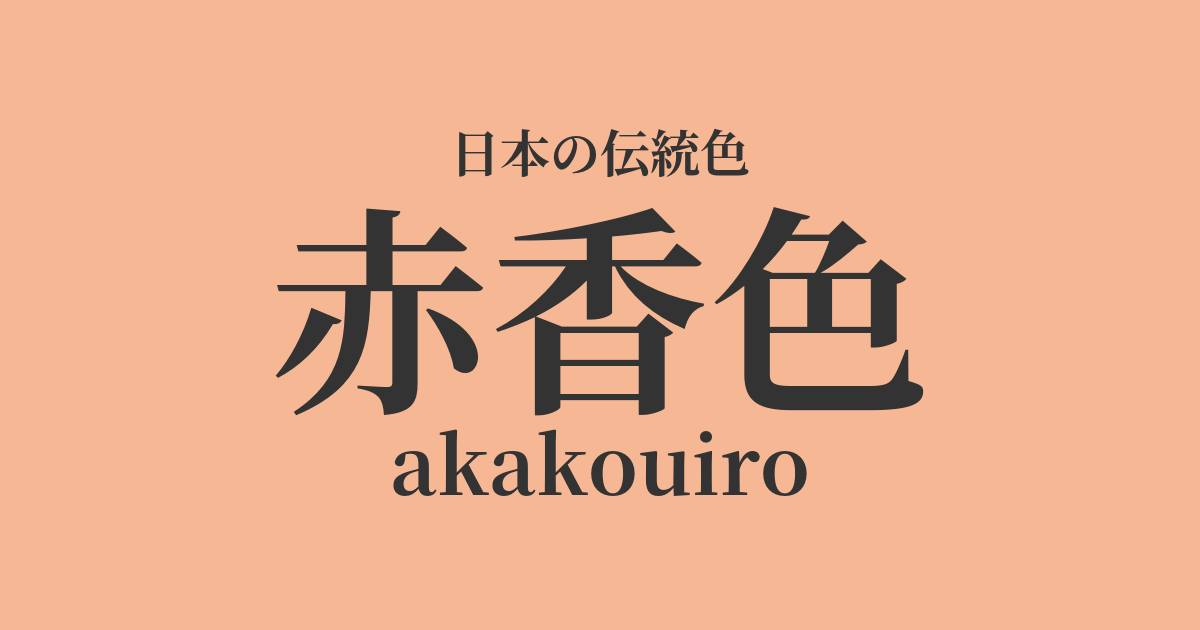
| Japanese color name | Reddish-brown |
|---|---|
| reading | akakouiro |
| HEX | #F6B894 |
| RGB | 246, 184, 148 |
What is "Akagane-iro"? Origin and etymology
The color "Akako" (red incense) originates from a dye made primarily from the decoction of cloves, an aromatic wood, with red tones added using safflower and sappanwood. While "Kōiro" (incense color) refers to the yellowish-brown color of clove dye, "Akako" (red incense) is said to have been named because it has a stronger reddish hue. Cloves have been used since ancient times not only as a valuable fragrance but also as a dye.
Its unique fragrance and beautiful colors were highly valued in the aristocratic society of the Heian period and it was considered a symbol of refined culture.
The historical background of the reddish-brown color
The origin of the reddish-brown color is thought to be traced back to "kozome," a type of dyeing that was popular during the Heian period. The Engishiki, a compilation of laws and rituals from that time, describes a dyeing technique that used cloves as the main dye and lye as a mordant, and this was the basic method of making kozome. Due to its rarity, this color was considered a color used only by people of high social standing, and it is said that at one time it was one of the forbidden colors whose wear was restricted.
As time went on, during the Edo period, it became more widely popular among ordinary people and was a familiar color used for kimonos and accessories.
Related literature, waka poetry, and seasonal words
The color reddish-brown, or its origin, incense dye, can also be found in the world of Heian period literature. For example, in "The Tale of Genji," considered to be the world's oldest full-length novel, expressions similar to "incense dye" are frequently found describing the colors of the characters' clothing. These elegant intermediate colors are effectively used to describe the splendid attire of the nobles, including Hikaru Genji. However, it is difficult to determine precisely whether the incense dye of that time was exactly the same color as modern reddish-brown.
Although it doesn't directly exist as a seasonal word, its color evokes images of autumn foliage and twilight skies, and it is sometimes associated with autumn scenery in waka poetry.
Though my garments are deeply dyed with fragrance, will they ever fade from your heart?
Color scheme preview
This is to check the readability of the text when this color is used as the background.
A proposed color scheme in reddish-brown.
Kutsuha color (#915E33)
The warmth of the reddish-brown and the deep brown of the withered leaf color harmonize to create a calm and profound color scheme reminiscent of autumn nature. This combination evokes a traditional Japanese atmosphere and gives an elegant and tranquil impression.
Bottle peek (#A2D7DD)
By combining a warm reddish-brown with a cool, very pale blue-green, a contrast is created that enhances each other's colors. This color scheme creates a light and sophisticated impression, with both freshness and warmth coexisting.
Two indigo (#6F6099)
By combining it with a shade of purple called "futa-ai," which was considered a noble color during the Heian period, the elegant atmosphere is emphasized. The softness of the reddish-brown color enhances the dignity and depth of the futa-ai, resulting in a dignified yet graceful color scheme.
Practical Scenes
In the world of traditional Japanese clothing, the reddish-brown color is used for formal kimonos such as visiting kimonos, casual kimonos, and accessories like obiage (kimono sashes). It is favored by women of all ages because it blends well with the skin and is expected to brighten the complexion. It is also easy to combine with other colors, making it a valuable color for expanding the range of outfit combinations.
In interior design, incorporating it into fabrics such as wallpaper, curtains, and cushions brings a warm and gentle atmosphere to a space. It pairs particularly well with wooden furniture, making it ideal for creating a natural and relaxing space.
In web and graphic design, it is used as a background or accent color. It gives the entire site a soft and friendly impression, creating a sense of security for the user. It is particularly well-suited to content related to traditional crafts, Japanese sweets, and lifestyle.