
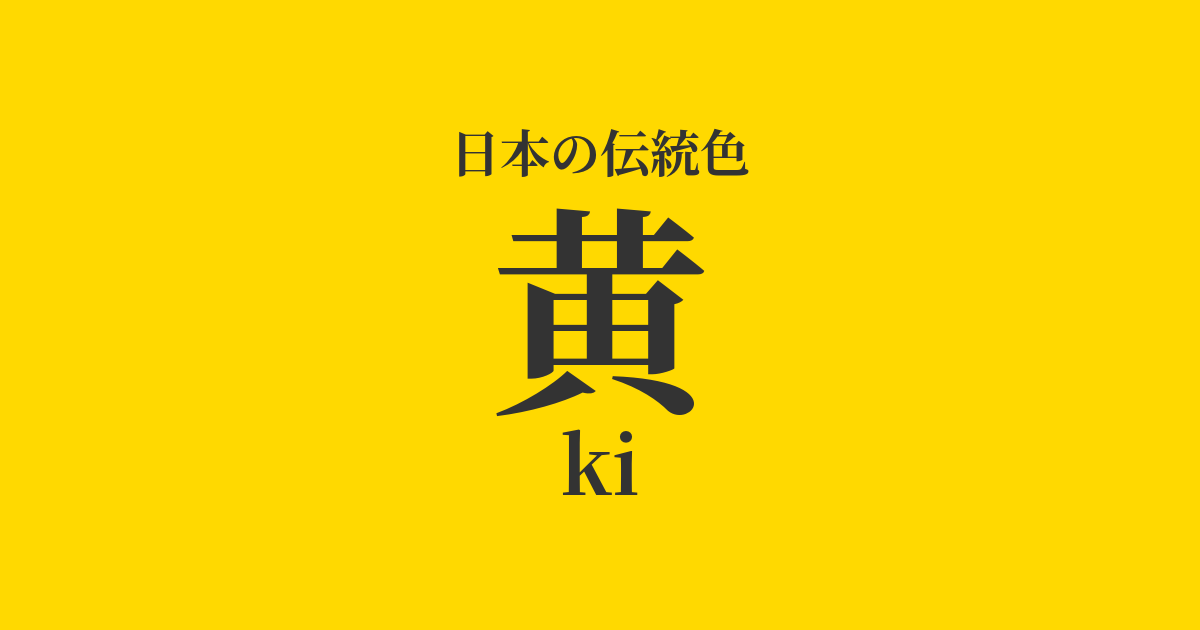
| Japanese color name | 黄 |
|---|---|
| reading | ki |
| HEX | #FFD900 |
| RGB | 255, 217, 0 |
What does "yellow" mean? Origin and etymology
There are several theories about the origin of the name of the color yellow, "ki," including that it is related to light and brilliance, or that it comes from the color of trees, but none are certain. The kanji character "黄" (yellow) is said to be a pictograph depicting a person with a jewel attached to their waist, and that the jewel was yellow. Since ancient times, people have found this color in familiar natural objects and incorporated it into their lives. In particular, as the color of a bountifully ripened rice stalk, it was also considered a symbol of harvest and wealth.
Traditional Japanese yellow dyes were primarily derived from plants. Representative examples include the fruit of the gardenia (kuchinashi), the bark of the Phellodendron amurense (kiwada), and the stems and leaves of the Japanese laurel (kariyasu). Gardenia produces a vibrant reddish-yellow, Phellodendron amurense a slightly greenish-yellow, and Japanese laurel a bright, translucent yellow. These dyes were used selectively depending on the material being dyed and the desired shade, enriching Japan's color culture.
Historical background of yellow
In the Yin-Yang and Five Elements philosophy, which originated in ancient China, yellow was considered the color that governs the center and was treated as the noblest color symbolizing the emperor. This philosophy had a significant influence on Japan as well, and yellow came to hold special significance. For example, the "Kōrozen" robe worn by the emperor during important ceremonies such as the enthronement ceremony was designated as an absolutely forbidden color, and was not permitted to be worn by anyone other than the emperor, thus demonstrating his authority and sacredness.
During the Heian period, yellow was used in the "kasane no irome" (layered colors) of aristocratic attire, playing an important role in expressing the seasons. Color combinations such as "kigiku" (yellow chrysanthemum) and "yamabuki" (Japanese kerria) appeared in literary works, conveying the vibrant culture of that time to the present day. In the Edo period, a bright yellow dyed with turmeric became popular among commoners and was used in kimonos and accessories. As a result, yellow became established not only as a noble color but also as a more familiar and approachable color.
Related literature, waka poetry, and seasonal words
Yellow has long appeared in Japanese poetry and literature, evoking the golden glow of rice stalks and the moonlight. It is particularly often used to symbolize the bountiful autumn harvest, suggesting its deep connection to people's lives. Furthermore, it is a familiar color associated with spring flowers such as rapeseed and kerria, depicted as a bright color that heralds the arrival of the season.
In Heian period literature such as "The Tale of Genji," the colors of the characters' clothing are an important element in expressing their social status, feelings, and the sense of the season. For example, the "yamabuki no kasane" (a layered kimono in the color of yellow roses) is used to depict the vibrant scenery of spring, adding a colorful depth to the story. In this way, yellow has not only been a color in itself, but has also played a symbolic role in enriching the background of the story and the characters.
In the world of haiku, many plants that include the color yellow are used as seasonal words. "Rape blossoms" and "yellow daffodils" are spring seasonal words that evoke the breath of life, while "falling yellow leaves" is an autumn seasonal word that describes the way ginkgo and other leaves turn yellow and fall. These seasonal words condense vivid seasonal scenes into short words, stimulating the reader's imagination.
Though I ask who the owner of this robe is, the gardenia remains silent.
Color scheme preview
This is to check the readability of the text when this color is used as the background.
Yellow color scheme proposal
Bellflower color (#585EAA)
The vibrant yellow and the calm, bluish-purple bellflower color are close to complementary colors, enhancing each other's beauty. This color scheme, reminiscent of those found in Heian period attire, gives an elegant and noble impression, creating a classic yet refined atmosphere.
Light green (#A9D159)
The combination with the fresh green of spring leaves creates a bright and refreshing impression full of vitality. It is a harmonious color scheme found in nature and is suitable for creating a friendly and positive atmosphere.
Jet Black (#0D0015)
The vibrant yellow and deep black create a strong contrast, making each color stand out. Its high visibility strongly attracts attention. This color scheme gives a modern, sharp, and powerful impression.
Practical Scenes
In the world of kimono, yellow is a color that symbolizes vibrancy and youthfulness, and is often used in furisode (long-sleeved kimono), houmongi (formal visiting kimono), and children's celebratory kimono. It is especially suitable for expressing the feeling of spring, and when incorporated as an accent in accessories such as obi (sash), obiage (sash scarf), and han-eri (collar), it has the effect of brightening and enhancing the entire outfit.
In interior design, yellow is a color that brings brightness and warmth to a space. Incorporating it into fabrics such as cushions, curtains, and rugs creates a cheerful and positive atmosphere throughout the room. However, using it over a large area can be too stimulating, so it is most effective to use it partially as an accent color.
In web and graphic design, yellow is highly effective at attracting attention and is frequently used for call-to-action (CTA) buttons, banners, and highlighting important information. It is also suitable for brand images that aim to convey fun and energy, and when combined with black or dark gray text, it ensures high readability.