
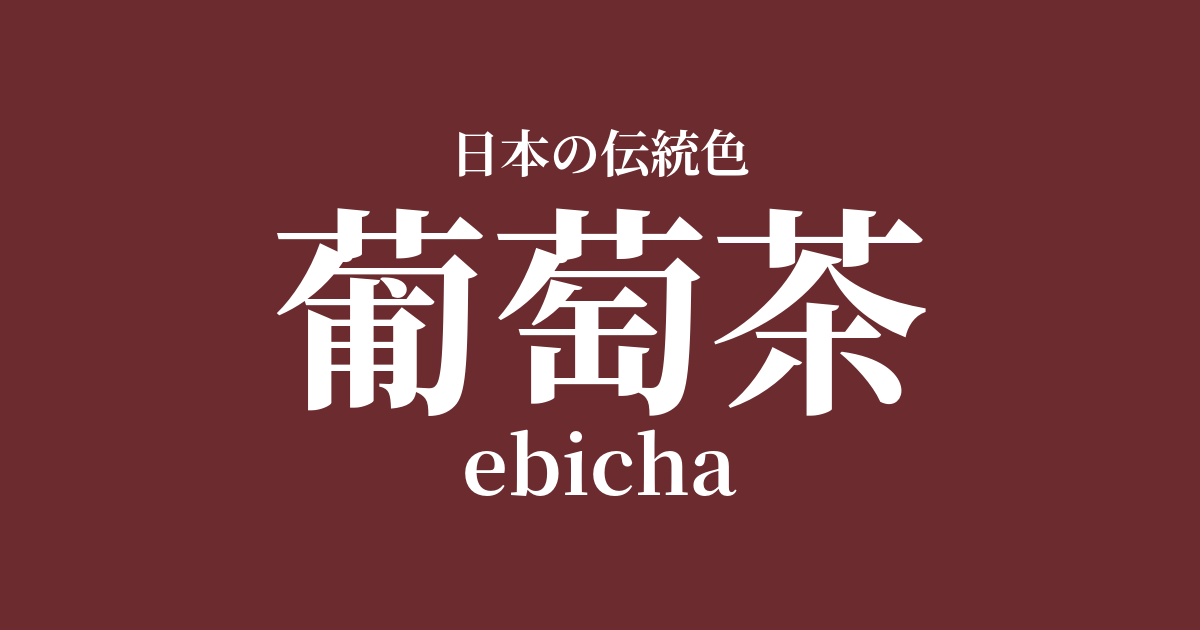
| Japanese color name | grape tea |
|---|---|
| reading | ebicha |
| HEX | #6C2C2F |
| RGB | 108, 44, 47 |
What is grape tea? Origin and etymology
Ebicha (葡萄茶) is a traditional Japanese color referring to a reddish-dark brown. Its name comes from its resemblance to the color of the skin of wild grapes. The reading of "葡萄" as "ebi" comes from the fact that the old name for wild grapes was "ebikazura," which is said to have been named because its vines twist and turn like the antennae of a shrimp. This "ebikazura" was later shortened, and "ebi" became established as a word to refer to wild grapes.
Contrary to its name, it is said that wild grapes were not actually used as a dye in the dyeing process. In Edo period dyeing techniques, it is believed that this deep reddish-brown color was achieved by combining red plant dyes such as madder and sappanwood with brown dyes such as chestnut bark and bayberry, and then treating them with an iron-containing mordant. It is one of the colors created through the ingenuity of the dyers of that time.
Historical background of grape tea
Grape tea became popular in the mid-Edo period, particularly during the Genroku era (1688-1704). The person who sparked this trend was the Kabuki actor Ichikawa Danjuro I. Because he favored using this color for his stage costumes, it became explosively popular among the common people and came to be known by the alternative name "Danjuro tea." This color became widely cherished as a symbol of the "chic" and sophisticated style of Edo at the time.
The shogunate at the time frequently issued sumptuary laws to curb the extravagant clothing of commoners. As a result, people avoided bright colors and developed a culture of finding and enjoying subtle differences in shades such as brown and gray. This is reflected in the phrase "forty-eight shades of brown and one hundred shades of gray," and grape brown is one of these diverse shades of brown that became refined within the townspeople's culture of Edo.
Related literature, waka poetry, and seasonal words
Grape-colored tea frequently appears in literary works and ukiyo-e prints depicting the customs of the Edo period. For example, in Ihara Saikaku's ukiyo-zoshi, which depicts the townspeople's society of the Genroku era, it is sometimes mentioned as a fashionable color of the time. Through these works, we can see that grape-colored tea was deeply rooted in the lives and fashion of people at that time. The depiction of colors in literary works is an important clue in understanding the culture and values of that era.
Furthermore, in ukiyo-e prints, especially actor portraits, this color is often used in the costumes of works depicting Ichikawa Danjuro. This has visually established the image of grape tea as "Danjuro tea." While "grape tea" itself is not a seasonal word, "grape" (budou), from which it is derived, is a seasonal word for autumn, and the color evokes the season of harvest and a sense of maturity.
Color scheme preview
This is to check the readability of the text when this color is used as the background.
Grape tea color scheme proposal
Pine green (#839B5C)
The reddish hue of grape tea and the calm green of pine needles complement each other, creating a near-complementary color relationship. This color scheme, reminiscent of plants in nature, creates a classic yet vibrant harmony. It's a combination that gives a traditional and elegant impression in the design of Japanese clothing and accessories.
Mustard color (#D1A553)
The deep grape brown, combined with a bright, slightly muted mustard yellow, achieves a balance of vibrancy and tranquility. This stylish color scheme evokes the "chic" of Edo-period Japan and is an eye-catching combination often seen in Kabuki costumes. It is also well-suited to modern Japanese designs.
White training (#FCFAF2)
When paired with pure white tea, the richness and depth of color of grape tea are highlighted. The contrast is clear, yet the yellowish softness of the white tea gives an elegant impression. It's a simple and sophisticated combination that's easy to apply to modern designs.
Practical Scenes
In the world of traditional Japanese clothing, grape-colored tea has been a popular color since the Edo period, giving a sophisticated and refined impression. While often used in men's kimonos, haori jackets, and obi sashes, it can also be incorporated into women's obi sashes and accessories to create a refined, mature look. It's one of the most suitable colors for occasions involving traditional Japanese culture, such as attending a Kabuki performance.
In interior design, incorporating it into accent walls, curtains, cushions, and other fabrics brings a sense of depth and tranquility to a space. It pairs exceptionally well with natural materials such as wooden furniture, tatami mats, and washi paper, contributing to the creation of a modern Japanese space. With careful lighting, the depth and nuances of the color can be expressed more richly.