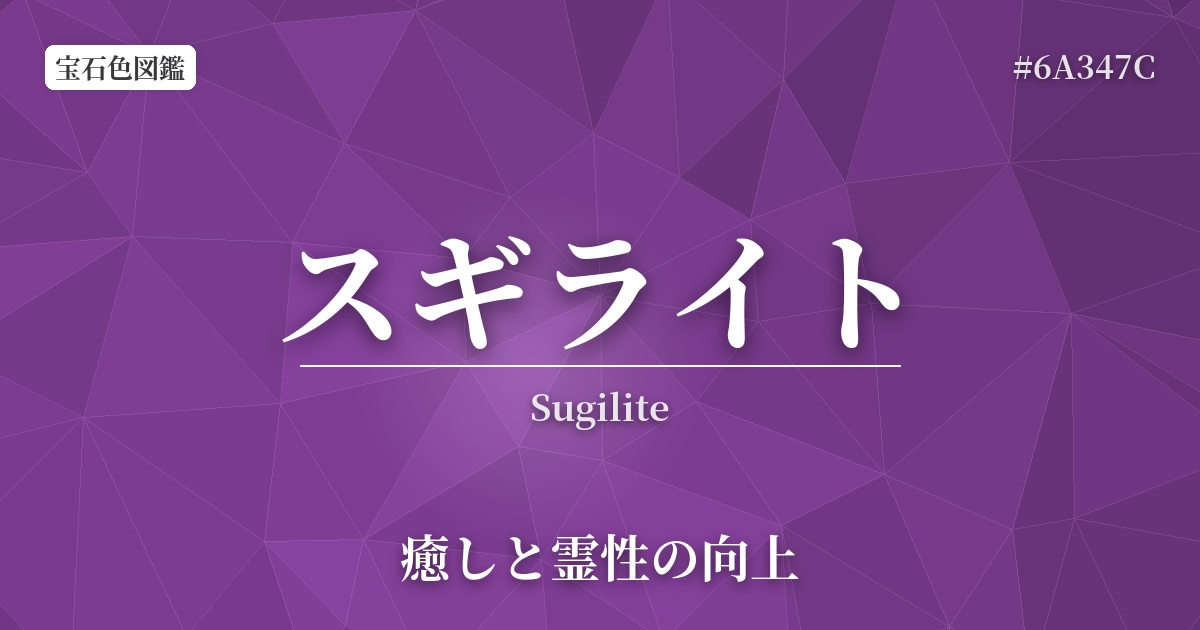
| English name | Sugilite |
|---|---|
| Katakana | Sugilite |
| HEX | #6A347C |
| RGB | 106, 52, 124 |
| Mineralogy | Silicate minerals |
What is Sugilite? Origin and Mineralogy
Sugilite derives its name from its discovery in 1944 on Iwagi Island in the Seto Inland Sea by Japanese petrologist Kenichi Sugi. Initially, it was not recognized as having any value as a gemstone, but in the 1970s, the discovery of beautiful purple specimens at the Wiesel mine in South Africa brought it worldwide popularity. It is a gemstone with deep ties to Japan, bearing the name of its discoverer.
As a mineral, it is classified as a silicate mineral with a complex composition containing potassium, sodium, lithium, iron, manganese, and aluminum. Its characteristic purple color is due to the manganese it contains. The color ranges from pale lavender to deep, rich royal purple, and each piece exhibits a unique appearance due to the presence of black matrix rock and other minerals.
Currently, South Africa is the main source of gem-quality sugilite, but production is decreasing year by year, and particularly vibrant and transparent pieces are becoming increasingly rare and valuable. Although production has also been reported in Japan, Canada, and India, most of the sugilite on the market comes from South Africa.
The history and culture of sugilite
Sugilite has a relatively recent history and does not appear in the jewelry of ancient civilizations. However, since its beautiful purple color attracted attention in the latter half of the 20th century, it has become known worldwide, especially with the spread of New Age thought, as one of the most important healing stones discovered in the 20th century.
In particular, it is sometimes referred to as one of the "world's three greatest healing stones," alongside Larimar and Charoite, and its spiritual aspects attract many people. Beyond its beauty as a gemstone, it holds special significance in modern times as a stone that supports inner peace and spiritual growth.
Sugilite and Color Psychology
The deep, noble purple of sugilite has long been considered a color symbolizing spirituality, intuition, and insight. This color is said to guide consciousness to a higher dimension and help deepen the connection with inner wisdom.
As a power stone, sugilite is believed to possess powerful healing properties. It is said to protect its owner from negative energy and shocks from external sources, bringing peace of mind and a sense of security. By alleviating stress and anxiety and balancing emotions, it is believed to support the development of strength to face adversity. It is also said to have a positive influence when one wishes to enhance creativity and inspiration.
Color scheme preview
This is to check the readability of the text when this color is used as the background.
Sugilite color scheme proposal
Lavender (#E6E6FA)
Combining the deep purple of sugilite with a pale lavender color creates a harmonious gradient. It gives a spiritual, calm, and very elegant impression.
Silver (#C0C0C0)
The combination of noble purple and sophisticated silver creates a modern and intellectual atmosphere. The colors complement each other, giving a sharp and stylish impression.
Saffron (#F4C430)
Saffron, a yellowish color close to the complementary color of purple, creates an exotic and vibrant contrast. It's recommended when you want to give off an artistic, confident, and energetic impression.
Practical Scenes
As jewelry, its unique color often makes it a central design element in pendants, brooches, and large rings. It's also popular as a bead for bracelets. However, due to its relatively low hardness, caution is needed when using it in delicate items like rings.
In interior design, incorporating the purple of sugilite as an accent color brings depth, tranquility, and a slightly mysterious atmosphere to a space. Using it in cushions, art, or small decorative items can help create a space conducive to meditation and relaxation.
In web design and graphic design, it is effective as a key color for sites themed around wellness, spirituality, or luxury. It can convey a sense of trust while simultaneously expressing a unique and special worldview.