
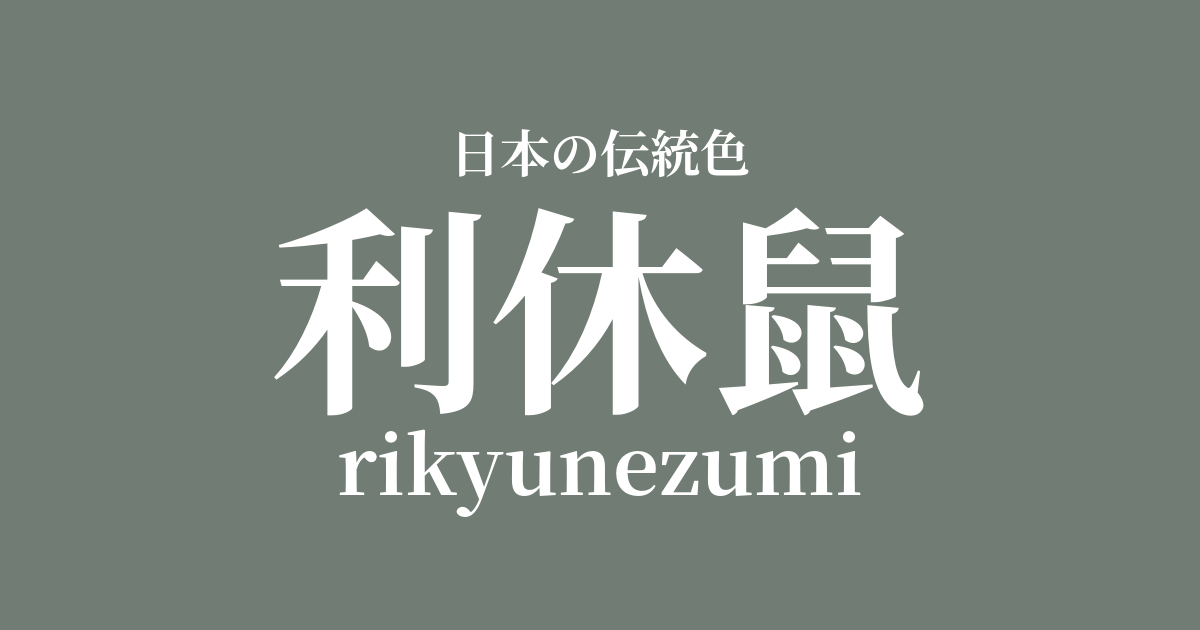
| Japanese color name | Rikyu mouse |
|---|---|
| reading | rikyunezumi |
| HEX | #707C74 |
| RGB | 112, 124, 116 |
What is Rikyu-nezumi? Origin and etymology
Rikyu-nezumi refers to a muted, greenish-gray color. It is said that the name originates from the fact that Sen no Rikyu, a tea master of the Azuchi-Momoyama period, favored this color. However, this color name only appears in literature from the mid-Edo period onward, and there is no conclusive evidence that Rikyu himself was directly involved.
Other colors bearing the name of Rikyu include "Rikyu-cha," and all of them share the common characteristic of being understated and profound hues that reflect the spirit of "wabi-cha," the tea ceremony established by Sen no Rikyu, which is an aesthetic sense that finds beauty in simplicity and tranquility.
The name is said to originate from the fact that it is a color created by mixing the green of matcha tea, which was favored by Rikyu, with the achromatic color mouse gray. It is not just gray, but has a slight hint of green, giving it a unique depth and refined impression. It is one of the colors that symbolizes the "iki" culture of the Edo period, in which people enjoyed finding subtle differences in subdued colors.
Historical background of Rikyu gray
The color name "Rikyu-nezumi" (Rikyu gray) became widely known during the mid-Edo period. At that time, the shogunate frequently issued sumptuary laws, severely restricting commoners from wearing extravagant clothing. As a result, people avoided bright colors and began to wear subdued colors such as brown and gray. However, within these restrictions, people unleashed their creativity and developed a culture of appreciating subtle differences in shades.
This was the color trend known as "Shijūhacchahyakunezumi" (Forty-eight shades of brown and one hundred shades of gray). Rikyu-nezumi was one of the colors that emerged during this trend, and it was loved by the townspeople of Edo not just as a simple gray, but as a stylish, greenish color. It is said that its popularity increased even further when Kabuki actors used it in their stage costumes. This color has been passed down to this day as a symbol of the Edo aesthetic sense that was born out of constraints.
Related literature, waka poetry, and seasonal words
While the color name "Rikyu-nezumi" (Rikyu gray) appears only briefly in classical literature, the spirit of "wabi-sabi" (a Japanese aesthetic emphasizing simplicity and transience) associated with this color is deeply rooted in many literary works and works of art. For example, the beauty of tranquility and simplicity found in Matsuo Basho's haiku resonates with the worldview evoked by Rikyu-nezumi. Its lack of ostentation, yet its quiet and profound elegance, forms the core of traditional Japanese aesthetics.
In modern Japanese literature, understated, deep colors like Rikyu-nezumi (a type of gray) play an important role in expressing the beauty of traditional Japanese spaces and colors, as discussed by Jun'ichirō Tanizaki in "In Praise of Shadows." Even without direct mention, its calm tone can be said to quietly exist in the background of stories as a color that symbolizes the Japanese landscape and spirituality. Although not designated as a seasonal word, it is sometimes treated as a color that evokes the tranquility of autumn or the atmosphere of winter.
Color scheme preview
This is to check the readability of the text when this color is used as the background.
A proposed color scheme using Rikyu gray.
White tea (#B59775)
The greenish-gray of Rikyu-nezumi and the bright, soft brown of Shiro-cha harmonize to create a natural and calming impression. This elegant and refined color scheme is well-suited to expressing the world of wabi-sabi. The colors complement each other, creating a gentle and refined atmosphere.
Deep scarlet (#822932)
Against the tranquil tones of Rikyu gray, the deep, vibrant red of deep crimson provides a powerful accent. The colors complement each other, creating a modern and striking space. It's a traditional yet bold combination that effectively draws attention.
White training (#F3F3F3)
By combining it with a nearly white shade of white, the subtle green hue of Rikyu-nezumi stands out. It creates a clean and sophisticated atmosphere, making it suitable for minimalist and modern designs. The color scheme has a clear contrast, giving a clean and intellectual impression.
Practical Scenes
In the world of kimono, Rikyu-nezumi (a shade of gray) is used in Edo-komon (a type of patterned kimono), solid-colored kimonos, and obi (sashes), creating a stylish and refined look. Because of its understated color, it's easy to add accents with the color of the obi or obi-jime (sash cord), allowing for a wide range of coordination possibilities. It's particularly popular as a color for men's kimonos and haori (jackets), conveying a sense of calm and mature dignity.
In interior design, incorporating it into wallpaper, curtains, sofas, and other fabrics can create a quiet and calming space. It blends naturally into both Japanese-style rooms and modern Western-style rooms. It also pairs well with other materials such as wood, stone, and metal, helping to create a high-quality and relaxing atmosphere.
In web and graphic design, using these colors as background or main colors creates an elegant and trustworthy impression. They also have the advantage of being easy on the eyes and reducing eye strain during prolonged viewing. Adding a small amount of a vibrant color as an accent color allows for the creation of sophisticated and modern designs.