
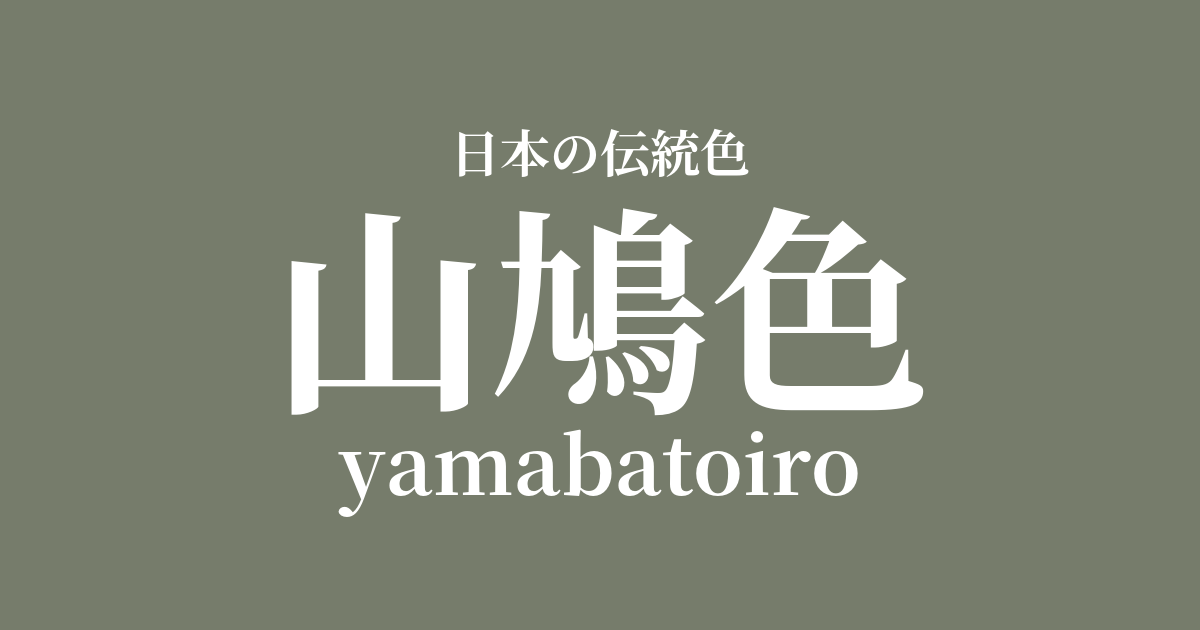
| Japanese color name | Dove color |
|---|---|
| reading | yamabatoiro |
| HEX | #767C6B |
| RGB | 118, 124, 107 |
- What is "mountain dove color"? Origin and etymology.
- Historical background of the color of the mountain dove
- Related literature, waka poetry, and seasonal words
- Color scheme preview
- A proposed color scheme in the color of a mountain pigeon.
- Practical Scenes
- FAQ
- A Japanese color similar to the color of a mountain dove.
What is "mountain dove color"? Origin and etymology.
As the name suggests, "mountain dove gray" is a dark gray with a greenish tint, derived from the color of the feathers of the mountain dove (Oriental turtle dove). In particular, it captures the complex hue seen on the neck and back of the mountain dove, which shimmers with green and purple depending on the light. It is said to be derived from "hatoba-nezumi," a purplish-gray color that was popular during the Edo period, and is characterized by a stronger green tint than hatoba-nezumi.
This color can be said to be one of the colors that symbolizes the delicate sense of color of the Japanese people, who accurately capture the subtle hues of the natural world and give them their names.
This color is not simply gray, but possesses a unique depth and tranquility due to the inclusion of a gentle green that evokes the breath of life. Its hue, reminiscent of a wild dove quietly standing in the mountains and fields, resonates with the Japanese aesthetic of stillness and wabi-sabi. Though not flashy, it is a refined color that never grows tiresome, and has long been an integral part of people's lives.
Historical background of the color of the mountain dove
The name "mountain dove color" is believed to have become commonly used from the mid-Edo period onward. During this time, the variations in brown and gray increased so dramatically that the phrase "forty-eight shades of brown and one hundred shades of gray" was coined, and people enjoyed the subtle differences in shades. In particular, during the Bunka-Bunsei period (1804-1830), "dove gray" became extremely popular after the actor Ichikawa Hyakujuro used it for his stage costumes.
The color "Yamabato-iro" (mountain dove gray) is thought to be one of the colors that originated from the popularity of "Hatoba-nezumi" (dove gray). Compared to the purplish Hatoba-nezumi, Yamabato-iro, which evokes a more natural green, was widely loved as a sophisticated color by people from the common people to the samurai class. Even when bright colors were restricted by sumptuary laws, these subtle intermediate colors developed as a way to enjoy fashion and enriched Japan's color culture.
Related literature, waka poetry, and seasonal words
While it's difficult to pinpoint any ancient literary works that directly use "mountain dove color" as a color name, the mountain dove itself has long been a motif in the world of Japanese poetry (waka). Along with its distinctive calls, such as "horohoro" and "dedepoppo," the mountain dove appears as a bird that expresses peaceful rural landscapes, and sometimes even a sense of melancholy. It is especially often used as a seasonal word in haiku, particularly in summer.
For example, the Kokin Wakashū (Collection of Ancient and Modern Japanese Poems) contains a poem in which the poet identifies with the solitary state of the poet through the cooing of a turtle dove. In this way, the gentle and somewhat melancholic image of the turtle dove is deeply connected to the calm and tranquil impression that the color turtle dove itself evokes. It is thought that the familiarity with the bird nurtured through literary works led to an affection for the color name.
When I hear the soft cooing of the wood pigeons, I feel sorrowful at my own loneliness.
Color scheme preview
This is to check the readability of the text when this color is used as the background.
A proposed color scheme in the color of a mountain pigeon.
White tea (#A38F7B)
Both are earth tones found in nature, giving a calm and harmonious impression. The calmness of the turtle dove color and the warmth of the off-white tea combine to create a natural and sophisticated atmosphere. This color scheme is easy to use in both Japanese and Western styles.
Wisteria color (#BBAADD)
The combination with wisteria purple, reminiscent of the purplish sheen of a wood pigeon's feathers, creates a refined and understated impression. The color scheme is both classic and modern.
Rusty light green (#698289)
Both colors are muted (grayish tones), creating a harmonious color scheme. The green of the mountain dove and the blue of the rusty light blue complement each other, giving an intelligent, cool, and profound impression. It is suitable for a calm, mature atmosphere.
Practical Scenes
In the world of traditional Japanese clothing, the color of the mountain dove is considered a calm and dignified color and is used in kimonos, haori jackets, and obi sashes. In particular, it is favored in men's kimonos as a color that gives a subtle yet stylish impression. When used as an accent in accessories such as obi ties and han-eri collars, it also has the effect of tightening the overall look of the outfit.
In interior design, using this color on large areas such as wallpaper, curtains, and sofas creates a calm and relaxing space. It pairs exceptionally well with wooden furniture and houseplants, and harmonizes well with natural modern and Japanese modern styles. It is suitable for creating a peaceful study or bedroom color scheme.
In web design and graphic design, using it as a background color can enhance content while conveying an impression of reliability and stability. It is also effective as a key color for websites themed around nature, tradition, or health, or for brands that want to project a sense of luxury.