
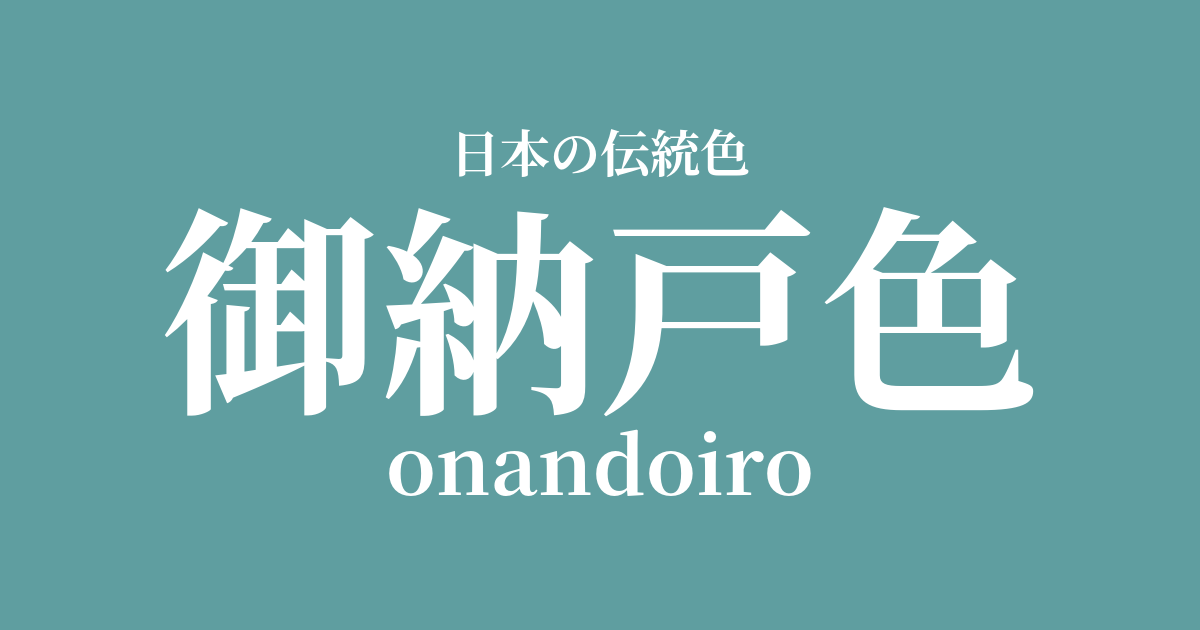
| Japanese color name | Onando color |
|---|---|
| reading | onandoiro |
| HEX | #5F9EA0 |
| RGB | 95, 158, 160 |
What is Onando-iro? Origin and etymology
The "nando" in "onando-iro" refers to a room used for storing clothes and furnishings. It is believed that the name originates from the color of the curtains and furoshiki (wrapping cloths) that were hung in the nando rooms of Edo Castle's inner palace and samurai residences. In particular, a strong theory suggests that the honorific prefix "go" was added because it was used in the shogun's nando room, hence the name "onando-iro."
This color is a type of indigo dye, where a deep indigo dye is first applied, and then a small amount of yellow dyes such as Phellodendron amurense or Japanese knotweed are added on top to create a unique greenish-blue color.
The historical background of the dark blue color
Onando-iro (a shade of brown) was a popular color from the mid-Edo period onward. In particular, during the Bunka-Bunsei period (1804-1830), sumptuary laws restricted commoners from wearing bright colors. As a result, a trend called "Shijuhachichahyakunezumi" (48 shades of brown and 100 shades of gray) emerged, where people enjoyed subtle differences in shades of subdued colors such as brown and gray. Onando-iro was one of these colors and was widely loved by the common people of Edo.
It is said that Kabuki actors had a significant influence on the popularity of this color. The popular actor Ichikawa Danjuro V used this color in his stage costumes, which became famous and solidified the popularity of "nando-iro" (a type of dark blue) among the common people. Furthermore, many derivative colors such as "sabi-nando" (rusty dark blue) and "tetsu-onando" (iron dark blue) were created, conveying to the present day the refined sense of color of the people of Edo.
Related literature, waka poetry, and seasonal words
Onando-iro (a shade of blue) frequently appears in literary works and ukiyo-e prints depicting the customs of the Edo period. In humorous novels and sentimental novels, it is often depicted as the color of the stylish kimonos worn by the characters, reflecting the fashion trends of the time. Although it is not directly designated as a seasonal word, it is sometimes mentioned in poetry as the color of summer kimonos and yukata, suggesting that it was perceived as a color that gave a cool impression.
In modern literature, Natsume Soseki's novel "Botchan" also features a description of a "deep blue shirt," depicting it as a color symbolic of the era.
Color scheme preview
This is to check the readability of the text when this color is used as the background.
Color scheme proposal in a dark blue color
White Rat (#DCDEE0)
The bright, elegant light gray accentuates the depth of the dark blue, adding a sense of cleanliness and coolness. It creates a simple and modern impression, making it easy to apply to web design and contemporary fashion. It's also an ideal color scheme for expressing the feeling of summer.
Persimmon color (#ED6D3D)
The blue-green of the dark blue-green and the reddish-orange of the persimmon, which are close to complementary colors, enhance each other. This combination evokes the sophistication of Edo, achieving both vibrancy and tranquility. It is particularly effective when used for accessories or as an accent color.
Indigo (#165E83)
Combining this dark blue with indigo, a color from the same indigo dye family as the dark blue, creates a unified and calm impression. The varying shades of color create depth, giving off an intelligent and sophisticated atmosphere. This color scheme is suitable for traditional Japanese clothing and elegant designs.
Practical Scenes
In the world of traditional Japanese clothing, dark blue is a popular color for both men and women. It is particularly used in men's kimonos and haori jackets, and women's yukata and obiage sashes, giving a stylish and cool impression. Its subdued hue makes it easy to harmonize with other colors, and it is favored by a wide range of ages.
In interior design, using it as an accent color brings depth and tranquility to a space. Using it on one wall of wallpaper, curtains, or cushions creates a sophisticated, modern Japanese atmosphere. It pairs particularly well with white, beige, and natural wood-grain materials.
In the fields of web design and graphic design, it is used as a color that conveys trustworthiness and intelligence. It is sometimes chosen as a corporate color or key color for a company's website, and its exquisite shade, which is neither too flashy nor too plain, gives users a sense of security and a sophisticated impression.