
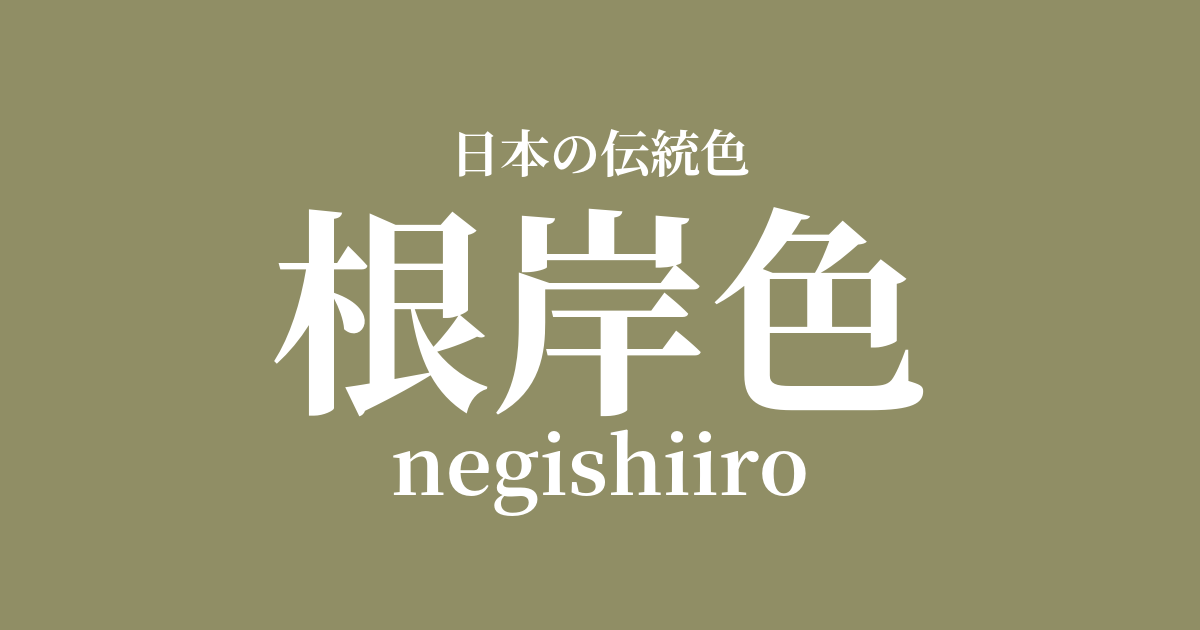
| Japanese color name | Negishi color |
|---|---|
| reading | negishiiro |
| HEX | #908E65 |
| RGB | 144, 142, 101 |
What is Negishi color? Origin and etymology
Negishi-iro is a muted yellowish-green that was popular in the mid-Edo period and is classified as a type of "uguisu-cha" (nightingale tea). There are several theories about the origin of its name, but one is that it was named after Kaya Shirao, a haiku poet who lived in Negishi, Edo (present-day Taito Ward, Tokyo), and who favored this color. Shirao was also known as the "hermit of Negishi," and it is said that his refined personality, along with the subdued and calming colors he favored, spread among the common people of Edo.
This color possesses both a tranquil quality that blends seamlessly into natural landscapes and a sophisticated, refined sensibility that appeals to connoisseurs.
Another theory suggests that the color was named "Negishi color" because it was a favorite color of Ichikawa Danjuro III, a Kabuki actor who also lived in Negishi. Danjuro was an immensely popular actor, and the colors of the kimonos he wore quickly became fashionable colors throughout Edo. It is uncertain which theory is correct, but in any case, both theories share the commonality that the name of the color originates from Negishi, a center of Edo's culture, and the aesthetic sensibilities of the cultural figures who lived there.
Historical background of Negishi color
Negishi-iro is said to have been a particularly popular color during the mid-Edo period, from the Hōreki to the Meiwa era (1751-1772). During this time, townspeople's culture reached its peak, and kabuki and ukiyo-e were widely enjoyed as entertainment for the common people. In fashion, partly due to the sumptuary laws, subdued, muted intermediate colors, such as the "48 shades of brown and 100 shades of gray," were considered more stylish than flashy primary colors.
Negishi-iro was one of the colors that represented the trend, and its deep, understated hue was embraced by people as a color that embodied the Edo aesthetic. It was mainly used as a color for kimonos, and is thought to have been associated with the "uramasari" culture, which emphasized attention to detail in unseen parts such as the lining of haori jackets. This color reflects the delicate sense of color of the Japanese people, who appreciate the colors of nature and enjoy subtle differences in shades.
Related literature, waka poetry, and seasonal words
No famous waka or haiku directly mention the color name "Negishi-iro" (Negishi color). However, the haiku poet Kasha Hakuo, who is said to be the origin of this color, left behind many poems, and his works are imbued with a view of nature and the spirit of wabi-sabi that resonates with Negishi-iro. Furthermore, the nightingale, the source of the color's image, has long appeared in many literary works as a seasonal word for spring and has been cherished as a symbol announcing the arrival of spring.
The muted green of Negishi-iro perfectly captures the colors of the mountains and fields in early spring when young leaves begin to sprout, and it also overlaps with the color of the plum and willow branches that nightingales like to perch on. In Edo period humorous and satirical books, the colors of the characters' clothing were sometimes depicted as the fashionable colors of the time, and it is possible that Negishi-iro was depicted in such works as a color symbolizing the "chic" or "sophisticated" style of Edo.
Color scheme preview
This is to check the readability of the text when this color is used as the background.
Negishi-color scheme proposal
Aphrodisiac tea (#715C1F)
Like Negishi-iro, this is a popular shade of brown during the Edo period. Combining similar colors creates a calm and harmonious depth. It's a sophisticated and refined color scheme that evokes the "chic" of Edo, a favorite among connoisseurs.
White training (#FEFBF4)
Shironeri is a slightly yellowish shade of refined silk. When paired with muted colors like Negishi-iro, it enhances the beauty of both colors, creating a clean and elegant look. The resulting contrast gives a neat and tidy impression.
Rusty light green (#839B97)
The muted blue-green of Sabiasagi is adjacent to the equally muted yellow-green of Negishi-iro, creating a harmonious, natural gradient. It exudes a sense of coolness amidst its calmness, creating an intelligent and serene atmosphere.
Practical Scenes
In the world of traditional Japanese clothing, Negishi-iro is a sophisticated color favored by connoisseurs, used in plain kimonos, haori jackets, obi sashes, and patterned kimonos. It is particularly often chosen for men's kimonos and for women who prefer a more subdued look. While not flashy, it enhances the texture of the material and creates an elegant and dignified appearance.
In interior design, incorporating this color into wallpaper, curtains, and furniture upholstery can create a calm, modern Japanese space. It pairs exceptionally well with natural materials such as wood, bamboo, and washi paper, making it ideal for coordinating relaxing study or bedroom spaces. Using it as a base color, rather than an accent, adds unity and depth to the entire space.
In web and graphic design, using it as a background or main color can convey images of trustworthiness, tradition, and nature. It is particularly effective as the brand color for established websites, organic products, and traditional crafts. Its versatility, which allows it to appear both modern and classic depending on how it is combined with other colors, is also a major appeal.