
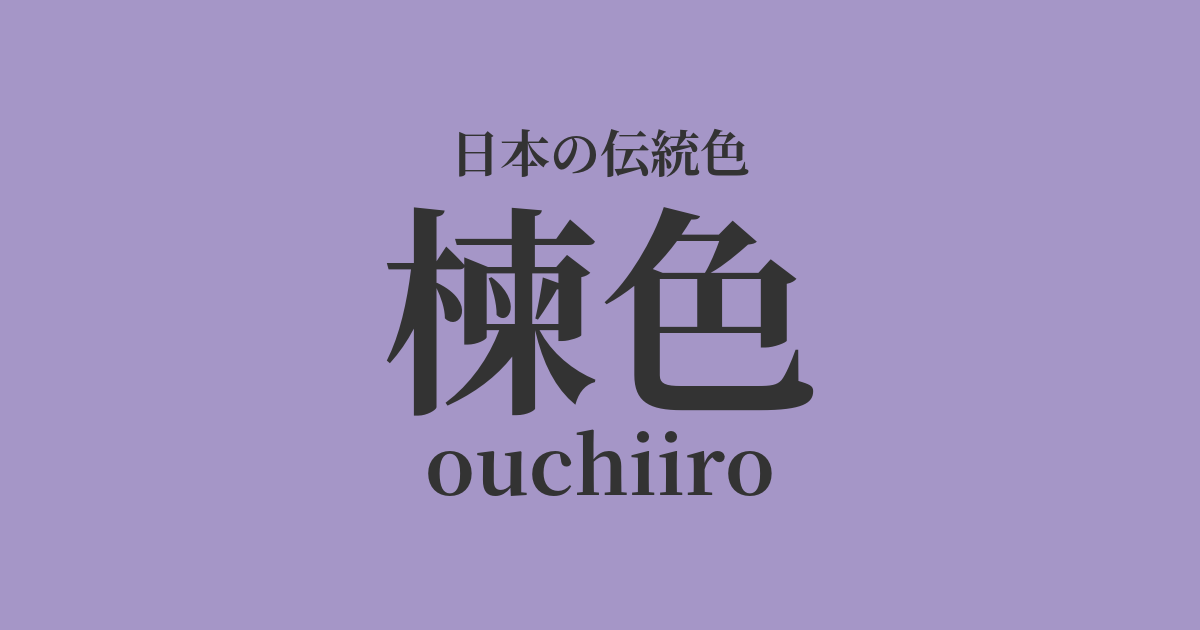
| Japanese color name | Maroon color |
|---|---|
| reading | ouchiiro |
| HEX | #A596C7 |
| RGB | 165, 150, 199 |
What is the color of the chinaberry tree? Origin and etymology.
"Needle color" refers to a pale bluish-purple color, like the flowers of the needle tree (also known as uchi or sendan) that bloom in early summer. In ancient times, it was also called "auchi," and the name can be found in the Manyoshu, an ancient collection of Japanese poetry. This elegant color was deeply loved by the aristocracy of the Heian period. It is said that the flowers, fruits, and bark of the needle tree were used as dyes, but it seems that it was difficult to consistently produce this color.
Therefore, it is possible that this color was achieved by combining the root of the gromwell plant (shikon) or other dyes.
The historical background of the chinaberry color
The color neem blue is widely known for its appearance in "The Pillow Book," a masterpiece of Heian period literature. Sei Shonagon praised the beauty of the neem flower, writing, "Even the leaves of the neem tree are a very cool blue, and the flowers themselves are a very lovely color." The book also describes noble people wearing neem blue fabrics in the summer, establishing its status as a noble color symbolizing the summer season.
The Engishiki (a historical document) mentions "Ouchi no Aya" as the color of the robe worn by the emperor in summer. This refers to a twill fabric dyed in the color of the chinaberry tree, indicating that this color was considered important enough to be used in formal court settings. Thus, chinaberry was not merely a fashionable color, but a color with special significance in the color culture of the Heian period.
Related literature, waka poetry, and seasonal words
The color chinaberry appears not only in "The Pillow Book" but also in "The Tale of Genji." In the chapter "Wisteria Leaves," there is a scene in which Hikaru Genji presents his son, Yūgiri, with a chinaberry-colored court robe. This depiction was used as an effective technique to express the character's elegance and refined taste, along with a sense of the season. In literary works, chinaberry plays a role in conveying to the reader the arrival of early summer and the elegant atmosphere that accompanies it.
Furthermore, in the world of haiku, "Neem blossoms" are firmly established as a seasonal word for summer. Their delicate and ephemeral beauty has been celebrated by many haiku poets, becoming an important element in expressing the changing seasons and scenery. They also appear in the poems of Matsuo Basho and Yosa Buson, adding color to the expression of seasonality in Japanese poetry.
The chinaberry blossoms my sister saw will surely scatter, yet my tears have not yet dried.
Color scheme preview
This is to check the readability of the text when this color is used as the background.
A proposed color scheme in chinaberry green.
White training (#FEFBF4)
The elegance and coolness of the chinaberry color are enhanced by the purity of the white. This color scheme evokes the summer attire of Heian-era nobles, creating a classic and refined impression. It is suitable when you want to achieve both cleanliness and elegance.
Young leaf color (#B5D36A)
This color scheme expresses the contrast between the pale purple flowers and lush green leaves of the chinaberry tree. It gives a refreshing and vibrant impression of early summer, creating a natural and bright atmosphere. It's a combination that evokes the beauty of nature.
Wisteria color (#BBADDE)
Like the chinaberry color, the wisteria color, derived from the flower of a plant, is a similar shade of purple. It creates a natural harmony like a gradient, evoking an elegant and refined Japanese aesthetic. It is a color scheme that is both calm and vibrant.
Practical Scenes
In the world of traditional Japanese clothing, the neem color is favored for summer kimonos, obi sashes, and accessories such as obiage (sash ties). Its cool and elegant hue is perfect for the season of unlined or lightweight garments, giving the viewer a refreshing impression. It is also a popular pattern for yukata (summer kimonos), possessing a classic yet timeless appeal.
In interior design, incorporating it as an accent in curtains, cushions, or wallpaper brings a sense of calm and elegance to the space. It pairs particularly well with natural interiors in white, beige, or wood tones, easily creating a sophisticated Japanese modern atmosphere.
In web and graphic design, using this color as an accent color gives the entire site a sophisticated and intellectual impression. It is particularly suitable for e-commerce sites dealing with traditional crafts, brands that emphasize luxury, and media outlets that disseminate cultural content.