
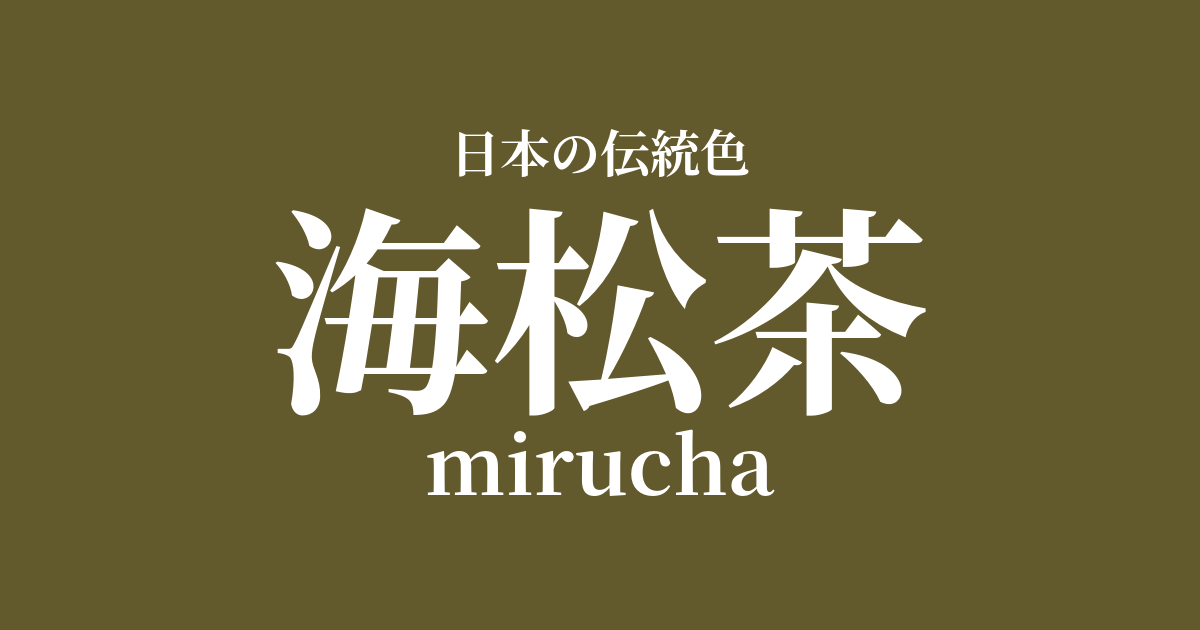
| Japanese color name | sea pine tea |
|---|---|
| reading | mirucha |
| HEX | #62592C |
| RGB | 98, 89, 44 |
What is Mirucha? Origin and Etymology
As its name suggests, Miru-cha (海松茶) derives its name from the color of "miru," a type of green algae that inhabits shallow seas. Miru has long been a familiar seaweed to the Japanese, used as food and as decorations during the New Year. Miru-cha is a blend of the dark yellowish-green color of this miru and the brown hues that were popular during the Edo period. The word "cha" (茶) is used not only to refer to brown, but also to muted colors in general, and Miru-cha falls into this category.
Historical background of seaweed tea
Mirucha (seaweed brown) became widely known during the mid-Edo period. As a result of the shogunate's sumptuary laws prohibiting commoners from wearing extravagant clothing, a culture emerged of finding and appreciating subtle differences within subdued and muted colors such as brown and gray. Mirucha was one of the fashionable colors known as "Forty-eight Browns and One Hundred Grays," symbolizing the refined aesthetic sense of the people of that time.
It is said that the popularity of this color was greatly influenced by Kabuki actors. In particular, the first Iwai Hanshiro, who was very popular as an onnagata (female impersonator), favored using it in his stage costumes, and it came to be known by the nickname "Hanshiro-cha" (Hanshiro's tea). As the color worn by popular actors became an object of admiration for the common people, seaweed tea became widely used in Edo.
Related literature, waka poetry, and seasonal words
The word "umimatsu" itself is ancient and has been used in waka poetry since the Manyoshu era. It is often used as a pun on "miru" (to see) and is frequently used to express feelings for a lover. The expression "umimatsu-iro" (umimatsu color) can be found in literary works from the Heian period, but the color name "umimatsu-cha" (umimatsu tea), which is still used today, was established as a fashionable color during the Edo period. As a seasonal word, umimatsu is used to represent summer.
Whenever I see the seaweed my beloved is wearing, I think, "Stay here, my beloved, do not reveal my name."
Color scheme preview
This is to check the readability of the text when this color is used as the background.
Seaweed tea color scheme proposal
Uguischa (#715C1F)
This combination of colors with similar shades of green creates a natural and calming harmony, emphasizing a Japanese aesthetic. It's a sophisticated and deep color scheme that appeals to connoisseurs.
Blue gold (#FABE22)
By combining a dark, subdued seaweed tea with a vibrant, bright turmeric color, the two colors complement each other. The result is a traditional yet modern and elegant impression, creating an eye-catching accent.
Suou (#9E3D3F)
The greenish-green seaweed tea and the reddish-brown sappanwood are close to complementary colors, creating a strong contrast. This color scheme has a classic and elegant feel, and it has the effect of highlighting the depth of each color.
Practical Scenes
Because it was a popular color during the Edo period, it is still commonly used today in traditional Japanese clothing accessories such as kimonos, obi sashes, and obi ties. It creates a sophisticated and refined atmosphere and is particularly favored in men's kimonos and the attire of discerning women.
In interior design, incorporating it into wallpaper, curtains, cushions, and other fabrics can create a calm, modern Japanese-style space. It pairs well with natural materials such as wood and bamboo, making it ideal for places where you want to relax, such as a study or bedroom.
In web design, using it as a background or accent color can give a site a sense of luxury or traditional image. It is particularly suitable for websites of long-established shops, traditional crafts, and Japanese restaurants.