
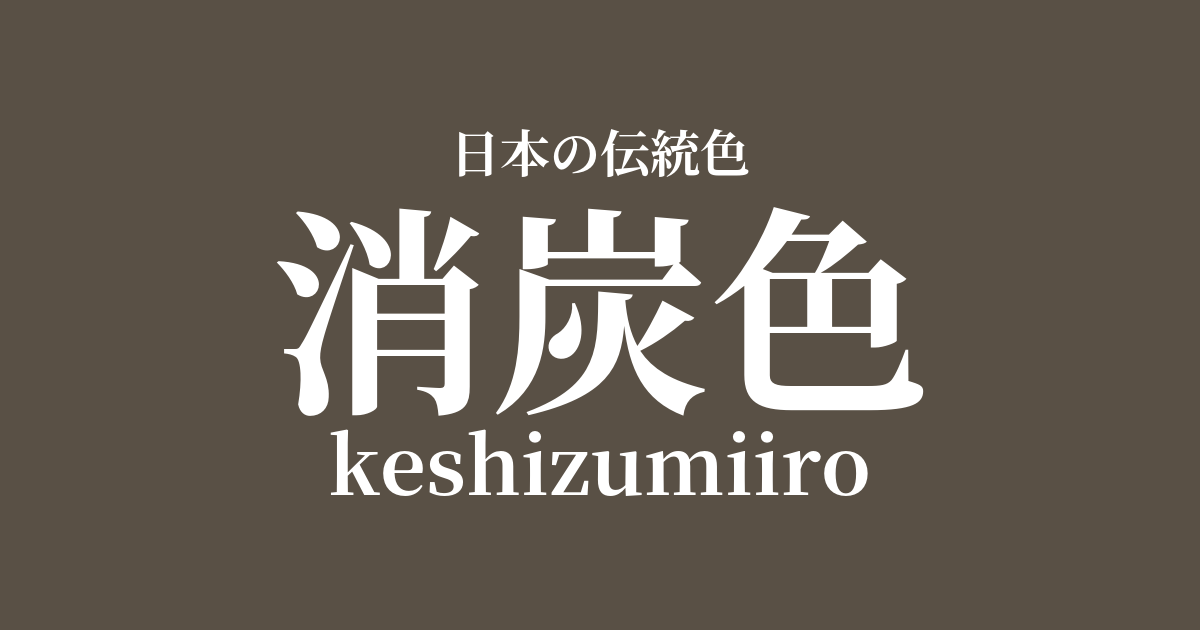
| Japanese color name | Charcoal brown |
|---|---|
| reading | keshizumiiro |
| HEX | #595045 |
| RGB | 89, 80, 69 |
What is charcoal gray? Origin and etymology.
The term "kessumi-iro" (消炭色), as the name suggests, originates from the color of charcoal after it has burned out. Charcoal, once the fire has died down, is not completely black, but has a unique, slightly grayish hue. It is believed that the Japanese, with their refined sensibilities, captured this common, naturally occurring color and established it as a color name. Especially during the Edo period, under the influence of sumptuary laws, subdued colors were favored, and subtle variations in shades of gray were appreciated.
Charcoal gray is one such color that has become integrated into people's lives.
Historical background of charcoal gray
The term "charcoal gray" first appears in literature during the Edo period. During this time, the shogunate frequently issued sumptuary laws, restricting commoners from wearing brightly colored clothing. As a result, people began to find subtle differences in shades of muted colors such as brown and gray, and a culture emerged that appreciated this as "chic" or "refined."
As exemplified by the phrase "forty-eight shades of brown and one hundred shades of gray," a great many variations of brown and gray were created, and charcoal gray was one of the colors that became widely used during that trend.
Related literature, waka poetry, and seasonal words
While there aren't many waka or haiku poems that directly mention charcoal gray, this color is deeply rooted in Edo period literature and culture. For example, in Ihara Saikaku's ukiyo-zoshi and Chikamatsu Monzaemon's joruri plays, the lives of townspeople are depicted, and gray-ish colors frequently appear in their clothing. Charcoal gray is thought to have played an important role in conveying the customs of the time as a stylish color that adorned the daily lives of ordinary people.
Furthermore, "charcoal" is a seasonal word associated with winter, and the color of charcoal is sometimes seen as a color that evokes the stillness and wabi-sabi atmosphere of winter.
Color scheme preview
This is to check the readability of the text when this color is used as the background.
A proposed color scheme in charcoal gray.
White training (#F3F3F3)
The deep, calm impression of the charcoal gray is enhanced by the pure, bright white of the off-white. While the contrast is clear, the softness of the off-white creates harmony, resulting in a sophisticated, modern atmosphere. It is used in combinations of kimono obi sashes and obiage (sash ties), and as an accent in interior design.
Silver mouse (#AFB1B4)
Combining charcoal gray with silver gray, which belongs to the same gray family, creates a unified gradient. The varying shades of color express depth and richness, giving a very elegant and calm impression. This color scheme embodies the Edo aesthetic that favored refined elegance and is easily applicable to modern designs.
Persimmon color (#9A5034)
The near-neutral charcoal gray is softened by the reddish-brown of persimmon tannin, adding warmth. This combination evokes natural materials and creates a simple, calming Japanese atmosphere. It is a popular color scheme for expressing the feeling of autumn, as well as for traditional crafts and Japanese-style interior design.
Practical Scenes
Charcoal gray was a popular color for the kimonos and haori jackets of townspeople during the Edo period. Even today, its subdued and calming tone makes it a favorite color for obi sashes, accessories, and especially men's kimonos and haori jackets. Its understated yet dignified hue makes it suitable for formal occasions such as tea ceremonies. Another characteristic is that, being close to achromatic, it harmonizes easily with other colors.
In the field of interior design, incorporating it into wallpaper, furniture, and fabrics brings a sense of weight and tranquility to a space. It also pairs well with modern designs, and when used as an accent color, it can create a sophisticated and chic atmosphere. It also looks beautiful when combined with different materials such as wood, metal, and concrete, making it suitable for creating urban spaces.