
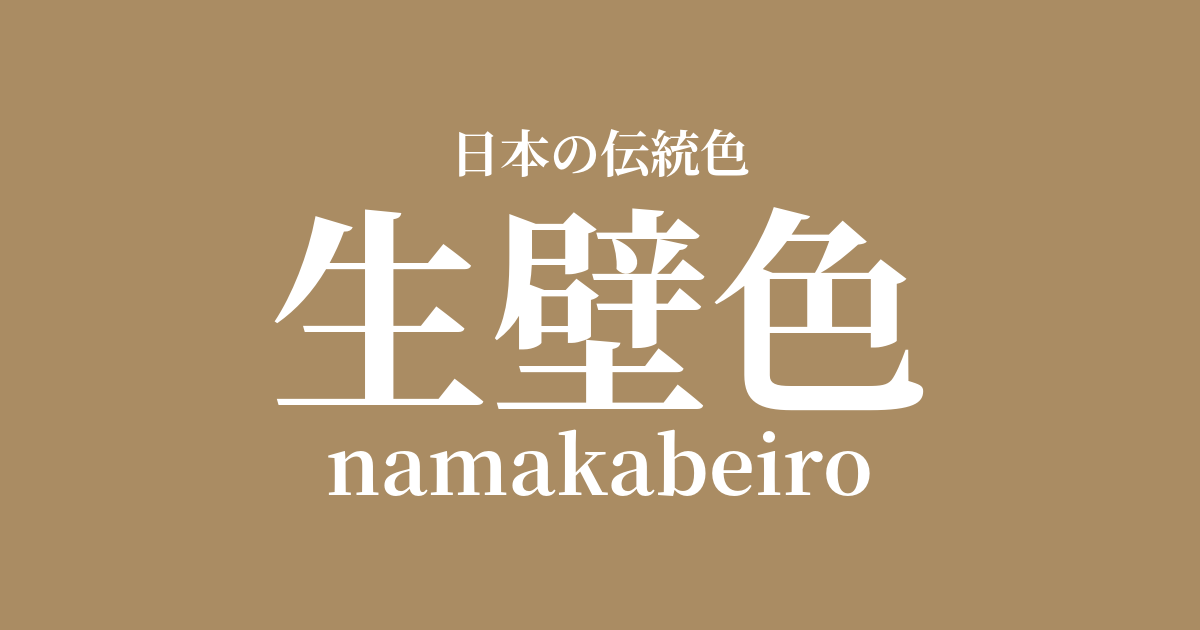
| Japanese color name | raw wall color |
|---|---|
| reading | namakabeiro |
| HEX | #AA8C63 |
| RGB | 170, 140, 99 |
What is "raw wall color"? Origin and etymology
Namakabe-iro (raw plaster color), as the name suggests, derives from the color of earthen walls that are not yet completely dry. Earthen walls used in traditional Japanese architecture are made by mixing earth with straw and sand, kneading it with water, and then applying it to the wall. Namakabe-iro is the slightly reddish-yellowish-brown hue of this wall before it is completely dry and still damp. It is the color of the natural material itself, characterized by its simple and warm texture. It is classified as a brownish-yellowish-brown color.
Historical background of the raw wall color
The term "namakabe-iro" (raw wall color) is considered a relatively new color name, originating in the Edo period. During this era of flourishing townspeople culture, many things familiar to people's daily lives became established as color names, and namakabe-iro is thought to be one such example. In particular, earthen walls were widely used in the construction of commoners' homes, tea rooms, and castles, and the color of the walls during the drying process was a part of the everyday landscape. It is a color name more often used in contexts related to architecture and plastering than in the context of dyeing.
Related literature, waka poetry, and seasonal words
The color of earthen walls is rarely directly used as a subject in waka or haiku poetry. However, it is believed to have played an important role as a background color that conveys the atmosphere of houses and buildings in Japanese literary works. For example, the color of earthen walls is an indispensable element when describing the wabi-sabi atmosphere of a tea room or the simple life of a farmer. Although it does not exist as a seasonal word, as a color rooted in architecture and daily life, it evokes images of Japanese culture.
Color scheme preview
This is to check the readability of the text when this color is used as the background.
Color scheme proposal for natural wall colors
Indigo (#165E83)
The warmth of the earthy color of the raw plaster and the deep blue of the indigo complement each other beautifully. This color scheme, often seen in traditional Japanese houses and noren (curtains), gives an impression of calmness and dignity. The combination of natural material colors creates a harmonious effect.
White tea (#B59775)
Both the natural plaster color and the off-white tea are yellowish-brown tones, making them a combination of similar hues. They create a natural, gradient-like connection, giving a soft, elegant, and sophisticated impression. They are suitable for creating a sense of unity in Japanese clothing and interior design.
Crimson (#B7282E)
The vibrant crimson red stands out as an accent against the calm, natural wall color. This color scheme evokes a scene of a twilight sky and earth, adding passion and splendor to a warm atmosphere. It's particularly effective as an accent color for Japanese accessories and designs.
Practical Scenes
Natural plaster colors are particularly useful in architecture and interior design due to their origin. Using them for wallpaper, plaster walls, earthen floors, or tiles in Japanese-style rooms creates a natural and calming atmosphere. They also pair exceptionally well with natural materials such as wood and bamboo.
In the world of kimono, it is sometimes used as the color of obi sashes and accessories. It is not flashy, but it has the ability to complement other colors and is chosen by people who prefer a stylish and understated look. It is especially considered a color that goes well with simple fabrics such as pongee silk and cotton.
In web and graphic design, it is used as a background color or as part of a color scheme based on earth tones. Because it is a color that conveys warmth and trustworthiness, it is suitable for websites that introduce natural products or traditional services.