
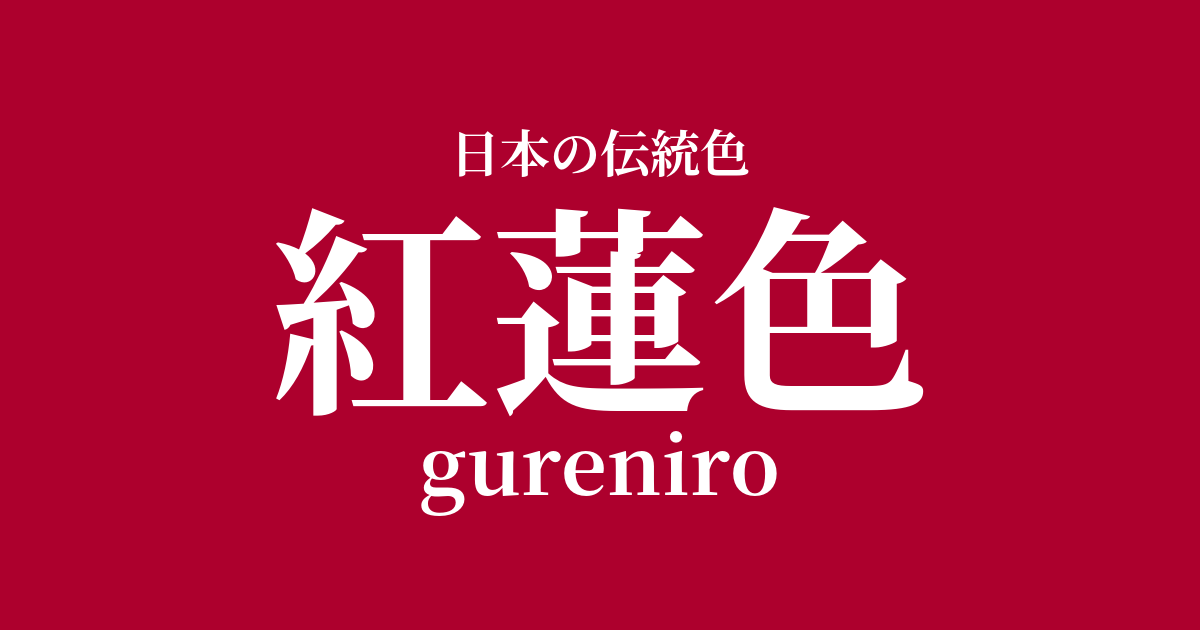
| Japanese color name | Crimson color |
|---|---|
| reading | gureniro |
| HEX | #AD002D |
| RGB | 173, 0, 45 |
What is "crimson lotus color"? Origin and etymology
The term "guren-iro" refers to a deep, vivid red color, like a raging flame. Its origin lies in Buddhist terminology, specifically in "Guren Jigoku" (Crimson Lotus Hell), one of the eight cold hells. This hell was named because the extreme cold caused the skin of the deceased to crack, and the flowing blood resembled a crimson lotus flower. From this terrifying yet beautiful scene, the color of a fiercely burning flame, especially a vivid red reminiscent of a lotus flower, came to be called "guren."
"紅" means a vivid red, and "蓮" means lotus flower; the two characters together express an intense red color.
Crimson historical background
The word "guren" (crimson lotus) itself has existed in Japan since ancient times, along with the introduction of Buddhism, but it is thought that it only became commonly established as a color name relatively recently. There are few examples of "guren-iro" (crimson lotus color) being explicitly written as a color name in Heian and Kamakura period documents. However, in Buddhist art such as depictions of hell, it has been visually represented as the color of raging flames.
Since the modern era, its dramatic and passionate imagery has been favored in literary works and the world of art. In contemporary times, it frequently appears in pop culture, particularly anime and video games, as a character's ability or symbolic color, and has become a widely known color name across generations.
Related literature, waka poetry, and seasonal words
The color crimson, due to its etymology, appears in Buddhist tales and literature. In modern literature, it was effectively used as a metaphor to symbolize intense passion or destructive beauty, as seen in Natsume Soseki's "The Poppy" where it is described as "a sudden burst of crimson flames." In the world of waka and haiku poetry, it is rarely used directly as "crimson," but it is sometimes used in conjunction with "flame," a seasonal word for summer, in phrases such as "crimson flames."
This powerful imagery is also effective in poetry when describing passionate scenes or dramatic landscapes.
Standing motionless amidst the crimson flames
Color scheme preview
This is to check the readability of the text when this color is used as the background.
Crimson color scheme proposal
Black (#1C1C1C)
The vibrant crimson red and the deep black of the ink color complement each other beautifully. This color scheme creates a powerful and dignified impression, making it suitable for modern Japanese designs. The dramatic contrast, like fire and darkness, leaves a strong impact on the viewer.
Golden (#E6B422)
The addition of luxurious gold to the passionate crimson creates a resplendent and noble impression. This traditional combination, also seen in Buddhist art and temple decorations, is ideal for expressing a festive atmosphere and authority.
Color produced (#FBFBF4)
By combining a vibrant crimson with a natural-looking off-white, the overall impression is softened, creating a refined warmth. The intensity of the colors is moderately toned down, resulting in an elegant and tranquil Japanese atmosphere.
Practical Scenes
In the world of kimono, crimson is used for formal wear such as furisode and uchikake, exuding a vibrant and powerful presence. Its vividness is further enhanced when combined with gold embroidery or black patterns, creating a luxurious feel suitable for celebratory occasions. It is also effective when used as an accent in accessories such as obi and obiage.
In interior design, using it on an entire wall can create a feeling of oppression, so it's generally used as an accent color in cushion covers, art panels, and small accessories. When incorporated into a modern space based on black, white, or gray, it can bring a passionate and dramatic atmosphere to the entire space.
In web and graphic design, it is highly effective when used for buttons or important headlines that you want to attract the user's attention. It is suitable for conveying a strong brand image or a passionate message, and can maximize visual impact.