
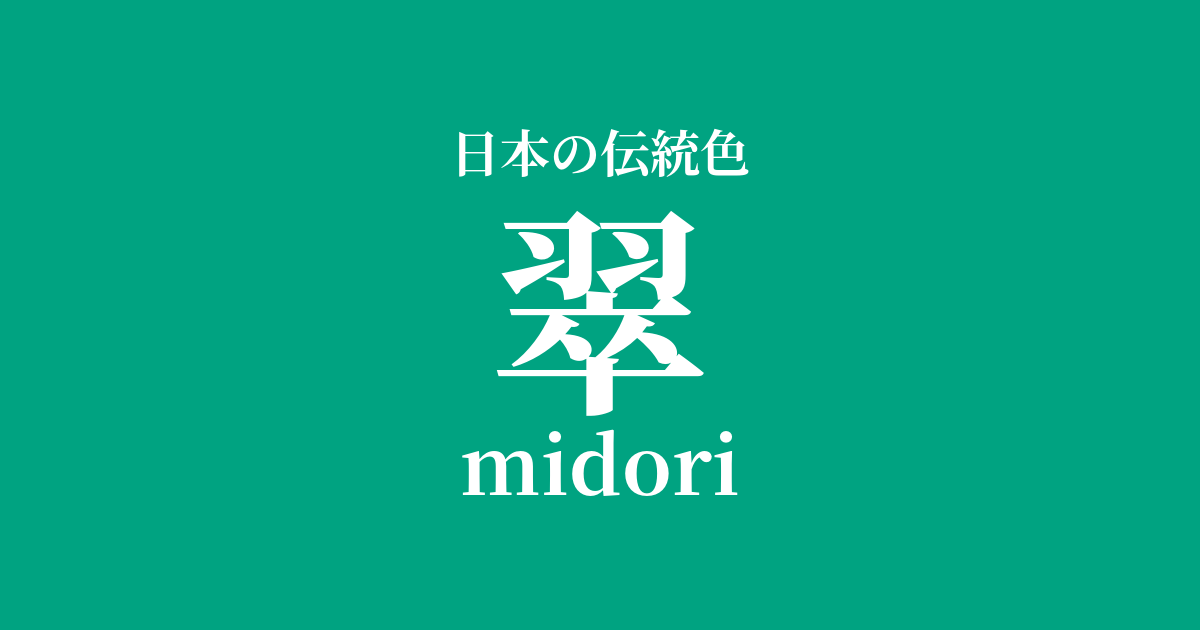
| Japanese color name | 翠 |
|---|---|
| reading | midori |
| HEX | #00A381 |
| RGB | 0, 163, 129 |
What does "Sui" mean? Origin and etymology
The color "midori" (翠) is derived from the beautiful feather color of the kingfisher. The kanji characters "翡" (hi) refer to the male kingfisher, and "翠" (sui) refer to the female kingfisher, and it is believed that the name was given because of the vivid blue-green color of their feathers. It is also widely believed that the gemstone jadeite (翡翠, hisui) was named because its color resembles that of a kingfisher's feathers.
Thus, "Sui" has become established as a word that refers not merely to green, but to a deep, vibrant blue-green color that evokes a sense of vitality and mystery.
The historical background of Midori
In ancient China, the color emerald green was considered a noble color because kingfisher feathers were highly valued as ornaments. This cultural influence spread to Japan, where it came to be used in Heian period literature to describe the deep, beautiful green of nature. For example, lush, green mountains were called "suiran," symbolizing the ideal green. Even as dyeing and weaving techniques advanced in the Edo period, emerald green continued to be highly valued as a special color.
Related literature, waka poetry, and seasonal words
The word "sui" (翠) has been frequently used in Japanese literature to describe the vibrant beauty of nature. In particular, in the world of Chinese poetry, it was an indispensable word to express the color of lush green mountains and willow leaves. Its beautiful sound and color were also favored in waka and haiku, as seen in Matsuo Basho's haiku, "Tears staining the rock azaleas, my sleeves are sui." Furthermore, "suiu" (翠雨), meaning "green rain," is a summer seasonal word referring to rain falling on green leaves, and is deeply connected to the rich scenery of Japan's four seasons.
Tears stain the rock azaleas, and my sleeves are azure.
Color scheme preview
This is to check the readability of the text when this color is used as the background.
Green color scheme proposal
Crimson (#B7282E)
The vibrant blue-green of midori and the deep red of akane are close to complementary colors, enhancing each other's beauty. This creates a contrast reminiscent of autumn leaves and evergreen trees in nature, resulting in a powerful and striking color scheme. It emphasizes a Japanese aesthetic while also conveying a modern atmosphere.
White green (#D6E9D6)
By combining a pale, whitish green with a more subdued green, a gradient of color is created. This gives a refreshing, calm, and elegant impression, making it suitable for quiet and peaceful spaces and designs. The combination evokes images of mountain mist and clear streams.
Golden (#E6B422)
The combination of deep green and shimmering gold has long been a color scheme symbolizing nobility and luxury. The mystical atmosphere of green, combined with the splendor of gold, creates a dignified impression. It can express the traditional beauty found in folding screen paintings and high-quality crafts.
Practical Scenes
In traditional Japanese clothing, green kimonos and obi sashes evoke a sense of calm and elegance. Especially when used as part of the pattern on formal kimonos such as visiting kimonos or formal kimonos, they tighten the overall impression and add depth. They tend to be favored as a color that brings out the mature charm of an adult.
In interior design, incorporating it into accent walls or cushions brings a sense of calm and sophistication to the space. It pairs exceptionally well with wood, making it suitable for modern Japanese-style spaces, studies, and other areas where concentration is desired. It offers a refined greenery that differs from typical houseplants, adding a touch of elegance to any space.
In web design, this color can be used to convey trustworthiness and intelligence. It is effective as the main color for a company's corporate website or as an accent color for a website showcasing traditional culture. It allows for the creation of a deep and immersive world while maintaining readability.