
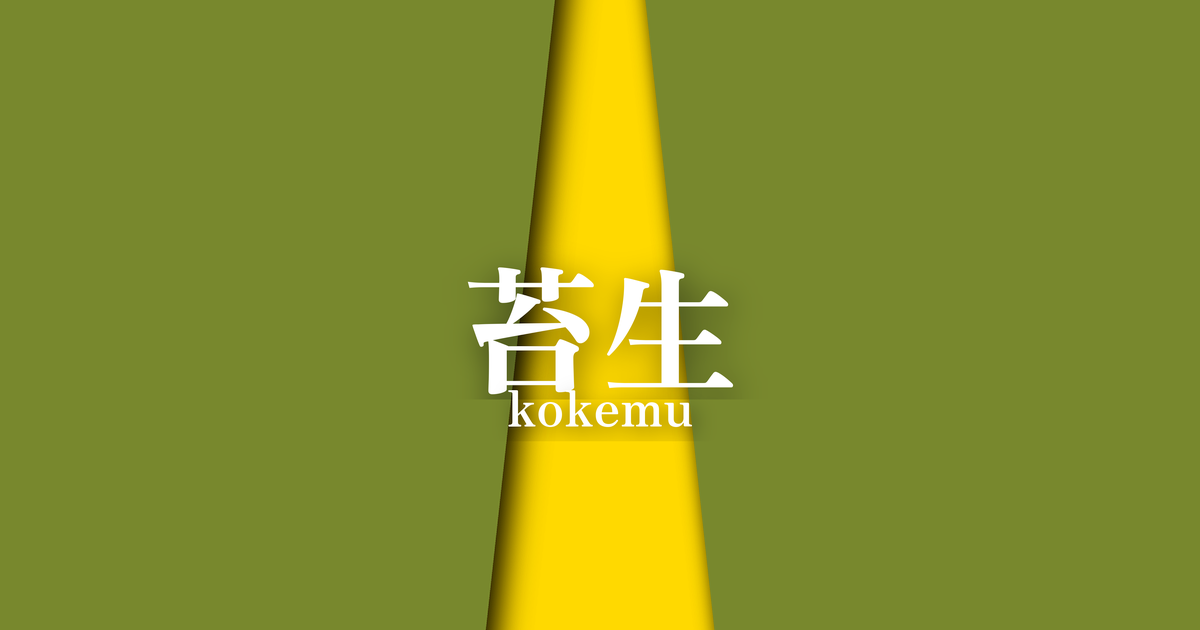
| Japanese color name | moss growth |
|---|---|
| reading | kokemu |
| season | 春 |
| Color of the table | Moss green (kokeiro) |
| Back color | Yellow (ki) |
What is moss growth? Origin and etymology
"Kokei" is a color combination that expresses the appearance of young moss sprouting on rocks and old trees with the arrival of spring. Its name is derived directly from the verb "moss grows," capturing the breath of nature's vitality. The deep, calm "moss green" on the outside represents the moss itself, which is moist, while the bright "yellow" on the inside is said to symbolize moss spores, newly sprouted young leaves, or sunlight filtering through the trees.
This combination of two colors creates a profound scene that evokes a sense of spring's arrival even amidst the silence.
The origin of this color scheme is deeply rooted in traditional Japanese aesthetics based on observation of nature. Heian-era aristocrats were keenly aware of the changing seasons and expressed them through the colors of their waka poems and clothing. Moss has long been a symbol of "the passage of time" and "wabi-sabi" in the world of waka poetry, but the "mossy" color scheme emphasizes the positive aspect unique to spring: the vitality of life that breaks the silence of winter and sprouts.
A major characteristic of this color scheme is its realistic color palette, which looks as if it were a snapshot of a natural landscape.
Historical background of moss
The exact origin of the "moss-covered" color scheme is uncertain, but it is thought to have originated in the mid-Heian period or later, when the culture of layered color combinations matured. It is presumed to have been used as an important color scheme to express a sense of the season, especially in formal wear for women, such as the court ladies' attire. It may have been favored as a stylish outfit that anticipated the breath of nature in the quiet season of early spring, before other flowers were in full bloom.
At that time, clothing was not merely garments, but an important cultural symbol that reflected the wearer's education and sensibilities. Choosing colors that reflected natural scenes, such as "moss," was proof of having a refined heart that loved nature and understood the subtle changes of the seasons. In particular, the combination of calm green and bright yellow, while not flashy, gave a sophisticated and elegant impression, and it is said to have been favored by educated aristocratic women.
Related literature, waka poetry, and seasonal words
In Heian period literature, the color combination name "Kokei" (moss-covered) does not appear directly very often. However, moss itself frequently appears in classical literature such as "The Tale of Genji" and "The Pillow Book," and is depicted as an important element that adds depth to the scenes in the stories. For example, moss-covered rocks and stone steps are effectively used in descriptions of lonely gardens that are not visited by people, or shrines that have stood for many years, to express the passage of time and the atmosphere of the period.
These literary images are thought to be the background to the profound worldview embodied in the color "mossy."
In the world of Japanese poetry, moss has been a recurring theme since ancient times. Just as "mossy robes" refer to the robes of Buddhist monks, it is often used as a word to symbolize a quiet life away from the secular world and the state of wabi-sabi (a Japanese aesthetic emphasizing simplicity and transience). On the other hand, moss in spring is also a symbol of new life, and its colors have stimulated the sensibilities of poets. The colors of "mossy growth" can be said to have taken this literary tradition into account, while elevating the aspect of it being a celebration of spring life into the beauty of the colors of the garment.
Even on moss-covered rocks, flowers have bloomed; how rare is the sight of the Japanese kerria flower.
Mossy season and scenery
"Mossy" is a color scheme that expresses the feeling of spring, especially from early to mid-spring when the snow melts and the earth regains its moisture. It depicts the scene of moss, which seemed to have withered during the winter, regaining its vibrant green color after the spring rains and sprouting new shoots. It evokes the quiet and peaceful scenery of spring fields and mountains before the leaves have yet to bud on the trees.
This color scheme is said to have been most appropriate for occasions such as court ceremonies celebrating the arrival of spring or short trips to appreciate nature. Unlike the vibrant colors of cherry blossoms and plum blossoms, this understated yet undeniably vibrant color combination was particularly favored as attire for mature women who deeply understood the laws of nature. It is a color scheme for experiencing a sense of oneness with nature on a quiet spring day.
Mossy color scheme proposal
Yamabuki (#FFBF00)
The yellow, the undertone of "Mossy," harmonizes with the color scheme, enriching the spring scenery. The green of the moss and the vibrant yellow of the kerria evoke the landscape of flowers blooming in the spring fields and mountains. By using similar colors, it creates a unified and vibrant impression.
Suou (#9E3D3F)
The subdued reddish-purple of the sappanwood creates a beautiful contrast with the deep mossy green. This traditional combination, also seen in Heian period attire, evokes an old-fashioned and elegant atmosphere. The colors complement each other, giving a dignified impression.
White training (#FEFEFE)
The pure, unadulterated white highlights the natural hues of "moss-covered" landscapes. This combination evokes the crisp air of spring and the clear streams flowing between rocks, creating a sense of cleanliness and elegance. It's a color scheme that's easily applicable to modern designs.
Practical Scenes
In modern Japanese clothing, "moss-covered" is incorporated into spring kimonos, obi sashes, obi ties, obiage sashes, and other accessories. In particular, using this color scheme with everyday kimonos such as tsumugi and komon creates a stylish look that subtly expresses the season. While not flashy, it is a color favored by connoisseurs and is popular among kimono enthusiasts.
Beyond traditional Japanese clothing, the "Mossy" color scheme can be used in a variety of fields. In interior design, using it on cushion covers, rugs, and wallpaper creates a calm, modern Japanese atmosphere. Because the color scheme is based on earth tones, it pairs very well with wooden furniture and houseplants.
In the fields of web design and graphic design, this color is suitable as a key color for content themed around nature, tradition, and sustainability. The calming effect of moss green and the brightness of yellow can be expected to convey both trustworthiness and approachability. As a color scheme that conveys Japanese aesthetics, it can also be applied to product design for overseas markets.