
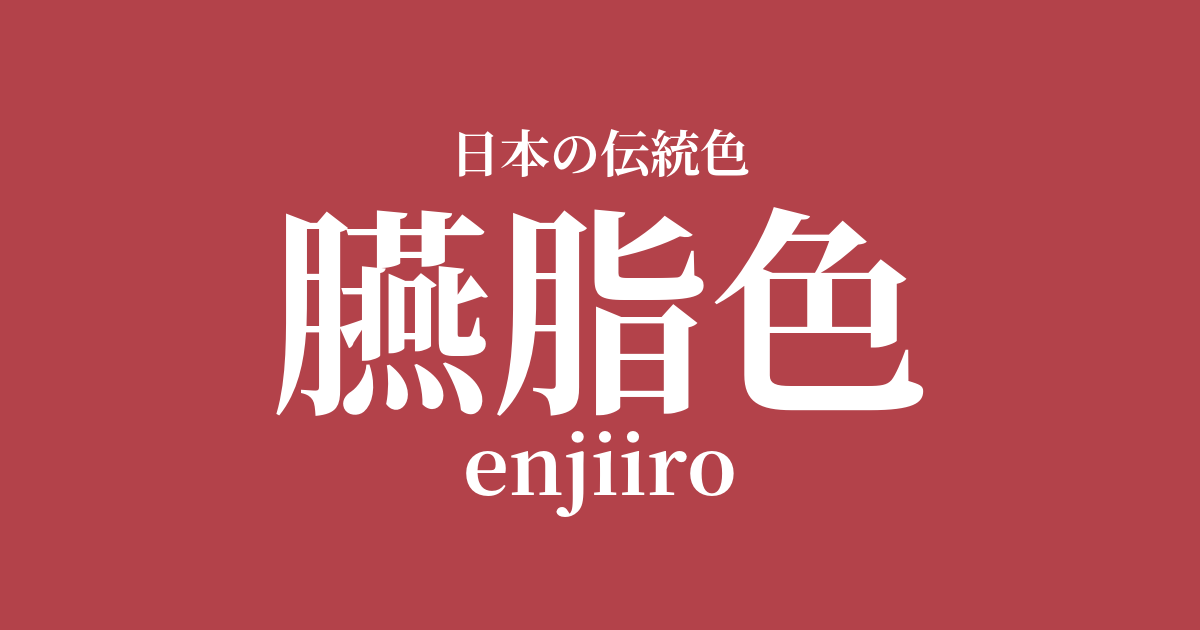
| Japanese color name | dark brown |
|---|---|
| reading | enjiiro |
| HEX | #B3424A |
| RGB | 179, 66, 74 |
What is maroon? Origin and etymology
The word "enji" (crimson) originates from the dye "enji." This word "enji" is said to have originated from "yanji," which referred to a red cosmetic produced in the ancient Chinese state of Yan. This dye's main component is carminic acid, an animal-derived pigment extracted from the lac insect in ancient times, and later from the cochineal insect (Japanese name: enjimushi), which is mainly native to Central and South America.
The deep, dark red color achieved using this pigment came to be known as "enji-iro" (crimson).
Traditional Japanese red dyes include plant-derived dyes such as safflower and madder, but maroon is a different dye derived from animals. In contrast to the vibrant red of safflower and the yellowish red of madder, maroon is characterized by its deep, purplish hue. Due to its unique color and its rarity as an imported product, it has a long history of being highly valued as a noble color.
The historical background of the maroon color
It is believed that cochineal dye, the raw material for maroon, was introduced to Japan sometime between the Muromachi and Azuchi-Momoyama periods. Brought to Japan by Portuguese merchants through trade with the West, its vibrant and deep color, unlike any red dye previously available in Japan, attracted considerable attention. In particular, the "scarlet" battle surcoat said to have been favored by Toyotomi Hideyoshi is thought to have been dyed with this cochineal.
Because it was an expensive and rare imported color, maroon was initially a color that only privileged classes such as daimyo, samurai, and wealthy merchants could use. Its luxurious hue was considered a symbol of power and wealth, and it was used in armor, battle jackets, and the kimonos of noble women. In the Edo period, with the development of dyeing and weaving techniques, production increased and it gradually spread among the common people, but it remained a color of luxury.
Related literature, waka poetry, and seasonal words
Because the color "enji" (crimson) is a relatively recent name, it does not directly appear in classical Heian literature such as "The Tale of Genji." However, expressions such as "deep crimson" and "deep red" used in these works are consistent with the deep, lustrous red image associated with enji. These colors served as the attire of noble figures, symbolically representing their status and feelings.
In modern literature, many readers associate the color crimson with "Akashatsu," a character in Natsume Soseki's novel "Botchan." In the story, Akashatsu is portrayed as an undesirable character who opposes the protagonist, and the gaudy color of his clothing effectively conveys his personality. Thus, in works from the modern era onward, crimson can be seen as a color used to highlight a character's individuality.
Color scheme preview
This is to check the readability of the text when this color is used as the background.
A color scheme proposal in crimson.
Indigo (#274054)
This traditional Japanese color scheme features a warm, deep red of maroon and a calm, deep blue of indigo, complementing each other beautifully. It conveys a sense of gravitas and refinement, and is a classic combination that has been seen for centuries in kimono pairings and crafts.
Blue gold (#FABE2C)
The combination with a vibrant yellow, reminiscent of turmeric dye, creates a luxurious and festive atmosphere. The depth of the maroon is complemented by the brightness of the turmeric, giving it a magnificent and powerful impression, similar to that found in art from the Azuchi-Momoyama period.
White training (#F3F3F3)
By combining it with a lustrous white reminiscent of refined silk, the depth and vibrancy of the deep red color are further enhanced. This creates a sense of cleanliness and elegance, resulting in a sophisticated color scheme that is easily applicable to modern designs. The contrast between red and white also evokes a sense of celebration.
Practical Scenes
In the world of traditional Japanese clothing, maroon is an extremely popular color for kimonos and obi sashes. When used in formal wear such as furisode and houmongi, it creates an elegant and sophisticated look, along with a touch of glamour. Incorporating it as an accent in accessories such as obi ties and han-eri collars also has the effect of tightening up the overall look.
In interior design, it is most effective when used as an accent color. Incorporating maroon into cushion covers, curtains, rugs, etc., can add warmth, depth, and a sense of luxury to a space. It harmonizes well not only with Japanese-style rooms but also as an accent color in modern Western-style rooms, bringing a sense of calm and elegance to the space.
In web and graphic design, its strong presence makes it effective when used for elements that you want to attract attention. Using it for buttons or important headings can guide the user's gaze. When used as a background color, combining it with light colors such as white or off-white allows you to create a page that is elegant and powerful while ensuring readability.