
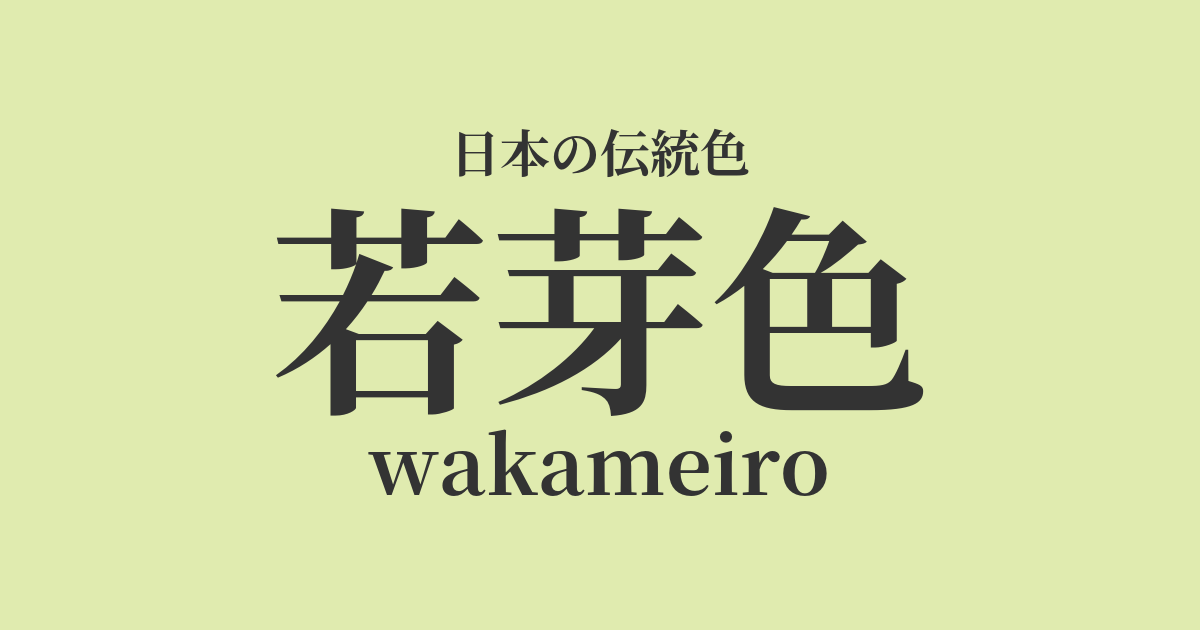
| Japanese color name | Young green |
|---|---|
| reading | wakameiro |
| HEX | #E0EBAF |
| RGB | 224, 235, 175 |
What is "young sprout color"? Origin and etymology.
Wakame-iro, as the name suggests, is a bright, pale yellowish-green color derived from the color of young shoots of plants that sprout in early spring. "Wakame" means "young shoot" and does not refer to the color of the seaweed wakame. It is a color that strongly evokes positive images such as the breath of life, growth, and hope, and it reflects a uniquely Japanese sense of color that captures the subtle changes of nature and gives color names to them. It is one of the colors that symbolize spring, giving viewers a sense of peace and freshness.
The historical background of the young green color
The color name "Wakame-iro" (young sprout green) itself does not appear in historical documents from ancient times, and is considered a relatively new color name that was coined in modern times. However, the culture of appreciating the fresh green of spring has existed since ancient times. In the Heian period, colors reminiscent of spring budding, such as "Wakakusa-iro" (young grass green) and "Moegi-iro" (sprout green), were favored by the nobility, and combinations of "Wakakusa" and "Moegi" can be seen in the color schemes of clothing (kasane no irome).
The color "wakame-iro" (young sprout green) can be said to have originated within this tradition of cherishing the green of spring, as a way to express more subtle differences in color.
Related literature, waka poetry, and seasonal words
In the world of haiku, "young sprouts" and "budding" hold an important place as seasonal words for spring. These are symbols that herald the end of winter and the rebirth of life, and many haiku poets have captured their powerful presence in their poems. Although the direct expression "young sprout color" is rarely used in literary works, the bright and hopeful image associated with this color often underlies the depiction of spring scenes.
The color of young shoots is one of the essential colors for expressing a sense of the seasons and a view of nature in Japanese literature.
Color scheme preview
This is to check the readability of the text when this color is used as the background.
A color scheme proposal in the shade of young leaves.
Cherry blossom pink (#FEEAFA)
By combining it with cherry blossom pink, a quintessential spring color, it's possible to express the beautiful scenes of spring, from budding to blooming flowers. The resulting color scheme gives a gentle, calm, and hopeful impression.
Kutsuha color (#917347)
Combining bright, fresh green with calm, muted brown tones creates a harmonious blend of earthy colors. This evokes a sense of the cycle of life and the depth of nature, creating a peaceful and calming space.
White training (#FFFFFF)
When paired with pure white, the freshness and cleanliness of the young sprout green are further enhanced. This color scheme gives a minimalist and modern impression, bringing lightness and brightness to the design.
Practical Scenes
In traditional Japanese clothing, the color young sprout green is often used for kimonos, obi sashes, and accessories such as obiage (sash ties) in early spring. It is an ideal color for expressing youthfulness and a sense of the season, and incorporating it into formal kimonos such as visiting kimonos or casual kimonos can give an elegant and vibrant impression.
In interior design, incorporating light green accents, cushions, and curtains creates a bright and refreshing atmosphere throughout the room. It pairs particularly well with natural and Scandinavian-style interiors, and combining it with houseplants further enhances the natural and comfortable feel.
In the fields of web and graphic design, it is frequently used for themes related to wellness, organic products, and childcare. It is effective when you want to convey a sense of security, gentleness, and naturalness, and can give viewers a clean and positive impression.