
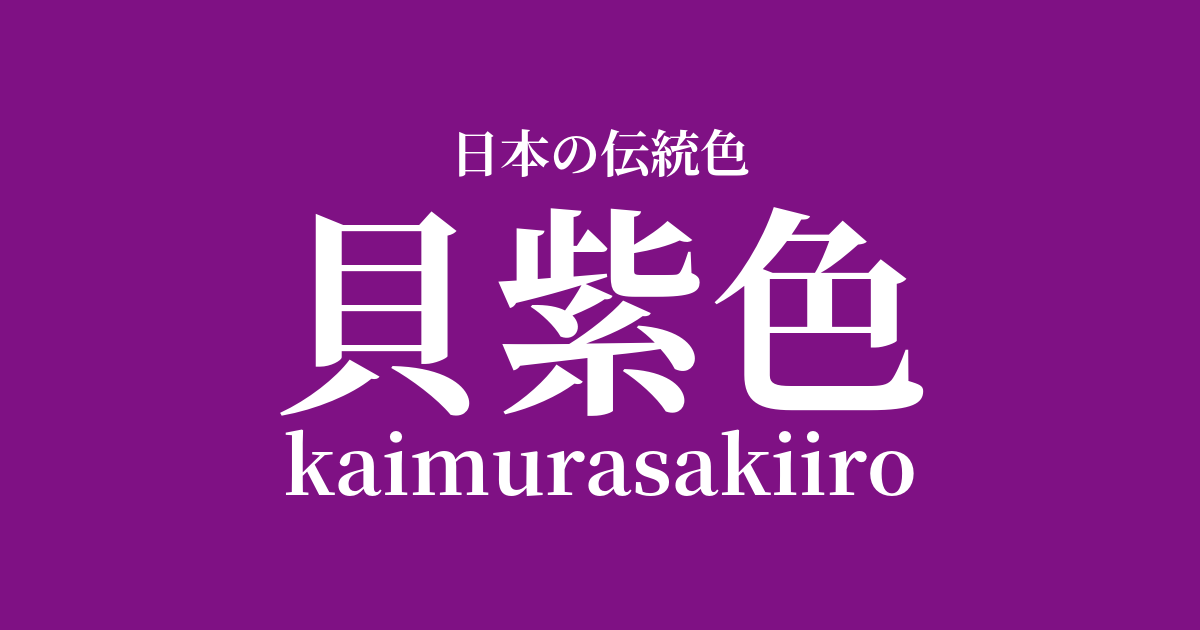
| Japanese color name | shell purple |
|---|---|
| reading | kaimurasakiiro |
| HEX | #7F1184 |
| RGB | 127, 17, 132 |
What is Tyrian purple? Origin and etymology
Tyrian purple is a color derived from a dye made from the secretion of the purple gland (hypogillary gland) of snails belonging to the family Muricidae. This secretion changes from colorless to yellow, green, blue, and then purple upon contact with air and subsequent oxidation. This phenomenon is due to a photochemical reaction, and the beautiful purple color is obtained through a very complex process. Only a small amount of dye can be extracted from a single snail, and due to its rarity, it has been treated as an expensive dye since ancient times.
The historical background of the color Tyrian purple
The history of Tyrian purple is ancient, believed to have originated in Phoenicia around 1600 BC. This technique flourished along the Mediterranean coast, with Tyre-produced purple being considered the finest and known as "Tyrian purple" or "royal purple." In the Roman Empire, it became a color that only a select few privileged classes, such as emperors and senators, were permitted to wear, and it was a symbol of authority.
In Japan, descriptions of purple dye can be found as far back as the "Records of Wei: Account of the Wa People," but the most reliable artifacts include the "Purple Ground Phoenix-Shaped Brocade" among the treasures of the Shōsōin. However, ancient Japanese purple dye mainly came from the roots of the gromwell plant, and there is debate as to whether Tyrian purple dye was used on a large scale. It is known that Tyrian purple dye is still used in some of the ceremonial garments used in the Shikinen Sengu (periodic rebuilding) of Ise Grand Shrine.
Related literature, waka poetry, and seasonal words
Due to its rarity and noble nature, Tyrian purple is sometimes depicted as a special color in literary works. However, instances where "Tyrian purple" is explicitly mentioned in classical Japanese literature are fewer than instances where "purple" dyed from gromwell is used. This is thought to be because plant-based dyes were the mainstream for purple dyeing in Japan. Although it does not directly exist as a seasonal word, its noble hue is sometimes associated with elegant scenes.
Color scheme preview
This is to check the readability of the text when this color is used as the background.
A proposed color scheme using Tyrian purple.
Golden (#E6B422)
The noble purple-yellow and shimmering gold are a combination that symbolizes authority and luxury. It evokes the court cultures of ancient Rome and Japan, giving an impression of dignity and grandeur. This color scheme is often seen in jewelry and ceremonial attire.
White training (#FFFFFF)
When paired with pure white, the vibrancy and depth of the Tyrian purple stand out. It achieves both cleanliness and elegance, creating a sacred atmosphere. This sophisticated color scheme can be applied to Shinto shrine attire as well as modern designs.
Blue gold (#FABF14)
The reddish-purple of Tyrian purple and the vibrant yellow dyed with turmeric are close to complementary colors, enhancing each other's beauty. They create an exotic and vibrant impression, attracting the viewer's eye. They are used in festival costumes and crafts.
Practical Scenes
Due to its rarity and noble image, Tyrian purple is often used in special clothing and crafts. In particular, it is used in ceremonial garments for Shinto rituals and in the sashes of high-end kimonos, expressing a sense of formality and prestige. Its unique, deep hue further enhances attire for special occasions.
In interior design, using it as an accent color brings a sense of luxury and tranquility to a space. Incorporating it into cushions, curtains, or parts of the wallpaper creates an elegant and sophisticated atmosphere. Its appeal is further enhanced when combined with colors such as gold, silver, and white.
In web and graphic design, it is effective in expressing a brand's sense of luxury and uniqueness. Using it as a logo or key color can instill a sense of trust and exclusivity in users. However, because it is a strong color, it is important to adjust the area of use and balance it with white or light gray.