
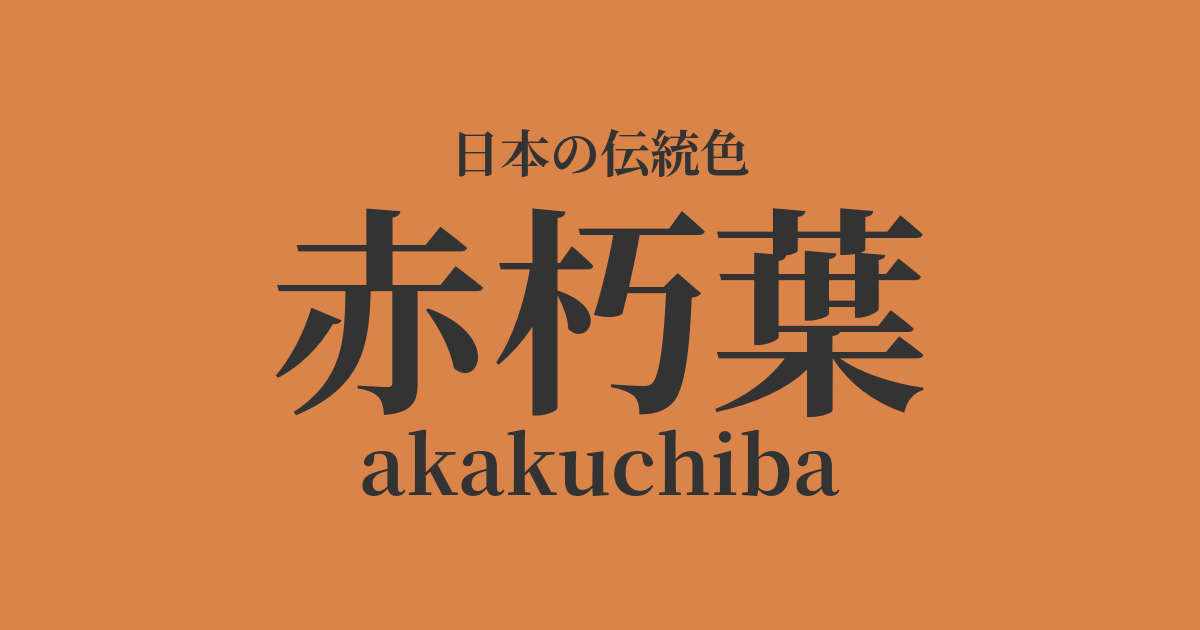
| Japanese color name | red rotting leaves |
|---|---|
| reading | akakuchiba |
| HEX | #DB8449 |
| RGB | 219, 132, 73 |
What is Akakuchiba? Origin and etymology
"Kuchiba" is a word that describes the process of autumn leaves withering and decaying. Among these, "Akakuchiba" (red kuchiba) is a particularly strong reddish color that captures the fleeting beauty of leaves as their vibrant autumn colors fade. It can be said that this color was born from a uniquely Japanese sensibility that finds beauty in the changing seasons of nature. The color kuchiba has been used since the Heian period, and various shades such as Aokuchiba (blue kuchiba) and Kikuchiba (yellow kuchiba) were distinguished according to the stage of leaf decay.
This delicate classification of colors speaks to the rich sense of color possessed by the aristocracy of that time.
Historical background of red withered leaves
The color "kuchiba-iro" (decayed leaf green) frequently appears in Heian period literature, particularly in "The Tale of Genji." It is depicted that Hikaru Genji wore a reddish-brown costume while performing a dance, suggesting that it was recognized as a noble color. At the time, it is believed that the dye was primarily produced by combining the yellow of gardenia and the red of safflower. Later, during the Edo period, it became popular among commoners, giving rise to a wide variety of shades known as "kuchiba-iro 48-shade" (48 shades of decayed leaf green), and it was widely used for kimonos and obi sashes.
Related literature, waka poetry, and seasonal words
The color reddish-brown is an indispensable color for depicting autumn scenery and appears in many literary works. In the "Autumn Leaves Gathering" chapter of "The Tale of Genji," there is a famous scene in which Hikaru Genji dances while wearing a reddish-brown garment. This depiction not only showcases the beauty of the color but also symbolically expresses the feelings of the characters and the changing seasons. Furthermore, "decayed leaves" is also used as a seasonal word for autumn and has the effect of evoking feelings of loneliness and "mono no aware" (a sense of pathos or melancholy) in waka and haiku poetry.
Since ancient times, this color has been deeply intertwined with the Japanese aesthetic sense.
In the tenth month, before the autumn rains have even begun to fall, the withered leaves on the peaks are already beginning to dye the sky.
Color scheme preview
This is to check the readability of the text when this color is used as the background.
Red withered leaf color scheme proposal
Dark Green (#00552E)
The warmth of the reddish-brown leaves and the tranquility of the deep green harmonize to create a deep, calming impression reminiscent of an autumn forest. The colors complement each other, evoking a sense of nature's richness. This combination also blends well with a Japanese aesthetic.
Indigo (#274054)
The warm-toned reddish-brown and the cool-toned indigo are close to complementary colors, and they have the effect of making each other appear more vibrant. This combination, based on traditional Japanese color sensibilities, gives an intelligent and sophisticated impression.
Generation color (#FBF6E5)
The warm hues of the reddish-brown leaves are enhanced by the soft, natural white of the off-white color. It creates a simple and tranquil atmosphere, making it ideal for creating a reassuring space. Perfect for natural-style designs.
Practical Scenes
The subdued color of reddish-brown leaves makes it widely used in the world of traditional Japanese clothing. In particular, incorporating it into kimonos, obi sashes, and accessories worn during the autumn season can elegantly express a sense of the season. Its color, neither too flashy nor too plain, is favored by many people of all ages.
In interior design, incorporating accent walls, cushions, curtains, and other fabrics can add warmth and depth to a space. It also pairs very well with wooden furniture, contributing to the creation of a natural and calming room atmosphere.
In web and graphic design, using it as a background or accent color can create a warm and traditional impression. It is particularly effective for content related to history and culture, or when you want to evoke a sense of autumn.