
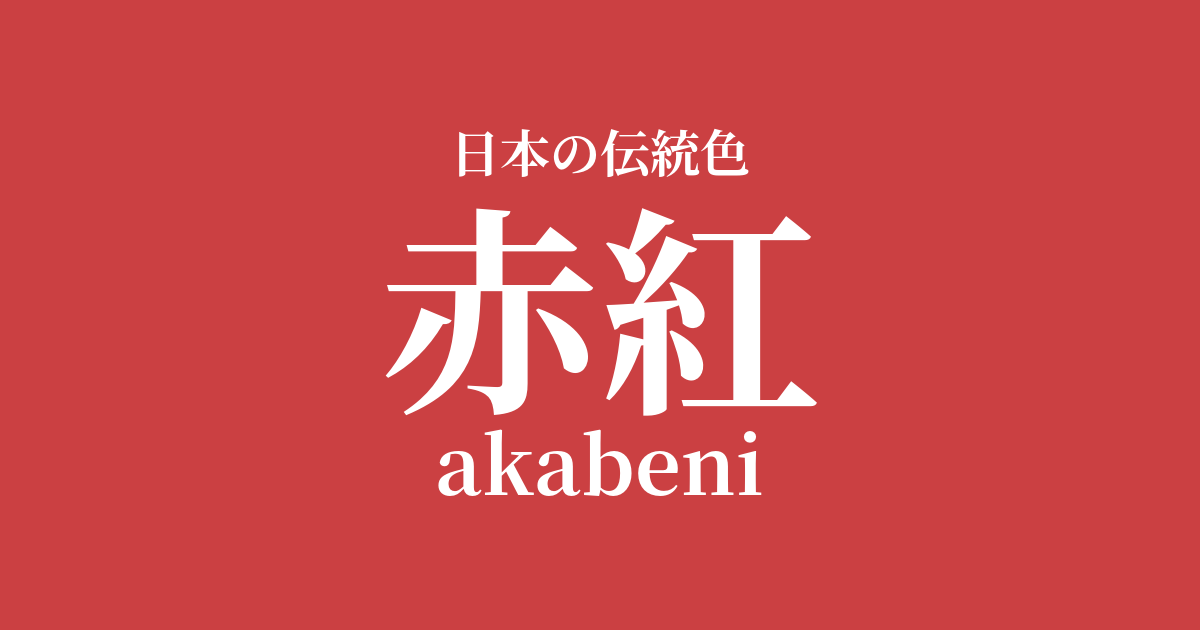
| Japanese color name | red red |
|---|---|
| reading | akabeni |
| HEX | #CB4042 |
| RGB | 203, 64, 66 |
What is "Akabeni"? Origin and etymology
Akabeni refers to a vibrant red color dyed with pigment extracted from the petals of the safflower (Benibana), a plant belonging to the Asteraceae family. In ancient times, it was called "Kure no Ai" (Indigo of Wu), and is said to derive its name from the fact that it was a dye introduced from the Kingdom of Wu in China. Safflower petals contain a water-soluble yellow pigment and a red pigment that is extracted with an alkaline liquid, and a complex process was required to extract only the red pigment.
Therefore, crimson was treated as an extremely precious and expensive color.
The name "Akabeni" (赤紅) emphasizes its particularly deep and vivid red color, distinguishing it from the lighter shades dyed from the same safflower. While it is also simply called "Beni" (紅), the term "Akabeni" is used to clearly indicate its color, as lipstick and blush in cosmetics are also called "Beni." This color is deeply rooted in Japanese culture as a symbol of vitality, passion, and nobility.
The historical background of crimson
The technique of dyeing with safflower is believed to have been introduced to Japan from mainland China along with Buddhism during the Asuka period. By the Nara period, it was already being used to color the clothing of noble people. In the Heian period, crimson became a color that women longed for, and it was widely used in formal attire such as the twelve-layered kimono, as well as in makeup such as lipstick and blush. This color was considered one of the "forbidden colors" that only the emperor and some court nobles were permitted to wear, and its rarity made it a symbol of authority.
Safflower remained popular among samurai women from the Kamakura period onward, but in the Edo period, domestic cultivation of safflower was encouraged, and "Mogami safflower," produced in the Mogami region (present-day Yamagata Prefecture), became known nationwide as a top-quality product. As a result, safflower became more widely available, but it remained an expensive dye. For ordinary people, it continued to be a special color used only on special celebratory occasions.
Related literature, waka poetry, and seasonal words
Crimson red, or simply "red," frequently appears in Heian period literature as a color symbolizing beauty and nobility. In works like "The Tale of Genji" and "The Pillow Book," it is an indispensable color when describing the color schemes of the women's clothing and their makeup. For example, the beauty of thin fabrics dyed crimson, and the layered colors of "crimson plum blossoms" convey the refined aesthetic sense of the aristocratic society of the time.
In the world of Japanese poetry, while the word "crimson red" itself is rarely used directly, the raw material, "safflower," and the sleeves of garments dyed crimson are sometimes featured as subjects. These poems were used not only to express the beauty of the color, but also to symbolize human emotions such as love and the sadness of parting. As a seasonal word, "safflower" represents summer, and the scenery of its vibrant flowers in bloom is depicted in many haiku.
The eyebrows resemble the flowers of rosary.
Color scheme preview
This is to check the readability of the text when this color is used as the background.
Suggested red color scheme
Black (#1C1C1C)
The combination of vibrant crimson and deep ink black enhances each other beautifully. It evokes a sense of strength and dignity, a classic color scheme often seen in traditional Japanese lacquerware and kimono patterns. It can also be applied to modern designs.
Blue gold (#FABE00)
This combination features the color of turmeric, a plant-derived dye like crimson. The warm colors complement each other well, creating a luxurious and festive atmosphere. The vibrant color scheme is reminiscent of the "layered color combinations" seen in the attire of Heian period aristocrats.
White training (#FFFFFF)
By combining it with pure white, the vibrancy of crimson is brought out to its fullest. Purity and passion coexist, giving an impression of nobility and dignity. The combination of red and white is an auspicious color scheme used in Japanese ceremonies and celebrations.
Practical Scenes
In the world of kimono, crimson is a representative color used for formal attire such as furisode (long-sleeved kimono) and uchikake (bridal kimono). As a color that symbolizes protection against evil and vitality, it adds splendor to celebratory occasions. By incorporating it as an accent in accessories such as obi (sash), obi-jime (sash cord), and han-eri (collar), it can tighten the overall look and give a stylish impression.
In interior design, incorporating crimson red into fabrics such as cushion covers, curtains, and table runners adds warmth and vibrancy to a space. An accent wall painted in this color is also effective, but because it's a strong color, it's best to avoid overuse and use it sparingly. It harmonizes well not only with Japanese-style rooms but also with modern spaces.
In web and graphic design, crimson is effective when used for buttons or important headings that you want to attract attention. It is also suitable as a theme color for brands that emphasize Japanese tradition and luxury. Because it can be too stimulating when used extensively as a background color, it is generally used as an accent color in combination with other more subdued colors.