
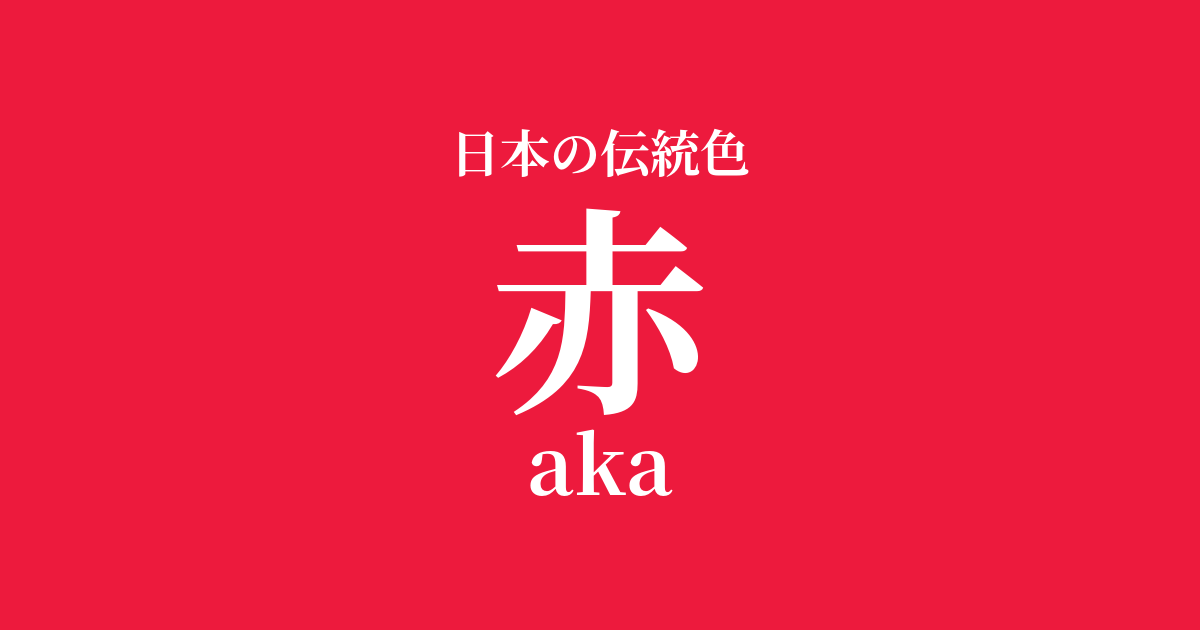
| Japanese color name | 赤 |
|---|---|
| reading | aka |
| HEX | #ED1A3D |
| RGB | 237, 26, 61 |
What does "red" mean? Origin and etymology
The most widely accepted theory is that the word "red" originates from "aka," meaning "bright," which describes the brightening of the sky as night breaks. As the color of the sun, fire, and blood, it was one of the most familiar colors in the lives of ancient people and was recognized as a fundamental color symbolizing life itself. In ancient times, mineral pigments such as red clay (ochre) and cinnabar were used as dyes.
Among plant dyes, the root of madder has been used since ancient times, and safflower, which was later introduced from the continent, was treated as a very expensive and valuable dye because it produced a more vivid red color.
Red has been treated not merely as a color, but as a color with special meaning. In ancient societies, red was believed to have the power to ward off evil spirits and was used in rituals and ceremonies. The frequent use of red in tomb murals and burial goods is thought to have been intended to protect the deceased from evil spirits and to pray for rebirth. It was also considered a color that symbolized fire and the sun, representing vitality, passion, and authority.
Thus, red is an important color that forms the foundation of Japanese culture, as it is linked to natural phenomena and people's beliefs.
Historical background of red
The history of the color red is long, with evidence of red pigment being found on pottery and clay figurines from the Jomon period. During the Kofun period, red was used in murals in stone chambers with the meaning of warding off evil. In the Twelve Levels of Court Rank established during the Asuka period, deep red "kokihi" was used for the ranks of "Daijin" and "Shojin," which were the next highest ranks after purple, indicating that red had long been established as a noble color.
In the Heian period, the vibrant red dyed with safflower became a "forbidden color," a special color that only the emperor and certain high-ranking individuals were permitted to wear. Red also symbolized beauty and high status, as evidenced by the use of crimson thin fabrics in the twelve-layered kimono worn by aristocratic women. In the age of the samurai, red was favored as a color that enhanced bravery and morale, and was used in weapons and banners. Units known as "red-armored" were considered a symbol of elite soldiers.
Related literature, waka poetry, and seasonal words
Red frequently appears in classical Japanese literature, coloring a variety of scenes and emotions. The Manyoshu anthology contains many poems that describe the crimson color that dyes the evening sky. In particular, Nukata no Okimi's poem, "Going to the purple fields and marked fields, does the field guardian not see you waving your sleeves?" is known as a famous poem that combines the beautiful scene illuminated by the crimson light with feelings of love.
In Heian period literature such as "The Tale of Genji" and "The Pillow Book," red was used as the color of clothing for noble women, expressing their splendor and beauty. Expressions such as "crimson robes" and "the scent of red plum blossoms" symbolize the characters' social status and refined aesthetic sense. It is also depicted as a symbol of passionate love and vitality, adding depth and color to the stories.
On the way to Murasakino, the way to Shimeno, the field guardian does not see you waving your sleeve.
Color scheme preview
This is to check the readability of the text when this color is used as the background.
Red color scheme proposal
White (#FFFFFF)
Red and white have long been considered the most auspicious color combination in Japan, symbolizing celebratory occasions. They are seen in shrine gates and white walls, and in celebratory red and white banners, simultaneously expressing purity and the vibrant energy of life. The strong visual contrast creates a clear and powerful impression.
Black (#000000)
The combination of red and black is a traditional color scheme that conveys strength and dignity. A prime example is Negoro-nuri lacquerware, where the two colors complement each other. It creates a modern and refined impression, exuding a passionate yet dignified atmosphere.
Golden (#E6B422)
The combination of red and gold creates a luxurious, celebratory impression. As seen in screen paintings and furnishings from the Azuchi-Momoyama period, it has been used as a color scheme symbolizing wealth and power. It is ideal for celebratory occasions and auspicious designs, and evokes a sense of exhilaration in the viewer.
Practical Scenes
In the world of kimono, red is a color with special significance. It is especially frequently used in formal attire for special occasions such as weddings and coming-of-age ceremonies, such as furisode and uchikake. It is considered a color that enhances the vitality and splendor of young women, and is suitable for expressing celebratory feelings. It can also be used as an accent color in accessories such as obi and obiage to add a stylish touch to the entire outfit.
In interior design, red is an effective accent color that brings energy and warmth to a space. Incorporating it partially through cushion covers, rugs, or art panels can enliven the entire room. An accent wall, where just one wall is red, adds depth and a dramatic atmosphere to the space, creating a modern and sophisticated impression.
In web and graphic design, red is known as a color that strongly attracts user attention. Using it for purchase buttons, warnings, and important headlines can draw attention and encourage action. It is also suitable for brand images that want to convey passion and vitality, but overuse can give an aggressive impression, so it is important to balance it with achromatic colors such as white and gray.