
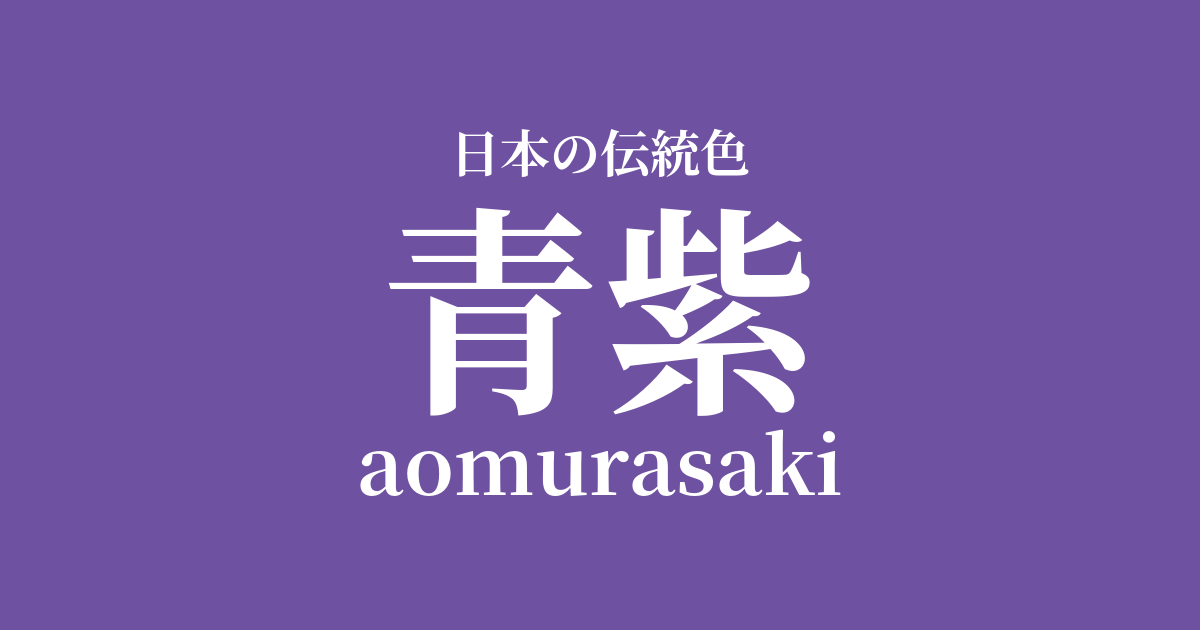
| Japanese color name | blue-purple |
|---|---|
| reading | aomurasaki |
| HEX | #6F51A1 |
| RGB | 111, 81, 161 |
What is blue-violet? Origin and etymology
As the name suggests, blue-violet refers to a bluish-purple color, and it is a traditional Japanese color. The root of the gromwell plant (Murasaki), which is used to produce purple dye, changes in color depending on the mordant and process used during dyeing. Blue-violet is said to be produced by using a mordant such as camellia ash with the pigment extracted from the root of the gromwell plant, thereby creating a stronger blue hue.
Furthermore, it is said that a technique called "shikon-gasane," which involves layering purple dye over an indigo underdye, was also used to create a deep blue-purple color.
The historical background of blue-purple
Purple has long been a color symbolizing noble status, as it was the highest-ranking color in the Twelve Levels of Court Rank established by Prince Shōtoku. In the Heian period, purple was further subdivided, giving rise to a variety of color names such as "deep purple" and "light purple." Blue-violet is one of these, and its elegant and intellectual impression made it a favorite color for the clothing and furnishings of the nobility.
In particular, the colors of flowers such as irises and bellflowers are said to have played an important role in expressing a sense of the seasons.
During the Edo period, instead of the expensive gromwell, "aobanagami" (blue flower paper) made from the blue pigment extracted from the petals of the dayflower was sometimes used as a substitute dye. However, the noble and sophisticated image of bluish-purple remained unchanged, and it was depicted in the costumes of Kabuki actors and in ukiyo-e prints, becoming a popular and stylish color. Even in modern times, its subdued hue continues to be loved by many people.
Related literature, waka poetry, and seasonal words
Bluish-purple is a color that frequently appears in the world of Heian period literature. In "The Tale of Genji," purple is often used to symbolize the nobility and inner character of the characters, and among them, bluish-purple is sometimes depicted as the color of clothing worn by intelligent and quiet characters. In waka poetry, bluish-purple flowers such as bellflowers, irises, and wisteria were often featured in poems, becoming themes to express the changing seasons and feelings of love.
While there isn't a specific seasonal word for "blue-violet," the word "bellflower" (kikyo) is associated with autumn and evokes images of this color.
When the bellflowers bloom at my dwelling, it seems the sun has already begun to set in the evening.
Color scheme preview
This is to check the readability of the text when this color is used as the background.
Blue-purple color scheme proposal
White training (#F3F3F3)
The noble and intellectual impression of blue-violet is enhanced by the pure and soft white of shironeri. This color scheme balances cleanliness and elegance, creating a quiet and refined space. It is said to be a good match for layering kimonos and as a background or accent color for websites.
Blue gold (#FABE22)
By combining blue-violet with turmeric (a yellowish color), which is close to its complementary color, the two colors vividly enhance each other. The resulting color scheme is vibrant yet evokes a sense of Japanese aesthetics, making it effective for festival decorations and as an eye-catching design accent.
Silver mouse (#AFB1B4)
The calming blue-violet tones harmonize with the cool, inorganic silver-gray hues, creating a modern and urban impression. This combination is suitable for conveying intelligence and trustworthiness, and can be used in business attire or minimalist interior design.
Practical Scenes
In the world of kimono, blue-violet is used in formal kimono such as visiting kimono, semi-formal kimono, and accessories like obi sashes, creating an elegant and sophisticated look. It is particularly useful for expressing a sense of the season when combined with patterns such as bellflowers and irises. Its subdued hue tends to be favored by a wide range of people, regardless of age.
In interior design, incorporating accent walls, cushions, and curtains can add depth and tranquility to a space. Combining them with white, gray, or wood-grain furniture can create a sophisticated, modern atmosphere or a quiet, contemplative Japanese-style space.
In web and graphic design, blue-violet is used to express trustworthiness and expertise. It is suitable for corporate colors and packaging designs for high-end products. It is easy to use as both a main color and an accent color, bringing depth and sophistication to designs.