
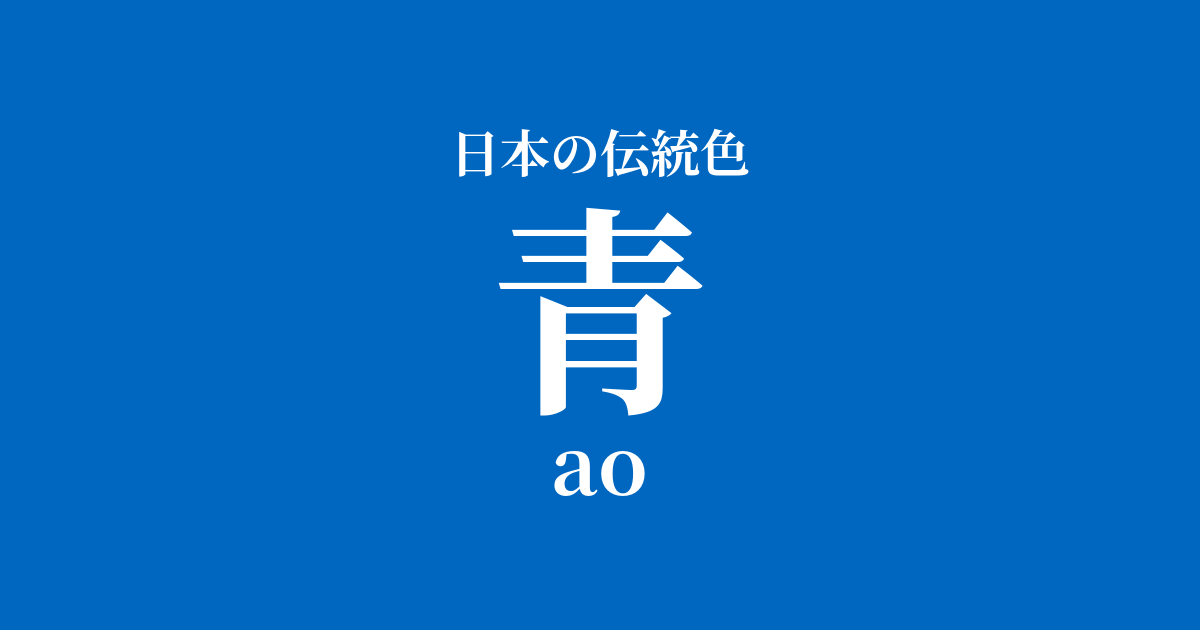
| Japanese color name | 青 |
|---|---|
| reading | ao |
| HEX | #0067C0 |
| RGB | 0, 103, 192 |
What does "blue" mean? Origin and etymology
The etymology of the word "ao" is not clearly understood, but the most likely theories suggest it derives from "au" (合), meaning the absence of light, or "ake" (明), meaning the dawn breaking. In ancient Japan, there were few words to strictly distinguish colors, and "ao" referred to a very broad range of colors, including not only the blue we know today, but also green, indigo, and even white and a dark gray. Even today, remnants of this can be seen in expressions such as "ao kosha" (green traffic light) and "ao na shita yama" (a lush, green mountain).
The historical background of blue
In ancient Japan, colors were expressed using four basic words: "aka" (bright), "kuro" (dark), "shiro" (clear), and "ao" (vague). "Ao" referred to a general range of indistinct, intermediate shades. As dyeing technology advanced during the Heian period, color names became more specialized. "Ao" came to primarily refer to colors produced by indigo dyeing, and various shades of blue were created by varying degrees of indigo, such as hanada (light blue) and ai-iro (indigo blue), which were used in the clothing of the nobility.
During the Edo period, indigo dyeing became widespread among ordinary people along with the popularization of cotton. Kimonos, hand towels, and noren curtains were dyed in a vibrant indigo blue, and its durability and the beauty of its color led to it becoming known overseas as "Japan Blue." In this era, blue became a color deeply rooted in the lives of ordinary people, and various shades of blue were enjoyed. Even in modern times, blue continues to be loved by many people as a refreshing color that evokes the sky and the sea.
Related literature, waka poetry, and seasonal words
The Manyoshu anthology contains many poems that use the word "blue," but most of them refer to the green of the mountains. In the famous poem, "Aoniyoshi Nara no miyako wa saku hana no niou ga gotoku ima sakari nari," "aoni" refers to verdigris (greenish-brown) and is used as a poetic epithet for Nara. This indicates that "ao" at that time was a broad concept that included the color green.
In Heian literature, works such as "The Tale of Genji" depict various shades of blue as the colors of the characters' clothing. For example, shades like hanada-iro (light blue) and asagi-iro (light blue) were used as important elements to express social status and the feeling of the season. As a seasonal word, "blue" is often used in words that describe the vibrant nature of early summer, such as "green leaves," "green rice fields," and "green storm."
Looking up at the blue ocean, mist rises, the sun hangs low, and I wonder where the boat is.
Color scheme preview
This is to check the readability of the text when this color is used as the background.
Blue color scheme proposal
White (#FFFFFF)
The combination of blue and white evokes images of the sky and clouds, and waves and whitecaps, giving a refreshing and clean impression. It is a classic color scheme also seen in the traditional Japanese pattern called Seigaiha, and is well-suited to expressing coolness and freshness.
Blue gold (#FABE00)
The vibrant blue and the slightly reddish-yellow turmeric color are close to complementary colors, enhancing each other's beauty. This color scheme gives a powerful and vibrant impression, with a strong visual contrast. It is a combination that can also be found in Buddhist art and crafts.
Indigo (#165E83)
By combining blue with indigo, a similar color, a deep, nuanced, and sophisticated gradation is created. This color scheme, reminiscent of the shades of indigo dye, is unified yet avoids monotony, giving an intelligent and refined impression.
Practical Scenes
In the world of kimono, blue is frequently used in yukata and summer kimono, giving a cool and refreshing impression. Indigo-dyed blue, in particular, shows various expressions depending on its shade, creating a stylish look. Pairing it with white or yellow in the obi or accessories can add a touch of freshness and elegance.
In interior design, blue is often used in bedroom and study wallpaper and curtains because it is believed to have a calming effect. Combining it with white or wood-grain furniture creates a clean and natural space. Using blue as an accent color in cushions and accessories is also effective.
In web and graphic design, blue is often used as a corporate color, symbolizing trustworthiness and integrity. It is particularly common on the websites of IT companies and financial institutions. When combined with white or gray, it creates a clean and intelligent impression, instilling a sense of security in users.