
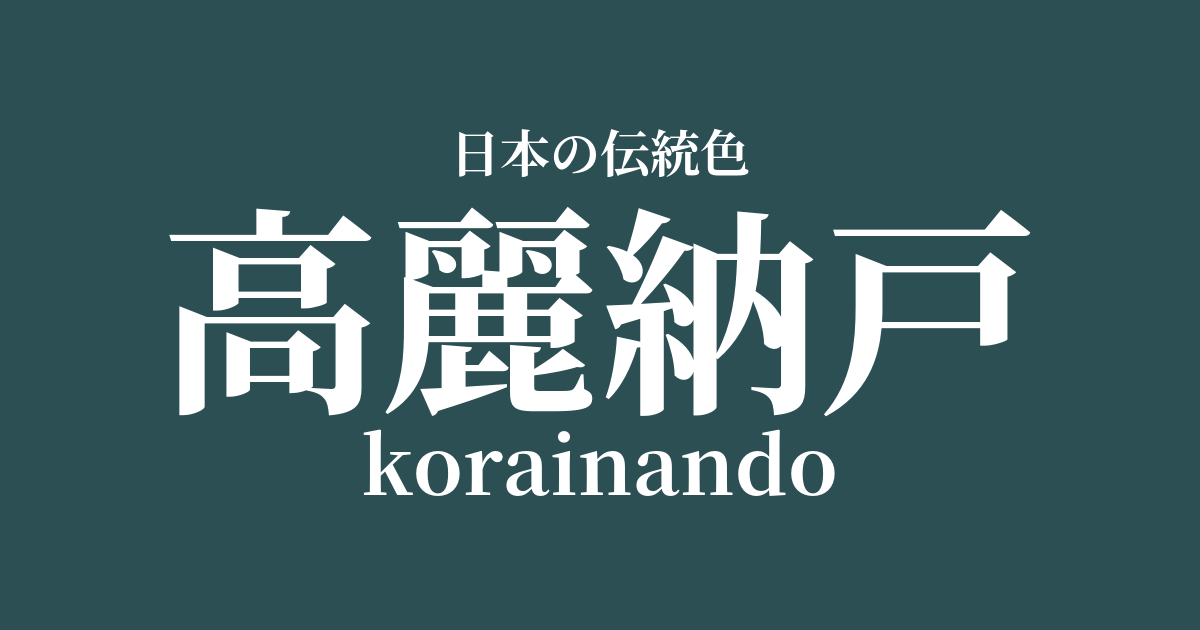
| Japanese color name | Korean storage room |
|---|---|
| reading | korainando |
| HEX | #2C4F54 |
| RGB | 44, 79, 84 |
What is a Koma-nando? Origin and etymology
Koma-nando is a traditional Japanese color referring to a dark blue with a greenish tint. "Nando-iro" is one of the color systems of indigo dye that was widely popular during the Edo period. There are several theories about the origin of its name, but it is generally believed to have been named because it resembles the dark color of a "nando" (storage room). The most likely explanation for the "Koma" prefix to Nando-iro is that it derives from the mysterious and deep blue-green color of Goryeo celadon, which was introduced from the Korean Peninsula.
It is believed that the beautiful celadon color influenced the name of this color.
The color "nando" (plain blue) can be expressed in various shades depending on the intensity of the indigo dye, and "Koma-nando" (Korean plaster blue) is particularly characterized by its strong green hue. It is said that this greenish-blue color was achieved by shortening the dyeing time in the indigo vat or by lightly pre-dyeing with yellow dyes such as Phellodendron amurense. It can be said to be one of the delicate and profound colors produced by the advanced dyeing techniques of Edo craftsmen.
Historical background of the Goryeo storage room
From the mid-Edo period onward, when sumptuary laws restricted the use of bright colors, the color "nando-iro" (a type of dark blue) was favored by a wide range of social classes, from commoners to samurai. In particular, along with brown and gray, it became one of the fashionable colors known as "48 shades of brown and 100 shades of gray," and a wide variety of variations arose due to differences in shade and hue. Koma-nando (another type of dark blue) was one such variation, and was favored as a "chic" color in Edo's townspeople culture.
Korean-style dark blue was used in a variety of applications, from the costumes of Kabuki actors to the everyday wear of townspeople and the lining of haori jackets. In particular, it was popular as a color that symbolized the Edo aesthetic of "ura-masari," where the outer fabric was a subdued color but the lining was elaborate. Its calm and deep hue made it ideal for expressing a refined style that was different from flashy fashion.
Related literature, waka poetry, and seasonal words
It is difficult to pinpoint any famous waka poems or literary works that directly mention the color name "Koma-nando." However, in Edo period works depicting customs such as sharebon (humorous novels), ninjobon (sentimental novels), and ukiyo-e (woodblock prints), nando-type colors are frequently depicted as fashionable colors of the time. Through these works, we can catch a glimpse of the role that Koma-nando played in the culture of Edo townspeople.
In particular, in the world of Kabuki, the color of the costumes was an important element that symbolized the character's personality and social status, so it is said that colors from the Nando family were used for various roles. Although it is not directly associated with seasonal words, its deep blue-green color is sometimes used to express a sense of the seasons, as it evokes the coolness of summer or the tranquility of autumn.
Color scheme preview
This is to check the readability of the text when this color is used as the background.
Color scheme proposal for the Korean-style storage room
White tea (#B59778)
The deep blue-green of the Korean-style brocade and the bright, warm beige of the white-brown create a beautiful contrast. The result is a calm yet gentle and elegant impression, giving it a sophisticated, modern Japanese feel. It is well-suited for interior design and traditional Japanese clothing.
Light blue (#00A3AF)
By combining the same blue-green shade of Kōrai-nando with a light blue-green color, a harmonious gradation is created. The brightness of the light blue-green is added to the deep Kōrai-nando, giving a refreshing and intellectual impression. This is effective in web design and kimono obi matching.
Persimmon color (#ED7D31)
The vibrant orange of persimmon, which is almost a complementary color to the blue-green of Korean indigo, enhances each other's beauty. This creates a powerful and striking color scheme that attracts attention. It is particularly effective when used as an accent color for accessories or designs.
Practical Scenes
In the world of traditional Japanese clothing, Kōrai-nando (a type of dark blue) is used for men's kimonos and haori jackets, and for women's obi sashes and obiage (decorative sashes). Its subdued color gives an impression of sophistication and refinement, and it is particularly appreciated as a color favored by connoisseurs. Depending on how it is combined with other colors, it can be enjoyed in any season.
In interior design, incorporating Korean-style plasterwork as an accent color in wallpaper, curtains, and cushions brings depth and tranquility to a space. Adding Korean-style plasterwork to a natural space with white or wood tones can create a modern Japanese and luxurious atmosphere.
In web and graphic design, using it as a background or main color conveys a sense of trustworthiness and intelligence. It pairs well with white or light gray text colors, helping to create a sophisticated design while maintaining readability.