
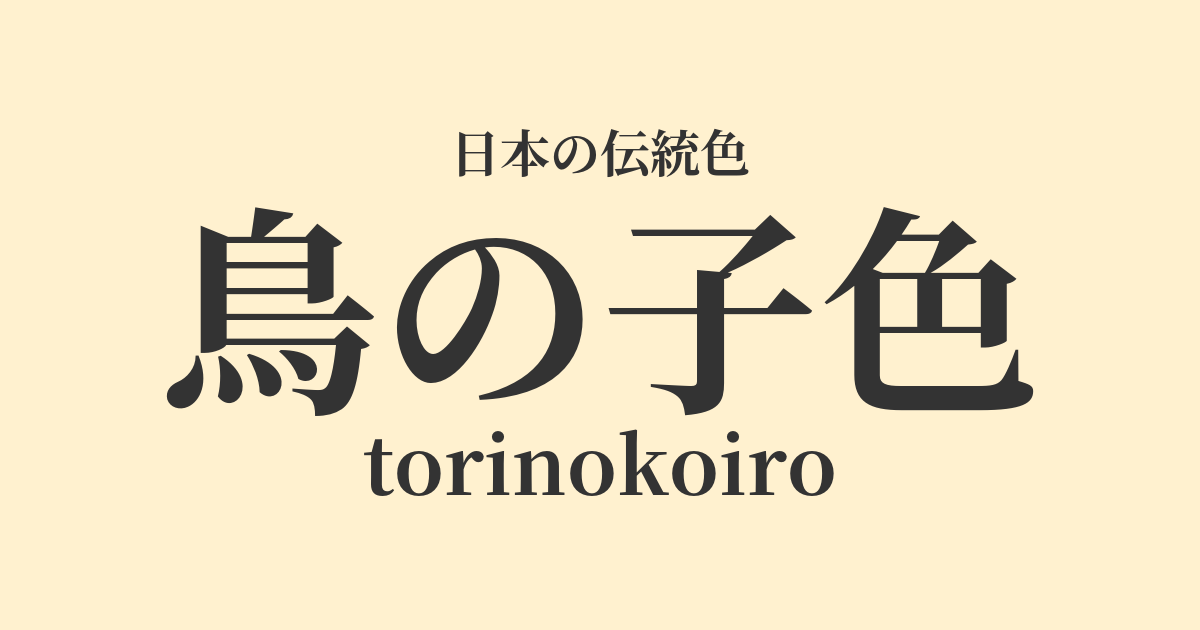
| Japanese color name | Bird's eye color |
|---|---|
| reading | torinokoiro |
| HEX | #FFF1CF |
| RGB | 255, 241, 207 |
What is "bird's egg color"? Origin and etymology
Torinoko-iro, as the name suggests, refers to a very pale yellowish-red color, like the shell of a chicken egg. "Torinoko" has long been a word meaning chicken egg, and the name originates from its gentle and warm hue. This color is also widely known as the color of "Torinoko paper," a high-quality Japanese paper made from ganpi (a type of fiber). It is said that the paper came to be called by this name because its color resembled the color of an eggshell.
This demonstrates how deeply rooted the Japanese aesthetic sense is in the gentle colors found in nature.
The historical background of the bird's egg color
The history of the Torinoko color is long, dating back to the Heian period. At that time, a smooth and lustrous paper called "Torinoko paper" was made from ganpi (a type of fiber), and the color of this paper became known as Torinoko color. This paper is mentioned in the Engishiki (a historical document), and it was a luxury item mainly used by the nobility and upper classes for writing and painting. In the Edo period, with improvements in papermaking technology, Torinoko paper became more widespread, and Torinoko color became a familiar color in people's lives, used in things like sliding doors and wallpaper.
Related literature, waka poetry, and seasonal words
In the world of literature, the color "Torinoko" (a type of Japanese paper) primarily appears as "Torinoko paper." For example, in Heian period literature such as "The Pillow Book" and "The Tale of Genji," Torinoko paper is depicted as synonymous with high-quality paper and treated as an important tool for writing waka poems and letters. Although there are few waka poems that directly mention the color, its presence as a background color that enhances the beauty of the ink and paints written on Torinoko paper adds an elegant touch to the stories.
This suggests that the color "bird's egg" played an important role in the aristocratic culture of the time.
The white of the bird's egg on the sliding door, this morning's snow.
Color scheme preview
This is to check the readability of the text when this color is used as the background.
Suggested color scheme in bird's egg color
Black (#1C1C1C)
The soft, light green background, with its striking ink black accents, is a classic combination that enhances the presence of characters and illustrations. It gives an elegant and dignified impression in calligraphy and traditional Japanese design.
Dark blue (#F4B3C2)
The soft yellow and gentle pink harmonize to create a warm and elegant atmosphere reminiscent of spring. It is suitable for feminine designs, Japanese clothing accessories, and Japanese sweets.
Young bamboo green (#78B474)
The warmth of the eggshell color and the freshness of the young bamboo green combine to create a natural and vibrant impression. It can express tranquility and cleanliness in interior and web design.
Practical Scenes
The delicate and understated color of Torinoko yellow is used in a variety of situations. In traditional Japanese clothing, it is used as the base color for kimonos and obi sashes, playing a role in highlighting other vibrant colors and patterns. It is especially valued as a color that adds elegance to formal attire such as visiting kimonos and formal kimonos.
In the field of interior design, it is widely used as a standard color for wallpaper and sliding door paper. It has the effect of making a space appear brighter and larger, and it harmonizes not only with Japanese-style rooms but also with natural modern Western-style rooms. It also goes exceptionally well with natural materials such as wood and tatami mats, creating a relaxing atmosphere.
In modern web and graphic design, the light yellow color (or "bird's eye" yellow) remains a popular background color. It's easy on the eyes and doesn't compromise content readability, making it less tiring to view for extended periods. It's suitable for creating minimalist and sophisticated designs, or when you want to express an organic atmosphere.