
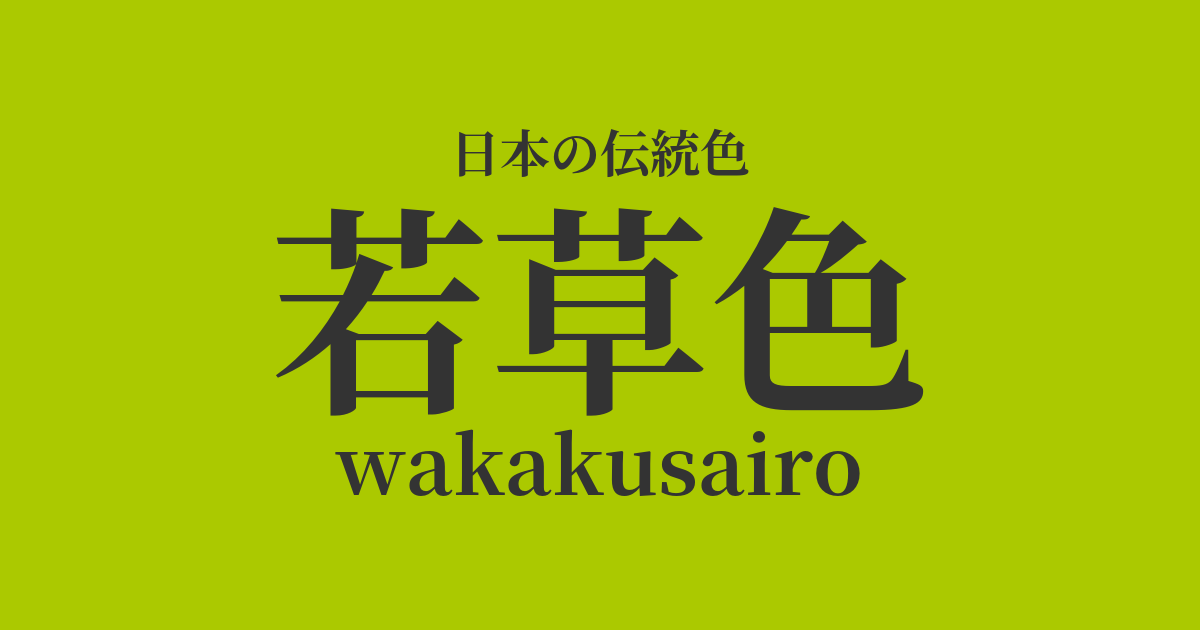
| Japanese color name | light green |
|---|---|
| reading | wakakusairo |
| HEX | #ABC900 |
| RGB | 171, 201, 0 |
What is "Wakakusa-iro" (light green)? Origin and etymology.
As its name suggests, Wakakusa-iro (young grass green) is a color name derived from the young leaves of grass that have just sprouted in early spring. It is a vibrant yellowish-green full of vitality and has been cherished by people since ancient times. It reflects the traditional Japanese sensibility of delicately capturing natural landscapes and incorporating them into color names. The word "waka" (young) carries meanings of freshness, immaturity, and hope for the future, and it is said that this color has been used in many situations as a symbol of new beginnings and growth.
A historical background in light green
The name "wakakusa-iro" (young grass green) is an old color name that can be found in literary works from the Heian period. It appears in "The Tale of Genji" and "The Pillow Book" as a color symbolizing youthfulness and the arrival of spring. In particular, it was a favorite color for spring clothing among the Heian aristocracy, and it is said that there was a combination of "wakakusa" in the layered color combinations (kasane no irome). In the Edo period, it became more widespread among the common people and came to be used in various things such as kimonos and crafts.
Related literature, waka poetry, and seasonal words
The color young grass has been used in many literary works to depict spring scenes. In "The Pillow Book," its freshness is praised with the expression "young grass, just beginning to sprout." In the world of haiku, "young grass" is established as a seasonal word for spring, and is used in poems to evoke the breath of life and hope. Through classical literature, we can see that young grass is not merely a color expression, but is deeply connected to emotions such as a sense of the season and youthfulness.
Young grass, picked up by a skylark chick
Color scheme preview
This is to check the readability of the text when this color is used as the background.
A color scheme proposal in light green.
Cherry blossom pink (#FEEAFA)
Combining the quintessential spring colors of light green and cherry blossom pink most symbolically represents the scenery of spring in Japan. It evokes a sense of the season, where life sprouts and flowers bloom, creating a bright and hopeful impression. This color scheme is highly compatible with traditional Japanese clothing and designs.
Golden (#E6B422)
Combining vibrant light green with lustrous gold creates an impression that is both luxurious and youthful. Gold symbolizes abundance and prosperity, and when combined with the vitality of light green, it creates an even more positive and powerful image. It is suitable for traditional patterns and celebratory designs.
Lapis Lazuli (#1F4788)
By combining a vibrant, light green with a deep, calming lapis lazuli blue, a contrast is created where each color enhances the other. The lightness of the light green is complemented by the richness of the lapis lazuli blue, giving a sophisticated and intellectual impression. This color scheme is suitable for modern designs and contemporary Japanese spaces.
Practical Scenes
In the world of kimono, light green is an essential color for spring attire. It is especially common in the furisode and houmongi worn by young women, as well as in accessories such as obiage and obijime. When combined with cherry blossom pink, white, or golden yellow, it creates a bright, lovely, and spring-like impression. As it is considered stylish to anticipate the season, it is generally worn from early spring to the height of spring.
In interior design, light green is an effective accent color that brings brightness and freshness to a space. Incorporating it into cushions, curtains, or parts of the wallpaper will give the entire room a lively feel. It pairs well with natural wood and white-based spaces, and when used with houseplants, it can create an even more natural and relaxed atmosphere.
In web and graphic design, light green is suitable for conveying concepts such as freshness, nature, and health. It is used as a brand color for organic product websites, environmentally related content, and new services and startups. When combined with white or light gray, it conveys a sense of cleanliness, while when combined with dark brown, it expresses the calmness of an earth tone.