
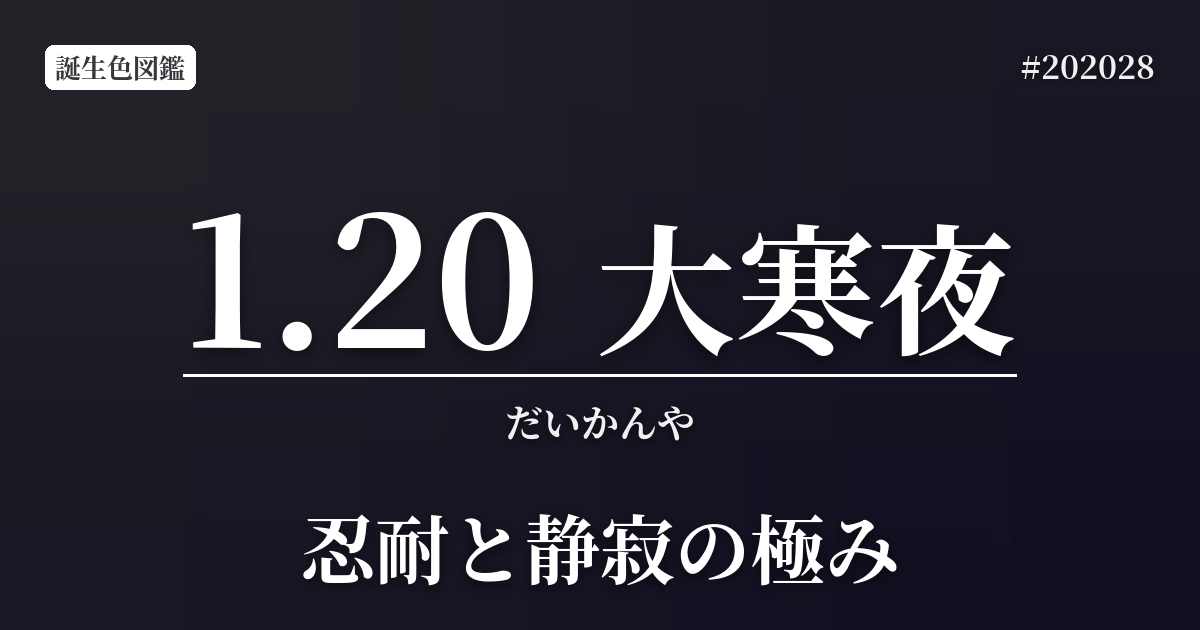
| birthday | January 20 |
|---|---|
| Color name | The coldest night of the year (Daikanya) |
| HEX | #202028 |
| RGB | 32, 32, 40 |
| Color meanings | The epitome of patience and silence |
- What is the birth color "Daikanya" for January 20th?
- The color's meaning is "the epitome of patience and tranquility," and it relates to personality.
- Connection to the seasons — Daikan (Great Cold): The coldest time of the year
- Color scheme preview
- Color scheme proposal for the coldest night of the year.
- FAQ
- Related traditional colors
What is the birth color "Daikanya" for January 20th?
"Daikanya" (Great Cold Night) is a color that evokes the icy, clear night sky of "Daikan," the coldest time of the year. This deep, quiet navy blue, almost black, gives off a sense of stillness and mystery, as if it could absorb even the light of the stars.
This color symbolizes the very essence of winter nature, where all things lie dormant, patiently awaiting spring. A dignified elegance permeates its coolness, possessing a calming power that encourages introspection. It is filled with a serene charm that invites you into a world of deep thought and meditation.
The color's meaning is "the epitome of patience and tranquility," and it relates to personality.
People who prefer this color tend to have a thoughtful and calm personality, carefully discerning the essence of things. They have little interest in superficial flashiness or noise, and value quiet environments for introspection.
Possessing strong perseverance and mental fortitude, they have the determination to stubbornly see things through once they've made a decision. Their unwavering adherence to their beliefs without being swayed by others may make them seem a little mysterious to some, but their honesty and sincerity earn them deep trust.
Connection to the seasons — Daikan (Great Cold): The coldest time of the year
January 20th marks "Daikan" (Great Cold) in the 24 solar terms. As the name suggests, it is the coldest time of the year. During this time, nature is quiet, and many plants and animals endure the harsh cold while waiting for the arrival of spring.
On the other hand, Japan also has a culture that takes advantage of this harsh cold. For example, "kanjikomi," the brewing of sake, miso, and soy sauce during this time, is said to produce a rich flavor because the low temperatures make it difficult for bacteria to grow and fermentation and maturation proceed slowly. It is also a season for training the mind and body, as martial arts "kankeiko" (winter training) is practiced during this time.
Color scheme preview
This is to check the readability of the text when this color is used as the background.
Color scheme proposal for the coldest night of the year.
Tsukihaku (#EAF4FC)
This color scheme, reminiscent of moonlight shining in the clear winter night sky, adds a touch of "moon white" to the deep darkness of a cold winter night. It evokes a dignified beauty and a sense of hope, like a single ray of light piercing through the silence. The contrasts enhance each other, creating a sophisticated impression.
Amber (#BF783A)
This combination adds the warmth of amber to the quiet, cold colors of a bitterly cold night. Like the flame of a fireplace lit on a cold night, it brings peace and warmth to the heart. It's a color scheme that evokes a sense of human warmth within an intellectual and calm atmosphere.
Lapis Lazuli (#1F4788)
By combining it with a "lapis lazuli" color that is slightly brighter than the coldest night of the year, it expresses a gradient like the sky as it transitions from the deepening of night to dawn. This color scheme further enhances an intelligent and sincere impression, creating a calm and profound worldview.