
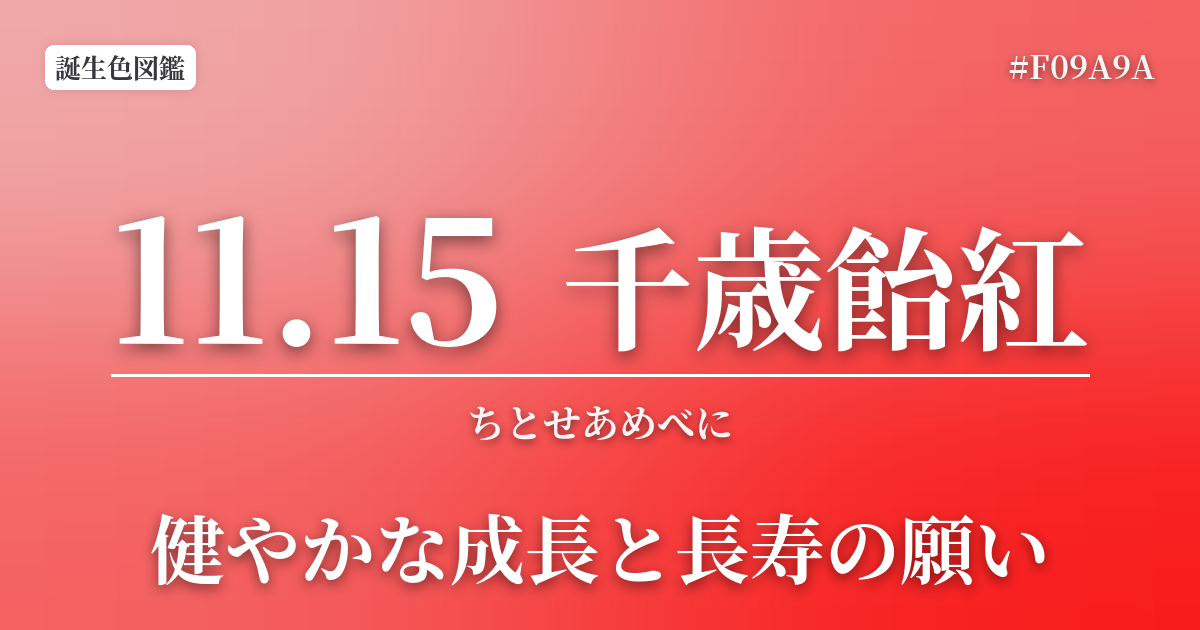
| birthday | November 15 |
|---|---|
| Color name | Chitoseamebeni (a type of candy) |
| HEX | #F09A9A |
| RGB | 240, 154, 154 |
| Color meanings | Wishing for healthy growth and longevity |
- What is "Chitose Ame Beni," the birth color for November 15th?
- The color's meaning is "a wish for healthy growth and longevity," and it relates to personality.
- Seasonal connections — Shichi-Go-San (a traditional Japanese rite of passage for children) and Chitose-ame (a type
- Color scheme preview
- Chitose Ame Beni color scheme proposal
- FAQ
- Related traditional colors
What is "Chitose Ame Beni," the birth color for November 15th?
The birth color for November 15th is "Chitoseame Beni." This birth color was created by this website, inspired by the Shichi-Go-San festival and Chitoseame candy. As the name suggests, it is a gentle, warm, pinkish-red color, reminiscent of the red and white "beni" (red) of Chitoseame candy, which celebrates a child's growth.
This color symbolizes the bright smiles of children and the love of families wishing for a healthy future. The color's meaning, "wishes for healthy growth and longevity," perfectly reflects the parents' hopes entrusted to the Chitose-ame candy. It's a color that warms the hearts of those who see it, filled with a sense of happiness.
The color's meaning is "a wish for healthy growth and longevity," and it relates to personality.
People who like this color tend to be loving and compassionate. In color psychology, pink shades, which are a mixture of red and white, are associated with gentleness, motherhood, and happiness. They are likely to be people who cherish those close to them, such as family and friends, and who can rejoice in their happiness as if it were their own.
Furthermore, possessing both the energy of red and the purity of white, they have a bright and sociable yet gentle aura that never intimidates others. They also have a childlike honesty and innocence, and their presence brings a sense of security and warmth to those around them.
Seasonal connections — Shichi-Go-San (a traditional Japanese rite of passage for children) and Chitose-ame (a type
November 15th is Shichi-Go-San, a traditional Japanese event to celebrate children's growth and pray for their future happiness. Boys visit shrines dressed in formal attire at the ages of 3 and 5, and girls at the ages of 3 and 7.
An essential part of this day is "Chitose-ame." These are long, red and white stick-shaped candies, and as the name "Chitose" suggests, they are a lucky charm given by parents to their children with the wish that they will live a long and healthy life until they reach the age of 1000. "Chitose-ame Beni" vividly reflects the joyous atmosphere of this celebratory day and the hope for a healthy future for the children.
Color scheme preview
This is to check the readability of the text when this color is used as the background.
Chitose Ame Beni color scheme proposal
Milky white (#F3F3F3)
This pure and gentle combination represents the red and white colors of Chitose candy. It enhances the celebratory atmosphere of a special day and highlights an impression of purity and innocence. It is perfect when you want to achieve both a sense of cleanliness and warmth.
Bamboo green (#A5D4AD)
By combining soft red hues with the vibrant green of young bamboo, the colors complement each other beautifully. This color scheme evokes the growth and youthfulness of children, creating a fresh and hopeful impression.
Walnut color (#A5836A)
The warm, inviting Chitose-ame red is complemented by a natural walnut color, creating a calm and reassuring color scheme. It evokes the deepening of autumn, creating a gentle, comfortable, and natural atmosphere.