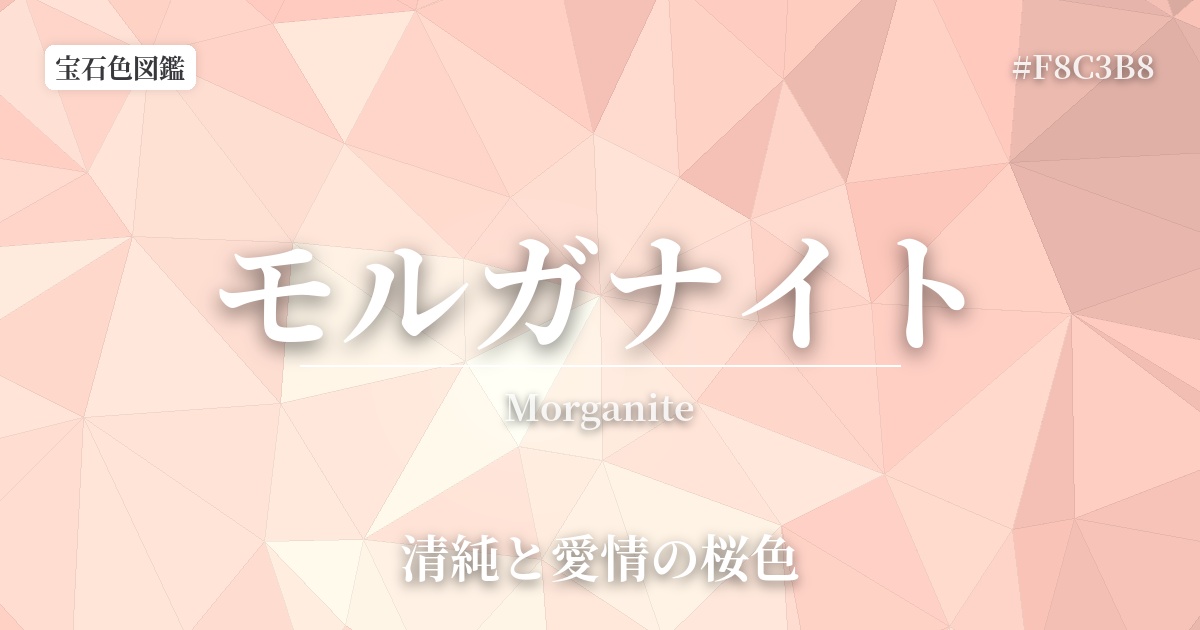
| English name | Morganite |
|---|---|
| Katakana | Morganite |
| HEX | #F8C3B8 |
| RGB | 248, 195, 184 |
| Mineralogy | Silicate minerals |
What is morganite? Origin and mineralogy
Morganite is a gemstone with a romantic story behind its name. It was named in honor of John Pierpont Morgan, a leading American banker and avid gem collector of the early 20th century. The name was coined by Dr. George Frederick Kunz, a renowned gemologist at Tiffany & Co. This fact speaks to how highly valued morganite was recognized from its very first discovery.
Mineralogically, morganite belongs to the beryl mineral group. This group also includes the vibrant green emerald and the clear blue aquamarine, and morganite is, so to speak, their "pink sister." This beautiful cherry blossom pink color is created by trace amounts of manganese ions contained within the mineral. Due to its delicate hue and high transparency, it is highly valued as a gemstone.
The main producing regions are Brazil, Madagascar, Afghanistan, and Mozambique. In particular, the Madagascar specimens, which were the first to be discovered, are considered to have a deep, beautiful color and are popular among collectors.
The history and culture of morganite
The history of morganite is relatively recent compared to many other gemstones, having been first discovered in Madagascar in 1910. Shortly after its discovery, its value was recognized by Dr. Kunz of Tiffany & Co., and through the company's strong promotion, it became known worldwide.
J.P. Morgan made significant contributions to the development of mineralogy, including donating his vast gem collection to the American Museum of Natural History and the French Museum of Natural History. Dr. Kunz's naming of the new pink beryl as "morganite" was a token of gratitude for Morgan's achievements and his deep love for gemstones.
While it doesn't have the long history of being part of royal jewelry traditions, its modern and elegant colors continue to captivate contemporary designers and jewelry enthusiasts. It's increasingly being chosen as an engagement ring, and is beginning to make its mark on history as a symbol of love in a new era.
Morganite and color psychology
The gentle, pale cherry blossom pink of morganite soothes the viewer's heart and brings a sense of calm. In color psychology, pink is considered a symbol of love, happiness, gentleness, and compassion. The translucent pink of morganite particularly evokes deeper spiritual connections, such as "pure love" and "unconditional love."
As a power stone, it is known as a "stone that attracts love and fosters compassion." It is said to be a comforting presence when you want to deepen your relationship with a loved one, or when you wish to love yourself and shine from within. It is also said to heal past emotional wounds and support you in moving forward into the future with a positive attitude.
Color scheme preview
This is to check the readability of the text when this color is used as the background.
Morganite color scheme proposal
Dove Gray (#C9C0BB)
The gentle pink of morganite, combined with a calm gray, creates a sophisticated and elegant look. This color scheme is perfect when you want to give off a calm and elegant impression without being overly sweet.
Celadon Green (#ACE1AF)
This color scheme evokes a natural and fresh impression, reminiscent of cherry blossoms and young leaves. It creates a gentle and calm atmosphere that evokes the arrival of spring, bringing peace to the heart.
Champagne (#F7E7CE)
The sparkling champagne color complements the pink of the morganite, enhancing the glamorous and romantic atmosphere. This combination is recommended for special occasions or designs that express elegance.
Practical Scenes
In the world of jewelry, morganite is extremely popular as an engagement ring stone due to its romantic hue. It pairs particularly well with rose gold, creating elegant designs where the gemstone and metal seem to blend seamlessly. When worn as a necklace or earrings, it can also have the effect of gently brightening the face.
In interior design, morganite serves as an accent color that brings warmth and elegance to a space. Incorporating the color of morganite into cushion covers, curtains, or artwork creates a calm and comfortable atmosphere throughout the room. It looks particularly good in natural spaces based on white, beige, and light wood tones.
In website and graphic design, this color is ideal for wedding-related themes, luxury cosmetics, and lifestyle brands. It effectively conveys femininity, purity, and sophistication.