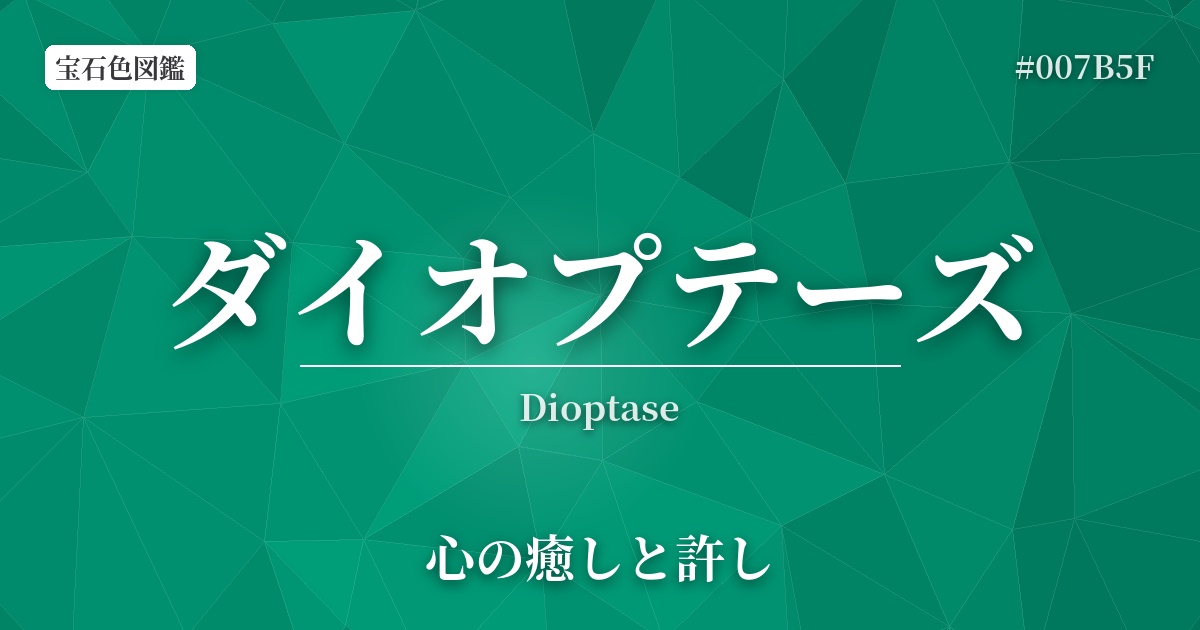
| English name | Dioptase |
|---|---|
| Katakana | Dioptase |
| HEX | #007B5F |
| RGB | 0, 123, 95 |
| Mineralogy | Silicate minerals |
What is dioptase? Origin and mineralogy
The name dioptase comes from the Greek words "dia," meaning "through," and "optos," meaning "visible." This name was chosen because, when the crystal of this mineral is viewed from a certain angle, the internal cleavage planes (the directions in which the crystal is prone to breaking) become visible.
Mineralogically, it is classified as a cyclic silicate mineral containing copper. This copper is the source of dioptase's breathtakingly beautiful green color. However, despite its beauty, it is relatively soft with a Mohs hardness of 5 and is extremely brittle due to its perfect cleavage. For this reason, it is extremely difficult to process into jewelry and is mainly prized as a rare collector's stone.
Major producing regions include Kazakhstan, Namibia, the Democratic Republic of Congo, and Arizona in the United States. In particular, crystals from the Tsumeb mine in Namibia are highly valued by collectors worldwide for their transparency and depth of color.
The history and culture of dioptase
Dioptase first appeared on the historical stage at the end of the 18th century. When it was first discovered in the Altyn-Tube mine in Kazakhstan, its vibrant green color led to it being mistaken for an emerald. At one point, it was also known by names such as "ashlite emerald" and "copper emerald."
However, in 1797, the renowned French mineralogist René-Just Haui studied this mineral in detail and discovered that it was a new type of mineral distinct from emerald. He then named it "dioptase" due to its distinctive optical properties.
Due to its fragility, there are few records of it being widely used as ornament in ancient civilizations. However, since its discovery, its unparalleled color has captured the hearts of many mineral enthusiasts and collectors, and to this day it continues to exude a special presence as the "phantom green."
Dioptase and Color Psychology
The deep, vibrant green of dioptase is said to bring peace and harmony to the viewer's heart. In color psychology, green symbolizes nature, growth, and healing, and is expected to have a balancing effect on mind and body.
In the world of gemstones, dioptase is known as a stone that symbolizes "healing and forgiveness of the heart." It is believed to work on the heart chakra, helping to release past emotional wounds and traumas and resolving emotional blockages.
It is said to help cultivate feelings of forgiveness towards oneself and others, and to support the breaking of negative emotional cycles. This will bring the mental strength and positive perspective needed to take a new step forward.
Color scheme preview
This is to check the readability of the text when this color is used as the background.
Dioptase color scheme proposal
Antique White (#FAEBD7)
The warm, antique white color complements the deep green of the dioptase, creating a natural and calming atmosphere. It's perfect for when you want to give off an organic and sophisticated impression.
Gold (#FFD700)
The golden sheen adds a rich accent to the green of the dioptase, creating a classic and luxurious impression. This timeless combination is perfect for jewelry and elegant designs.
Charcoal (#36454F)
The deep gray of charcoal highlights the vibrant green of dioptase, creating a modern and sophisticated contrast. This color scheme is recommended for urban and stylish spaces and designs.
Practical Scenes
In the world of jewelry, dioptase is treated as a very delicate gemstone due to its fragility. It is not suitable for rings or bracelets that are easily damaged by impact, and is mainly used in protected designs such as pendants and earrings. It is rarely cut, and is mostly made for collectors as raw gemstone jewelry that makes the most of the beautiful crystal shape.
In interior design, this deep green is a highly effective accent color that brings calmness and vitality to a space. Incorporating it into cushions, curtains, or artwork can create a sophisticated and relaxing atmosphere. It pairs particularly well with houseplants and complements a natural modern style.
In web and graphic design, dioptase colors are suitable for expressing themes such as reliability, growth, and nature. Using them in logos for environmental companies and wellness brands, or in packaging for premium organic products, can convey an image of quality and integrity.