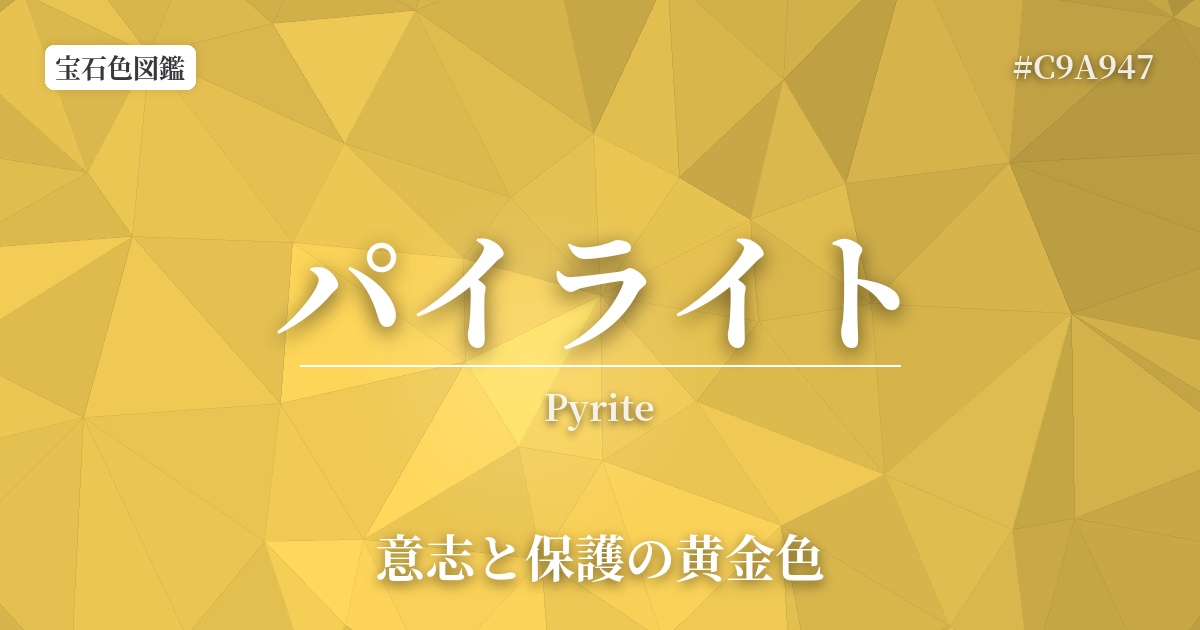
| English name | Pyrite |
|---|---|
| Katakana | Pyrite |
| HEX | #C9A947 |
| RGB | 201, 169, 71 |
| Mineralogy | sulfide minerals |
What is pyrite? Origin and mineralogy
The name pyrite comes from the Greek word "pyr," meaning "fire." This is because pyrite sparks when struck hard with iron or flint. Due to this characteristic, it was used in ancient times as a tool for starting fires.
Mineralogically, pyrite is a sulfide mineral (FeS2) composed of iron and sulfur. Its pale yellow color, similar to brass, and strong metallic luster have often led to it being mistaken for gold, earning it the famous nickname "Fool's Gold."
It is a very common mineral found in various geological environments around the world and is known for forming beautiful cubic and dodecahedral crystals. Major sources include Spain, Peru, Italy, and the United States.
Pyrite is sometimes found near gold veins and serves as a "pilot mineral" (a guide stone) for those searching for gold. It's an interesting mineral that can be mistaken for gold, yet it also provides an important clue to finding real gold.
The history and culture of pyrite
Pyrite has a long history, having been used as ornaments and ceremonial tools in many civilizations, including ancient Greece, Rome, and the Inca Empire. In particular, it is said that the ancient Incas used large, polished pyrite slabs as magical mirrors.
In Europe during the 16th and 17th centuries, marcasite gained popularity as a gemstone due to its brilliance. In Victorian England in particular, it became fashionable as "marcasite jewelry," but the material used in this jewelry was not actually mineralogical marcasite, but rather pyrite, which is more stable and has been cut into small facets.
The name "fool's gold" originates from its history of misleading many prospectors during the gold rush. However, among Native Americans, it was also cherished as a sacred stone that healed the mind and body.
Pyrite and color psychology
The powerful golden glow of pyrite symbolizes sun-like energy and is believed to enhance willpower, confidence, and drive. It is seen as a color that illuminates the path to achieving goals and provides the mental strength to face challenges.
Furthermore, due to its robust crystalline structure and spark-generating properties, it has long been believed to be a stone possessing powerful protective abilities. It is also considered a talisman that protects the wearer from negative energy and danger. It is also said to stimulate intellect and enhance memory and concentration.
Color scheme preview
This is to check the readability of the text when this color is used as the background.
Pyrite color scheme proposal
Midnight Blue (#191970)
The combination of pyrite's golden hue and profound midnight blue evokes the stars shining in the night sky, creating a dramatic and luxurious impression. The colors complement each other, resulting in a refined and powerful look.
Sienna (#A0522D)
By combining it with the warm, earthy Siena, the metallic sheen of pyrite gains a natural and calming feel. The color scheme is simple yet somehow evokes a sophisticated urban warmth.
Ivory (#FFFFF0)
The soft ivory background highlights the metallic sheen and golden hue of the pyrite. This combination creates a clean and elegant impression, bringing brightness and a sophisticated accent to the space.
Practical Scenes
In the world of jewelry, pyrite is popular for its unique metallic luster, used in beads, cabochons, or necklaces and bracelets that utilize the raw crystal form. It pairs particularly well with industrial and modern designs, and is often used in bold statement pieces.
In interior design, incorporating pyrite-colored accessories (such as photo frames, lighting fixtures, and decorative objects) can add warmth and a sophisticated accent to a space. It adds a touch of luxurious brilliance to industrial chic and modern styles.
In web and graphic design, this color is suitable for conveying a sense of luxury and stability. Especially when combined with a dark background, it can make elements such as buttons, icons, and headings stand out, effectively attracting the user's attention.