
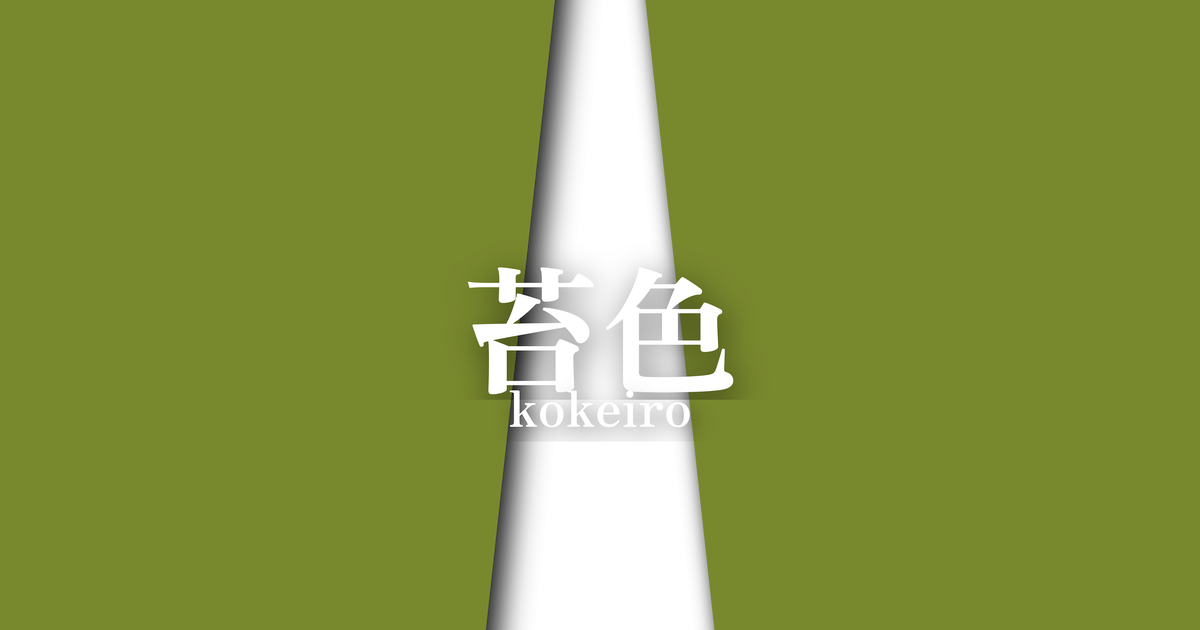
| Japanese color name | moss-colored |
|---|---|
| reading | kokeiro |
| season | Miscellaneous (year-round/celebratory) |
| Color of the table | Moss green (kokeiro) |
| Back color | White (shiro) |
What is moss green? Origin and etymology
"Moss green" is a color combination that represents the way moss takes deep root in rocks and old trees and grows over many years. The deep, subdued green of the outer layer is said to symbolize the moss itself, while the white of the inner layer is said to symbolize the rock surface on which moss grows, or the way it shines when wet with morning dew. Because moss grows very slowly and remains in place for a long time once it takes root, it has come to have auspicious meanings such as longevity, prosperity of the home, and permanence. For this reason, it has become a color that is often used at celebratory occasions.
The color is not simply green, but a deep, yellowish green, evoking the vitality of nature and the tranquil flow of time. It can be said that the color name reflects the Japanese aesthetic sense, which values calmness and dignity over flashiness. It is one of the colors that originated from the refined sensibilities of the Heian aristocracy, who incorporated natural landscapes into the color schemes of their clothing.
Moss-colored historical background
During the Heian period, in aristocratic society, expressing a sense of the seasons and personal refinement through "kasane no irome," which are combinations of colors used in clothing, was considered important. "Koke-iro" (moss green) was classified as a "zo" (miscellaneous) color, meaning it did not belong to a specific season, and could be worn throughout the year. In particular, it is said that its subdued hue made it frequently used for the noshi (court robe) and kariginu (hunting robe) worn by men in their prime and beyond.
Furthermore, as an auspicious color symbolizing longevity and prosperity, it was worn during celebratory ceremonies such as coming-of-age ceremonies and conferment of rank, as well as during New Year's celebrations. Its versatility across seasons and its auspicious meaning made it a highly valued color in the attire of court nobles. Even as time passed, its refined and dignified style was favored in samurai society and other similar groups.
Related literature, waka poetry, and seasonal words
In the world of classical literature, moss often appears as a motif symbolizing the passage of many years, a tranquil life detached from the secular world, or a wabi-sabi aesthetic. In works such as "The Tale of Genji" and "The Tale of the Heike," the expression "mossy robes" is found, which is mainly used as a metaphor for the robes of monks or simple clothing. In this case, it is often associated with Buddhist ideas such as seclusion and the impermanence of life.
However, "moss green," as a color combination for layered garments, differs from its literary, melancholic image; it carries a strong auspicious connotation of celebrating longevity. This is related to the fact that moss was seen as a symbol of permanence in the world of waka poetry, as it is celebrated in the national anthem, "Kimigayo." Thus, the word "moss" carries diverse nuances depending on the context, offering insight into the rich sensibilities of the Heian aristocracy.
May your reign last for a thousand, nay, eight thousand years, until the pebbles become mighty rocks covered with moss.
Mossy season and scenery
"Moss green" is classified as a "miscellaneous" color that is not limited to any particular season, making it suitable for year-round wear. The image of moss growing on rocks and slowly spreading over many years was considered a symbol of permanence and continuity. For this reason, it was recognized as a color with a universal beauty that transcends the changing seasons. It was especially favored for auspicious occasions such as New Year's celebrations and celebrations of longevity, where people wished for the prosperity and continuity of the household.
Its deep, subdued hues evoke a quiet, profound natural landscape, distinct from the youthful vibrancy of spring or the splendor of autumn. These colors are suitable for occasions where dignity and inner richness are valued more than ostentatious ornamentation, and they effectively convey the wearer's thoughtfulness and composure.
Moss green color scheme proposal
Kutsuha color (#917347)
The combination of deep green moss and the brown of fallen leaves creates a calm, natural scene reminiscent of a late autumn forest. The harmonious blend of earth tones results in an elegant and sophisticated color scheme.
White tea (#B59775)
Combining a deep, mossy green with a bright, soft off-white creates an overall bright and tranquil impression. The colors complement each other, resulting in a natural and sophisticated color scheme.
Suou (#9E3D3D)
The calming green and the deep reddish madder red have a near-complementary relationship, enhancing each other's beauty. This creates a classic and elegant atmosphere, making it a dignified color scheme suitable for celebratory occasions.
Practical Scenes
In the Heian period, this color was mainly used in men's court attire such as the Naoshi and Kariginu, as well as in the layering of women's Uchiki. Its subdued hue was particularly suitable for conveying the dignity of older individuals. In modern Japanese clothing, incorporating "moss green" into visiting kimonos, solid-colored kimonos, obi sashes, and obi ties can create an elegant and refined look.
Beyond traditional Japanese clothing, "moss green" is used in a variety of fields. In interior design, it can be used in wallpaper, curtains, and cushions to create a calming, modern Japanese space. In fashion, as one of the earth tones, it's easy to incorporate into jackets and knitwear, giving a natural and sophisticated impression. In web design and graphics, it's effective as a key color for websites themed around tradition and nature.