
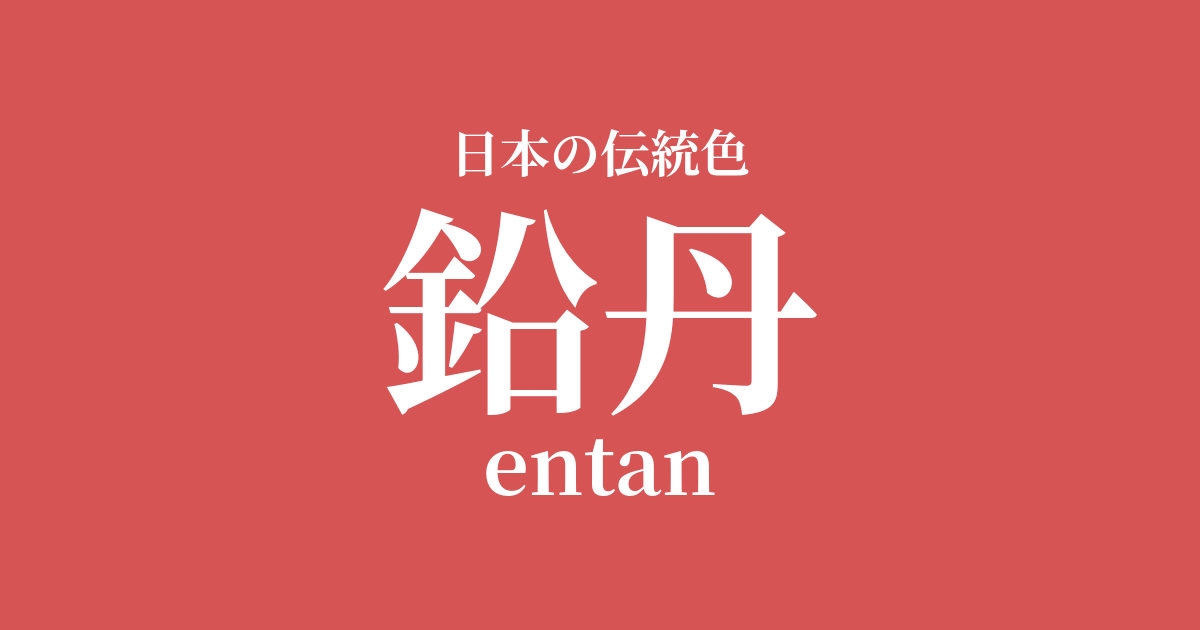
| Japanese color name | Red lead |
|---|---|
| reading | entan |
| HEX | #D75455 |
| RGB | 215, 84, 85 |
What is red lead? Origin and etymology
Red lead is a color derived from an artificial pigment whose main component is lead oxide (trilead tetroxide), which is produced by heating lead. As the name suggests, it means "red" made from "lead," or red earth or pigment. Because it is a chemically synthesized pigment rather than a natural mineral, it has long been possible to obtain a vivid reddish-orange color with stable quality. This color is also called red lead and has been widely used as a paint due to its rust-preventive properties.
Historical background of red lead
The use of red lead is ancient, and in Japan, its use can be seen in murals and excavated artifacts from the Kofun period. During the Nara period, it was used to color important cultural properties such as the murals in the main hall of Horyu-ji Temple and the treasures of the Shosoin Repository. From the Heian period onward, it was highly valued as an indispensable color for the pillars, torii gates, and building decorations of shrines and temples, and its vivid reddish-orange color was considered a symbol of protection against evil and sanctity. During the Edo period, it was sometimes used in ukiyo-e woodblock prints, but with the emergence of cheaper pigments, its role gradually changed.
Related literature, waka poetry, and seasonal words
Red lead, with its vibrant color, appears in literary works. However, it is rarely mentioned directly as "red lead," but rather as "vermilion" or "crimson." For example, it may be indirectly mentioned to describe the red color of shrine gates or buildings. Although it is not designated as a seasonal word, it is sometimes used in poetry to describe the scenery of shrine festivals and ceremonies.
Color scheme preview
This is to check the readability of the text when this color is used as the background.
Red lead color scheme proposal
Rusty light green (#6C9994)
The vibrant red lead is complemented by the calm blue-green of rusted light blue, creating a color scheme that evokes a traditional and solemn atmosphere, reminiscent of the architecture of Shinto shrines. The colors enhance each other, giving a dignified impression.
Nurehairo (#000B00)
When paired with the deep black of raven black, the reddish-orange of red lead stands out even more, creating a powerful and striking contrast. This combination evokes a sense of luxury and gravitas, reminiscent of lacquerware and traditional crafts.
Blue gold (#FABE29)
Combining it with a bright turmeric yellow creates a vibrant and festive atmosphere. Although it's a combination of warm colors, the difference in brightness creates contrast, resulting in a color scheme that conveys vitality and energy.
Practical Scenes
In the world of kimono, vibrant reddish-orange colors like red lead are used in obi sashes, accessories, or as part of patterns, adding splendor and strength to the attire. They are particularly effective as eye-catching accent colors in celebratory and festival attire. They also pair well with classic patterns, highlighting traditional beauty.
In interior design, incorporating red lead into accent walls, cushions, and decorative items can add warmth and energy to a space. It's suitable not only for modern Japanese-style spaces but also for creating an exotic atmosphere. Adding a single element to a natural space with white or wood tones creates a strong presence.
In web and graphic design, red lead is an effective color for buttons and headings that you want to attract attention. It's particularly effective when used on websites themed around tradition or history, as it visually conveys the concept. Combining it with black or dark blue creates a highly visible and powerful design.