
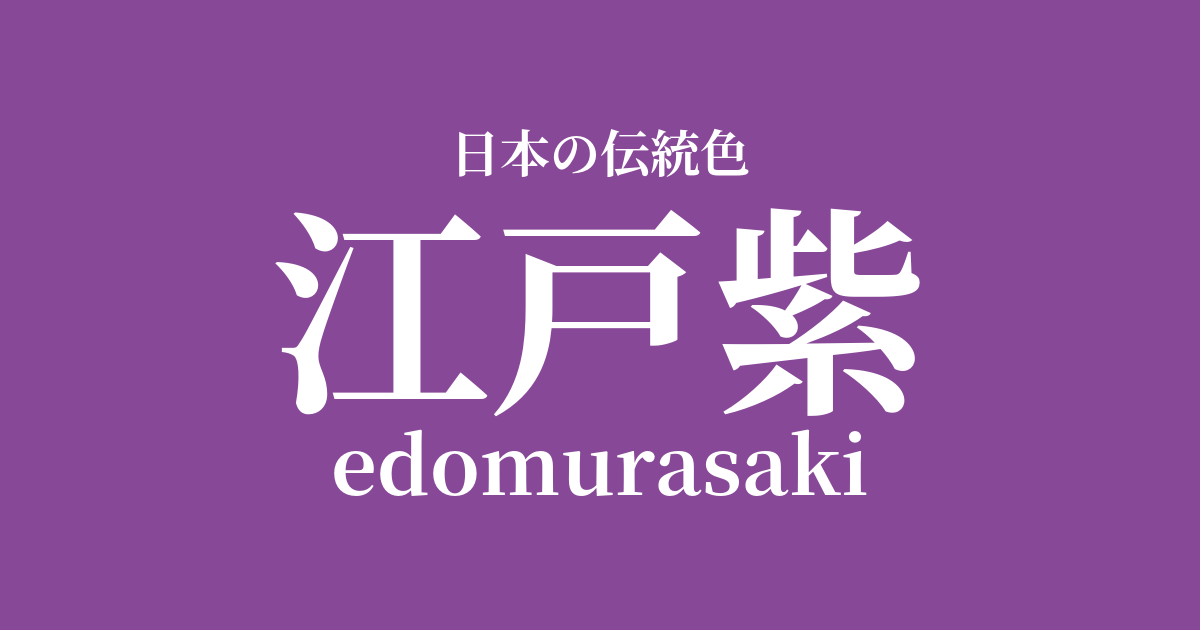
| Japanese color name | Edo purple |
|---|---|
| reading | Edomurasaki |
| HEX | #884898 |
| RGB | 136, 72, 152 |
What is Edo Murasaki? Origin and Etymology
Edo purple refers to a shade of purple that became popular in Edo (present-day Tokyo) from the mid-Edo period onward. Its name originates from the fact that it was dyed using shikon, the root of the gromwell plant (Murasaki), which grew wild in Musashino, near Edo (present-day Tokyo). At the time, purple was considered a noble color, and while "Kyoto purple," which had been used to dye clothes in the capital since ancient times, had a reddish tint, Edo purple is characterized by its bright, bluish hue.
This sophisticated color scheme resonated with the refined aesthetic sensibilities of the Edo people, and it became widely loved by ordinary people.
Historical background of Edo purple
Purple has historically been treated as a forbidden color, being the highest rank color in the Twelve Levels of Court Rank established by Prince Shōtoku, and was a color far removed from the lives of ordinary people. However, as townspeople culture flourished during the Edo period, people enjoyed fashion through subtle variations in shade, while circumventing the restrictions of sumptuary laws. Among these, Edo purple became particularly popular, and was also known as "Sukeroku purple" when it was the color of the headband worn by the Kabuki actor Ichikawa Danjūrō VII in the play "Sukeroku Yukari Edo Zakura," establishing its position as a fashionable color in Edo.
The popularity of Edo purple is deeply connected to the cultivation of gromwell, the plant used to make the dye. The Musashino Plateau was suitable for cultivating gromwell, and the easy availability of high-quality dye near Edo is considered one of the reasons for the widespread use of this color. However, after the Meiji era, the spread of inexpensive chemical dyes led to the gradual decline of traditional gromwell dyeing. Today, Edo purple is preserved as a color symbolizing Edo culture, along with its historical value.
Related literature, waka poetry, and seasonal words
Edo purple frequently appears in literary works and ukiyo-e prints depicting Edo culture and customs. It has a particularly strong connection to Kabuki theater, and is famous as the color of the headband worn by Sukeroku, the protagonist of the aforementioned play "Sukeroku Yukari Edo Zakura." This purple color made a strong impression on audiences as it symbolized Sukeroku's stylish and dashing Edo spirit. Furthermore, Edo-period humorous books and novels also depict characters wearing Edo purple kimonos and accessories, conveying the fashion of the time to this day.
Color scheme preview
This is to check the readability of the text when this color is used as the background.
Edo purple color scheme proposal
Silver mouse (#AFB1B4)
By combining it with the achromatic silver-gray that was popular during the Edo period, the sophisticated and refined impression of Edo purple is further enhanced. This color scheme is calm yet not too plain, creating an urban atmosphere.
Blue gold (#FABE29)
Turmeric yellow is a vibrant yellow and is close to the complementary color of purple, so they have the effect of making each other stand out. When combined with the bluish hue of Edo purple, it creates a striking color scheme that is both vibrant and elegant.
Aphrodisiac tea (#715C1F)
Kobuchi is a shade of brown that was popular during the Edo period, possessing a subdued and deep tone. When combined with bluish Edo purple, it creates a contrasting color while still giving an overall calm and harmonious impression. It is a color scheme well suited to a modern Japanese aesthetic.
Practical Scenes
In the world of kimono, Edo purple is considered a stylish color and is used in patterns such as komon (small-patterned kimono fabric), obi (sash), and han-eri (collar). In particular, when combined with stripes or checkered patterns, it can express the refined style favored by Edoites. Even today, it is sometimes chosen as a color that adds elegance to formal occasions, such as for visiting kimonos or solid-colored kimonos.
In interior design, incorporating Edo purple into accent walls, cushions, and small items like noren curtains brings a Japanese modern atmosphere and a sense of calm to a space. Adding just one touch of Edo purple to a natural space with white or wood tones creates a sophisticated impression. Because it's not too flashy, it's also suitable for spaces where you want to relax, such as bedrooms.
In web and graphic design, Edo purple can be used to express a sense of luxury, tradition, and trustworthiness. While using it as a main color can sometimes create an overly heavy feel, it's most effective as an accent color for headings and buttons. Combining it with white or gray backgrounds results in a highly visible and sophisticated design.