
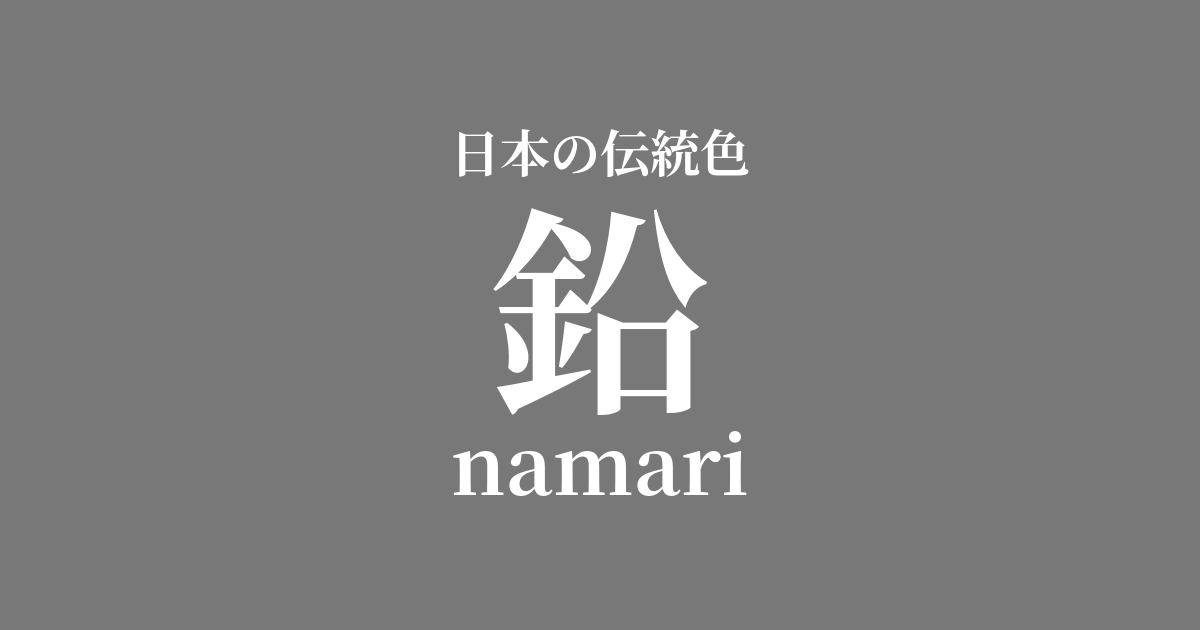
| Japanese color name | 鉛 |
|---|---|
| reading | namari |
| HEX | #787878 |
| RGB | 120, 120, 120 |
What is lead? Origin and etymology
Lead gray, as its name suggests, is a dark, bluish-gray color derived from the surface color of the metal lead. Lead has been used by humankind since ancient times, and its dull, heavy luster has become established as a color name. Compared to mouse gray, which is also in the gray family, lead gray has a stronger blue tint and is characterized by a metallic coolness. This unique color has been used to express calmness and a sense of gravitas.
Historical background of lead
The name "lead gray" appears in literature relatively recently, dating back to the mid-Edo period or later. At that time, against the backdrop of the shogunate's sumptuary laws restricting extravagant colors, a culture of finding subtle differences in muted colors such as brown and gray flourished among the common people. Lead gray was one of the popular colors known as "forty-eight shades of brown and one hundred shades of gray," and its subdued and refined hue was favored for use in kimonos and accessories as a color embodying the "chic" aesthetic of Edo.
Related literature, waka poetry, and seasonal words
Lead gray, with its heavy and dark hue, is frequently used in literature to symbolize overcast skies, rough winter seas, or melancholic moods. The expression "lead gray sky," in particular, is a widely established idiom used to describe the cold, oppressive winter weather. While not a direct seasonal word, the imagery associated with this color underlies many poems and songs, conveying a sense of winter's season and loneliness.
The train passes by below, beneath the low-hanging, leaden clouds, and I close my eyes and listen.
Color scheme preview
This is to check the readability of the text when this color is used as the background.
Lead color scheme proposal
Silver mouse (#AFAFAF)
By combining lead gray, a similar shade of gray, with a lighter silver-gray, a sophisticated monochrome gradation is created. While sharing a metallic texture as a common thread, the difference in brightness gives the color scheme an elegant and modern impression.
Persimmon color (#ED6D3D)
By combining the bluish, achromatic lead gray with the warm color of persimmon orange, a contrasting color scheme is created where each color enhances the other. The vibrancy of the persimmon orange softens the heaviness of the lead gray, creating a warm and lively impression.
Moss color (#69821B)
The inorganic impression of lead gray is combined with the organic, natural green of moss green, resulting in a color scheme that embodies both tranquility and vitality. It evokes images of moss growing on rocks, creating a quiet and profound harmony.
Practical Scenes
In the world of traditional Japanese clothing, lead gray has been a popular color for kimonos since the Edo period. It is particularly often used for men's haori jackets, kimonos, and obi sashes, creating a sophisticated and refined adult look. When combined with other shades of gray or brown, it results in a polished and elegant ensemble.
In interior design, incorporating it into wallpaper, furniture, and fabrics creates a modern and urban space. It pairs well with diverse materials such as concrete, metal, and wood, making it suitable for industrial and minimalist styles.
In web design, using black as a background or text color can convey a sense of reliability, stability, and sophistication. Combining it with white or black creates a sharp impression, while adding a vibrant color as an accent color results in a refined design with striking visual contrast.