
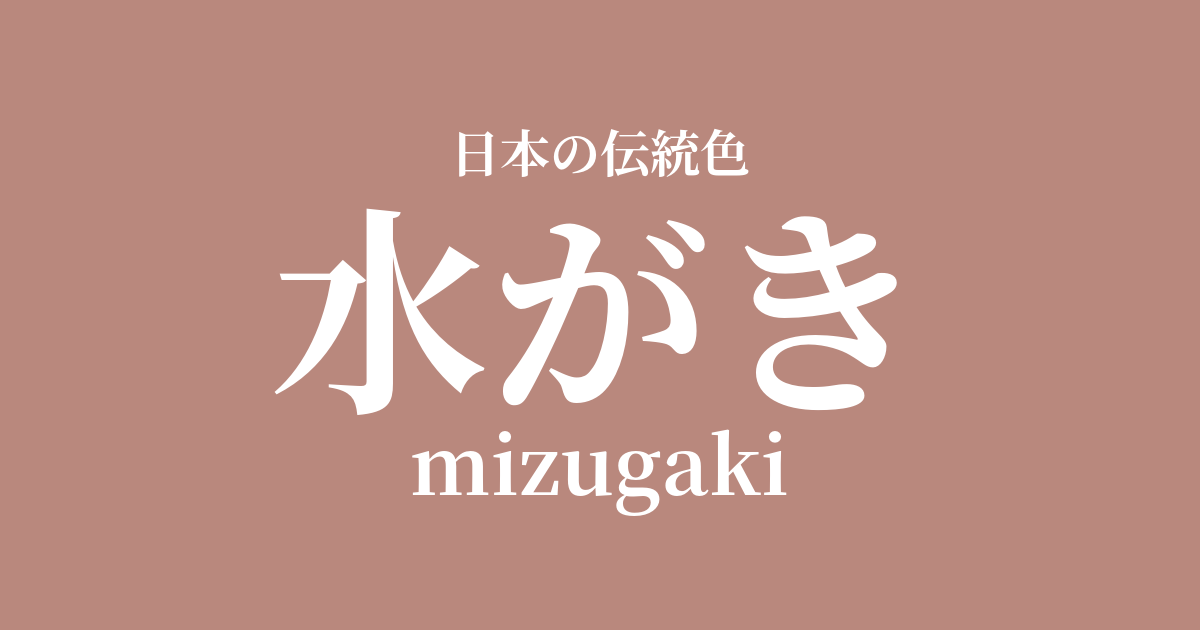
| Japanese color name | Water |
|---|---|
| reading | mizugaki |
| HEX | #B9887D |
| RGB | 185, 136, 125 |
What is Mizugaki? Origin and Etymology
"Mizugaki," written as "水柿" in kanji, is a color name related to persimmons, as its name suggests. There are two theories about its origin. One theory is that it was named after the color of a ripe, juicy persimmon that contains a lot of moisture. The other theory is that it comes from the color of persimmon tannin dyeing, a traditional Japanese dyeing technique. Persimmon tannin dyeing uses a tannin solution obtained from unripe persimmons, and "mizugaki" is thought to refer to a relatively light, reddish, gentle brown color among those dyes.
Historical background of water irrigation
The history of persimmon tannin dyeing, from which the color is said to originate, is long, with descriptions of persimmon tannin found in the Engishiki, a legal code from the Heian period. At that time, it was mainly used for waterproofing and preserving wood and Japanese paper. In the Edo period, persimmon tannin dyeing became widespread for the clothing of common people, and a variety of brown shades were created. The color name "Mizugaki" is also thought to have become established as one of the variations of persimmon tannin dyeing during this period.
It is said that its practicality and simple colors made it widely loved, from the formal attire of samurai to the work clothes of commoners.
Related literature, waka poetry, and seasonal words
It is difficult to pinpoint any famous literary works in which the color name "Mizugaki" directly appears. However, the persimmon, from which the color is derived, has long been a beloved fruit symbolizing autumn in Japanese poetry. Many poets have written about persimmons since the time of the Manyoshu anthology, and the fruit has been a motif that evokes the richness of the season and nostalgia.
As exemplified by Shiki Masaoka's haiku, landscapes with persimmons are associated with the quintessential Japanese landscape, and it can be said that the color of "Mizugaki" (a type of persimmon) reflects this literary sentiment and the gentle atmosphere of autumn.
As I eat a persimmon, the bell rings at Horyuji Temple.
Color scheme preview
This is to check the readability of the text when this color is used as the background.
Water-based color scheme proposals
Chestnut skin tea (#6D3C32)
Combining it with a deeper chestnut tea from the same tea family creates a unified and calming impression. A natural harmony, like a gradient, is created, making it suitable for expressing the warmth and simplicity of autumn.
鶸Menghuang (#8D9949)
The reddish-brown of Mizugaki and the youthful yellowish-green of Hiwamegi complement each other beautifully. This color scheme, reminiscent of trees and young leaves in nature, exudes vitality and creates an impression that balances energy and tranquility.
Navy blue (#192F60)
The combination of warm, muted tones and deep, sophisticated navy blue creates a refined, modern impression. The contrast between earth tones and dark blue highlights each other, creating a sense of luxury and stability.
Practical Scenes
In the world of kimono, mizugaki is often incorporated into accessories such as obi sashes, obi ties, and haori jackets. It pairs well with simple fabrics like tsumugi silk and cotton, adding warmth and depth to autumn outfits. The colors, neither too flashy nor too plain, are easily accepted by a wide range of age groups.
In interior design, it harmonizes beautifully with wooden furniture. Incorporating it into fabrics such as cushion covers, rugs, and curtains brings a warm and calming atmosphere to the entire room. It is particularly effective in creating Japanese modern or natural-style spaces.
In web and graphic design, using these colors as background or accent colors can instill a sense of security and trust in users. They are particularly useful in conveying a simple and sincere image on websites related to traditional crafts, natural foods, and lifestyle products.